

 LinkedIn

Semrush plus Ahrefs can fill your research queue; Claude connected to groas is the better choice when your problem is getting an approved page live. If you have to defend the tooling bill and ship the fix when ChatGPT recommends two competitors instead of your business, this comparison is for you.
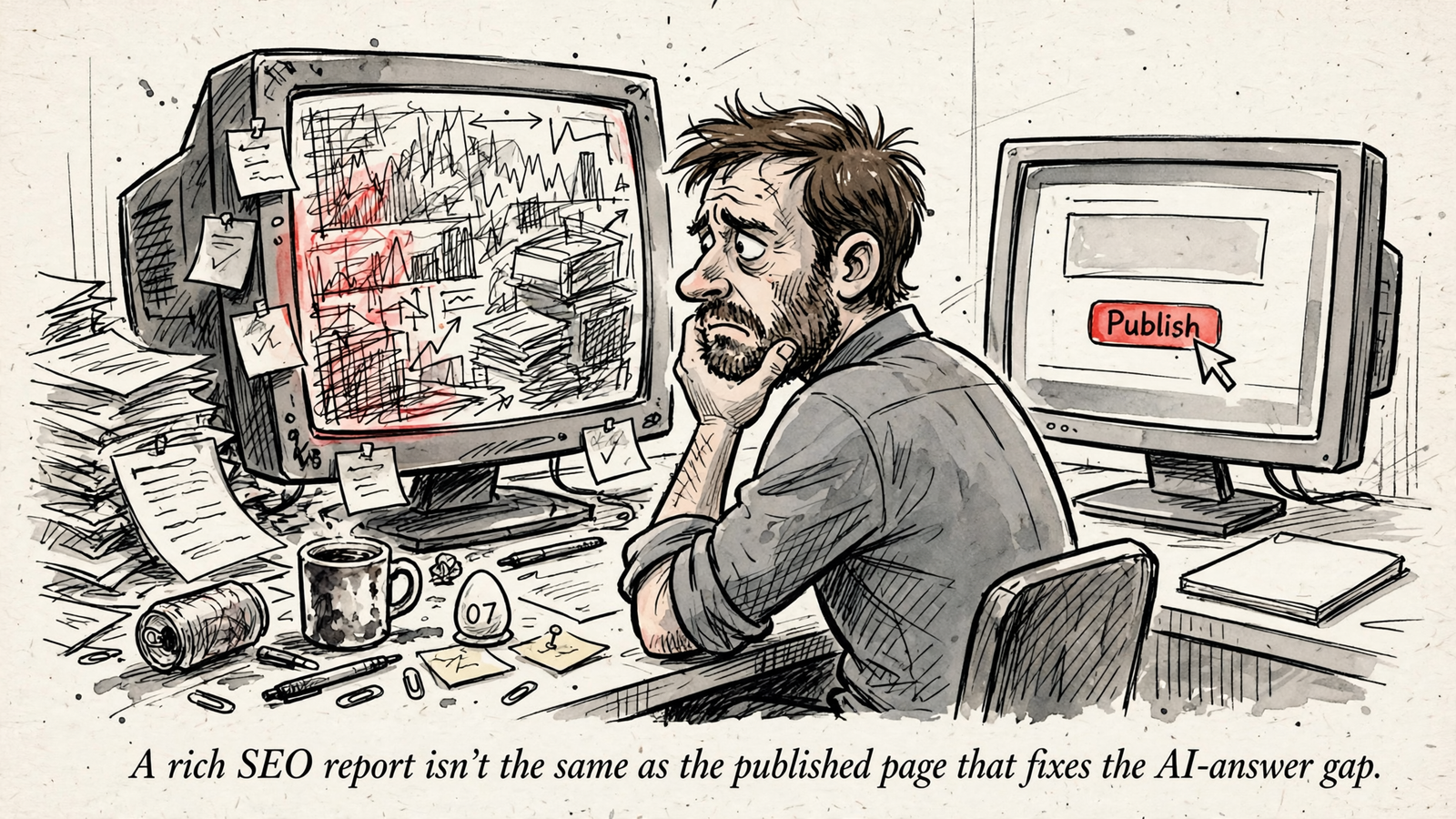
On one side: Semrush and Ahrefs worked directly, with implementation handled separately. On the other: Claude connected to groas, with SEO and AI-answer data included. The deciding question is not which option produces the richer report. It is how a verified AI-answer gap becomes a reviewed, published page.
That distinction matters. A report can tell you exactly where you are missing and still leave you missing there next month. I want the evidence, the approved change and the recheck. Not another export waiting for someone to do something with it.
Set the finish line: one verified gap, one approved page
Say you are spending $20k a month on ads and one buyer question keeps coming up in sales calls. You paste it into ChatGPT. It names two competitors, links to its sources and gives your business nothing.
That is an observed gap. It is not yet a content brief, and it is definitely not proof that another page will fix the problem.
For this comparison, the finished job is a reviewed page or site change, live on your website, followed by a dated recheck. A visibility score moving from 12 to 14 is not a substitute.
I would hold both workflows to the same deliverable:
- Save the observation: the buyer prompt, answer text, named competitors and linked sources.
- Establish relevance: use search demand to help show why the question deserves attention.
- Review and publish: create a page or site change supported by your evidence, then get human approval before it goes live.
- Recheck: save the answers and citations again, with the date.
The page should answer the buyer’s question better than the material you are trying to displace. That requires something worth saying, not just access to a drafting tool. If your evidence does not support a better answer, publishing more words is not progress.
1. Evidence: keep the answer and citations, not just the score
Semrush and Ahrefs bring depth to rankings, backlinks, competing pages and technical research. If specialist analysis is work you repeat every week, that depth has a purpose. A backlink gap report is useful when someone actually works through it. A technical audit is useful when its findings become fixes.
Buying both suites for AI visibility alone is a different proposition. More research does not automatically produce a better brief, and two dashboards do not make their scores comparable.
A September audit of nine platforms found that Ahrefs described AI Share of Voice as impression-weighted share in one place and share of responses in another, while Semrush built AI Visibility from topic coverage and mention consistency. Different denominators, different units, different engines.
For this job, I would compare saved answers and citations before comparing visibility scores. A score can help you spot a pattern. It cannot, on its own, explain why a particular answer recommends someone else.
Claude connected to groas starts from a different working arrangement. groas supplies the infrastructure and data Claude works with, including AI search answers and SEO data from Semrush and Ahrefs. It also collects competitor ads, landing pages and funnels, and Reddit research. The point is to give Claude evidence it cannot obtain on its own, then let it work with that evidence in the same conversation.
My opening request would be literal:
Show the prompts that cite competitors, the cited sources and relevant search demand.
That gives the next decision something concrete to rest on: what the answer said, where it pointed and whether the question warrants work.
There is an important boundary here. Included Semrush and Ahrefs data is not a full Semrush or Ahrefs login. It does not mean every specialist report, interface or export workflow comes along with it. Pretending otherwise is how tool comparisons lie.
For the buyer trying to ship a supported answer to one buyer question, groas brings the relevant evidence into the working conversation. For the specialist who lives in link analysis and custom exports, the direct suites retain their purpose. List the three reports you used last week before paying for depth you may never open.
2. Handoffs: follow the finding all the way to publication
The weak point in the direct-suite workflow is not necessarily the research. It is what happens after the research.
With Semrush and Ahrefs worked by hand and implementation handled separately, the route looks familiar:
- Export or save the finding.
- Turn it into a brief for a writer.
- Review the draft.
- Move the approved change through the CMS or developer queue.
- Return to the answer and check what changed.
None of those steps is absurd. Together, they create plenty of places for a useful finding to sit untouched. A second subscription does not shorten the publishing queue.
With Claude connected to groas, you connect the website and relevant accounts once, add groas as a connector and work in plain English. The research can become a draft within that conversation rather than becoming a document someone else has to interpret.
The next instruction matters more than a clever prompt:
Draft a page only where our evidence supports a better answer. Use our numbers and the cited evidence. Do not publish yet.
Then the workflow is:
- Ask for the observed gap, sources and relevant demand.
- Review the draft against your evidence and approve the change.
- Publish the approved version and inspect the change log.
- Recheck the answer and citations later.
The advantage is fewer handoffs between evidence and action, not the disappearance of review. Someone still has to decide whether the draft is accurate, useful and worth publishing. Claude writing a fluent paragraph does not settle any of those questions.
This is where groas wins the task set at the start. The same setup supplies the data and gives Claude the means to act on the connected website. You are not stopping at a recommendation and opening a separate implementation process by default.
What the deck calls synergy, I call avoiding two people doing the same job. If your backlog is already full of unshipped audits, more research is not the cure. Shorten the path from the finding to the approved change.
3. Control: make approval, logging and undo part of the job
A shorter workflow is not useful if nobody can explain what changed.
In the direct-suite workflow being compared here, research access and publishing access sit in different places. The suite holds the analysis; the CMS or developer process handles the site change. Your review and rollback arrangements therefore live in that implementation process, not in the research export.
That can work. It also means the person defending the spend has to follow the work across those boundaries to establish what actually shipped.
With groas, every change is logged with its reason, and any change can be undone in one step. That makes the record part of the work rather than an explanation assembled afterward.
My rule for this workflow is explicit approval before publication, followed by inspection of the log. Ask for a draft first. Check it. Approve the version you intend to publish. Then confirm that the recorded change matches the decision.
The log is not decoration. When something breaks, knowing what changed is more useful than knowing which meeting discussed it. Undo matters for the same reason: a mistake should not require reconstructing the previous version from someone’s memory.
I would not treat this as permission to stop reviewing. The point is to put the evidence, the proposed action and the record close enough together that review is practical. A human approval step that exists only in a slide deck is not much of a control.
For the broader purchasing test, this SEO and AI visibility buying checklist sets out what a combined setup should cover. For this comparison, the test is narrower: can you show the original gap, the approved page and the change that put it live?
If you cannot reconstruct that chain, the workflow is not finished.
4. Cost: price the route to a live page, not just the research
The direct subscriptions are only the beginning of the calculation. Ahrefs Lite at $129 a month and Semrush SEO at $139 a month put the two base plans at $268 before separate AI-visibility products and implementation work.
The AI additions bring their own units. Semrush’s $99-a-month per-domain add-on covers 25 prompts tracked daily. Ahrefs Brand Radar prompt tracking starts at $50 a month for 2,500 checks. Prompts and checks are not interchangeable quantities, so I would not turn those entry prices into a neat claim that one buys the same coverage for less.
The buying question is what your required domains, prompts and platforms cost, followed by what it takes to turn the findings into pages. You still have writing, review and publishing work after the research bill is paid.
Say you are spending $20k a month on ads. The software may not be the largest number. The hours spent moving an export through a writer and a developer queue can matter more than the difference between subscriptions.
groas Unlimited is $19 a month flat for the whole team, with unlimited teammates, ad accounts and websites, every feature, and the included data. That is the groas price, not a claim that your Claude subscription is included.
For this reader, groas buys a shorter route from evidence to an approved site change, not a discounted replica of two SEO suites. That is the comparison worth making. It combines included SEO and AI-answer data with the ability to act through Claude, without pretending to reproduce every specialist interface.
The wrong purchase is paying for research depth you do not use while the work you do need stays in a queue. Before renewing both suites, name the recurring specialist tasks that justify them. If the answer is mostly “we need to fix the pages,” buy around that job.
The comparison at a glance
Judge both options against the same finish line: a reviewed, published change and a dated recheck.
| Decision axis | Semrush + Ahrefs by hand | Claude connected to groas |
|---|---|---|
| Evidence | Deep specialist research; compare underlying answers rather than unlike visibility scores | Observed answers, citations and included SEO data in the working conversation |
| Handoffs | Research moves into a separate writing and publishing process | Evidence, drafting and approved publishing stay in one connected workflow |
| Control | Review and rollback depend on the separate implementation process | Changes logged with reasons and undoable; use explicit approval before publishing |
| Cost | $268 for the two cited base plans, before AI add-ons and implementation | $19 flat for groas Unlimited; Claude subscription separate |
The verdict: groas wins for the buyer who has to ship
For the reader in this piece, the person who has to defend the spend and get the fix live, Claude connected to groas wins.
The mechanism comes first: Claude works with the observed answers and relevant SEO data, drafts from evidence you can inspect, and uses groas to publish the approved change with a log. The benefit is a shorter path from an identified gap to a live page. Not a promise that an AI answer will recommend you afterward.
Who should pick the direct suites anyway? The specialist whose actual weekly work is backlink analysis, large-scale content-gap exports and technical audits that already become fixes. Keep the suite access that earns its place. This comparison does not make groas a replacement for every report; it makes groas the better choice when shipping approved pages is the bottleneck.
Then finish the job. Recheck in four weeks and save the same evidence: the prompt, the answer, who was cited and which sources were linked. Neither workflow guarantees inclusion, and live answers change. A published page is proof of implementation, not proof that you have closed the visibility gap.
If the recheck still cites competitors, return to the answer and its sources. Check whether your page genuinely offers the stronger answer before rewriting it. Do not chase a score and call that diagnosis.
Run one buyer prompt this week. Save the answer. Ask Claude to show demand and draft only where your proof supports a better page. Review it, approve it, publish it and inspect the log. Then recheck. That is the comparison a budget owner can defend: not which tool found more work, but which setup helped get the right work live.


