

 LinkedIn

A small Bing account can be worth watching every day without being worth changing every day. If it spends a few hundred dollars a week and gets a handful of conversions, should it run on AI autopilot or get a weekly ChatGPT review? Smart operators disagree because they’re trying to prevent different mistakes. One doesn’t want a fixable problem sitting there until Friday. The other doesn’t want a machine rewriting bids because Tuesday was slow. I’ve been the person making those changes at 1 a.m. I start with the evidence now, not the clock.
The case for weekly review: five conversions don’t make a bidding instruction
I’ll start with the strongest argument for leaving execution in human hands: a CPA can look precise long before it’s useful. Conversion-based bidding needs conversion tracking through UET or offline import. In its bid-strategy guidance, Microsoft recommends at least 30 conversions in the previous 30 days before setup and at least 30 before evaluating results. If the campaign has seven conversions this month, yesterday’s CPA is a number I can report. It isn’t a bid instruction. I used to pause keywords that needed more time and give more room to the ones that got lucky on Tuesday. Both decisions felt like account management when I made them.
Then there’s conversion delay: the time between the click and the conversion. Microsoft reports conversions by click date, so a recent period can look more expensive while sales from those clicks are still coming in. A week ending on Sunday is a complete date range. That doesn’t mean the conversions for that week have finished reporting. If I compare it with an older week whose conversions have had time to come in, I’m asking one week to make its case before all the evidence is in. The weekly review gives me a chance to catch that before anyone changes the account.
By weekly ChatGPT review, I mean ChatGPT reads the account, tells me what it sees, and leaves every decision to me. Bing Ads is the old name for Microsoft Advertising, which includes Bing search and its partner and audience networks. MCP is the connection standard that lets ChatGPT use tools and data outside the chat. Microsoft’s official MCP tools can pull campaigns, keywords, ads, and performance for a date range, but they never modify account data. That’s a useful constraint when I’m still figuring out what a reasonable change looks like.
I’d give the first review this prompt:
Review the last complete period and the preceding comparable period. Account for conversion delay. Identify issues, but change nothing.
I want the review to tell me three things:
- What changed.
- Which apparent problems might disappear once conversions come in.
- What I’d do if they don’t.
I want that last part written down before I approve anything. Otherwise it’s easy to look back at a bid change, a budget move, and a paused keyword and tell myself I had three good reasons. Sometimes I had one bad Tuesday. If the recommendation is to wait, I want the review to say what I’m waiting for. That gives me something to check next week instead of another recommendation to start from scratch.
The tradeoff is time. I have to read the recommendations and approve edits I could have queued. On a thin account, I’ll pay that cost rather than make three changes on the strength of the same unfinished data. Before the first autopilot conversation, I’d send a client the case for leaving some zero-conversion Bing keywords alone. The first job of the review is to tell me what can wait.
The case for autopilot: some problems shouldn’t wait until Friday
The best argument for always-on execution has nothing to do with a machine being better at bids. Some problems are visible without a conversion verdict. An ad is serving on a partner network I meant to exclude. A campaign hits its daily cap by 9 a.m. while another sits idle. A search term has spent more than one target CPA without a conversion, and the query itself gives me a reason to look. A weekly review can find all three. It can’t tell me about them until I run it.
Microsoft’s own automated rules show what this side of the debate looks like in practice. A rule can pause an ad on a previous-day trigger, raise a budget by a specified percentage up to a maximum, or send a notification without touching anything. The action follows a condition I wrote in advance. It doesn’t depend on deciding whether a campaign’s latest CPA is its new normal. Take that 9 a.m. cap: I know the campaign has hit it. I don’t yet know whether it deserves money from the campaign sitting idle. An alert gets me the first piece of information without pretending it answers the second question.
The distinction matters for search terms. In one practitioner discussion, the suggested workflow flagged terms after roughly one target CPA in spend with zero conversions, then required a person to approve a negative keyword. The number gets the query onto my desk. It doesn’t decide what happens to it. That’s still useful automation: I don’t have to be the one checking whether the threshold has been crossed.

This is where groas autopilot differs from a read-only connector. I connect the account once. Autopilot starts off. When I switch it on, only the actions I’ve enabled can run within the rules I set. Each change comes with a logged reason and can be undone in one step. I don’t have to sit in the chat to catch an issue, but I also don’t have to give the system discretion over bids just to get help watching spend.
The strongest version of this case starts with two lists: what can run and what needs approval. I’d ask ChatGPT to propose reversible, capped actions based on spend or intent, not on CPA from five conversions. Bid strategy, targets, match types, and budget shifts above the cap go on the approval list. The point of always-on execution is to act sooner when the decision is already made, not to make more decisions because the dashboard is open.
Cross-examination: what does the evidence actually let me do?
What if spend is up and conversions are still coming in?
Rising CPA is a question, not a verdict. Microsoft’s bid-strategy report has a status for Limited: low data volume: there aren’t enough conversions or enough revenue to optimize bidding. The report also uses conversion delay to help determine when to check performance again. If I react before then, I can cut a campaign whose recent clicks haven’t had time to convert.
Review-only has the advantage here. I can write “wait for attribution” in the notes and leave the account alone. Autopilot has to follow that same instruction without me there to supply it. If the evaluation date hasn’t arrived, the rule should leave bids and performance-driven budget shifts alone. That doesn’t mean ignoring a spend alert. It means dealing with the alert on its own terms rather than treating it as proof that performance has slipped. Keep watching. Flag what needs a look. If the evidence is insufficient, say so. I want that answer at least as much as I want an action log telling me what changed.
Can a Google winner tell me what to do on Bing?
Google’s conversion history isn’t Bing’s evidence. There’s a mechanical problem before I even get to CPA: Microsoft warns that scheduled Google imports can reactivate campaigns and restore settings, including budgets, from Google Ads. I can correct a setting in Microsoft on Monday and have the next import put it back. That makes the import schedule part of what I check before trusting a fix to stick.
Then there’s performance. In one r/PPC discussion, an operator reported roughly $80 CPA on Google and roughly $200 on Bing after following Microsoft’s optimization suggestions. That’s not a forecast for another account. It’s a good reason not to treat the Google number as an instruction for Bing. I’d reject any rule that uses Google’s results to change Bing bids without checking the Bing campaign’s own conversions.
The verdict: keep the watch on and the bids behind approval
For the small Bing account spending a few hundred dollars a week and seeing only a handful of conversions, I pick weekly review for optimization. I’d add bounded autopilot for jobs that don’t require a performance verdict. What decides it is the campaign’s own conversion evidence. There may be enough evidence to flag spend or enforce an explicit boundary well before there’s enough to move a target. I don’t need to make the account wait a week for the first kind of attention, and I don’t need to let the second kind of decision run every day just because it can.
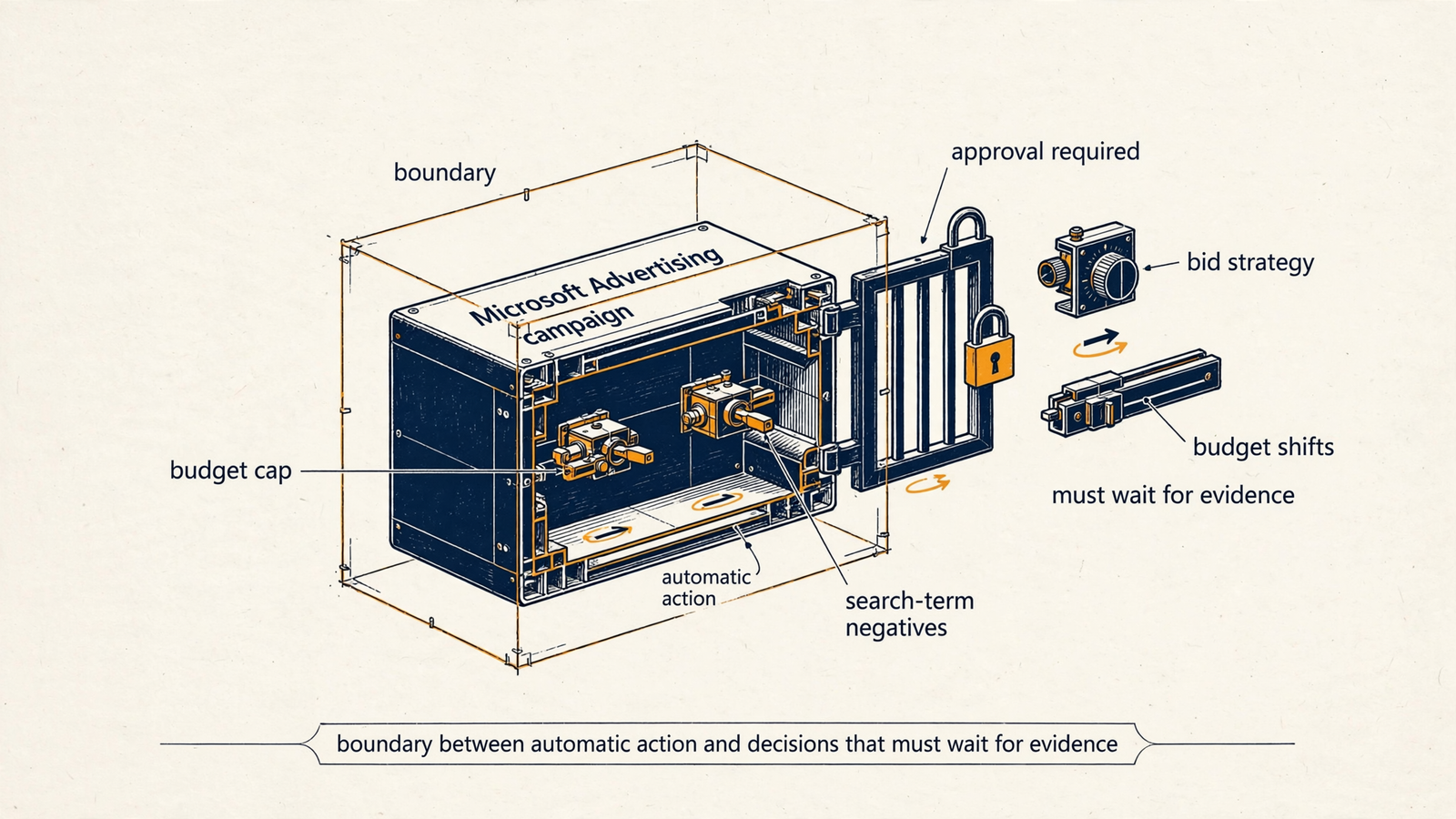
I’d set it up in this order:
- Run review-only for a few weeks. Look at comparable periods, anomaly flags, and change history. Those are the kinds of checks Microsoft’s read-only connector supports. If I’m setting up groas, I’d connect it to ChatGPT and keep autopilot off. The live connection can still take an action I approve. A pasted spreadsheet can only show me the snapshot I gave it.
- Write rules that don’t ask thin data to do too much. Name the goal, trigger, cap, and review date. For example: “Flag a search term that spends more than one target CPA with zero conversions after the conversion-delay window. Require approval before adding a negative. Never change a bid. Escalate if daily spend exceeds the cap.” The rule tells me when I should hear about the problem and makes clear that hearing about it isn’t the same as approving a fix. If a stranger can’t follow the rule as written, I’m not switching it on.
- Keep bid-strategy and expansion decisions behind approval. My bar is 30 conversions in 30 days for the campaign in question, not the account in aggregate, with time for those conversions to report. That’s a bar for considering a change, not an instruction to make one. Microsoft’s learning timeline also calls for leaving the learning period alone before judging results. Once I enable a rule, I read the reason for each change and undo anything that doesn’t match what I wrote.
This is where groas beats a pasted CSV and a screenshot summary. I can start by reading live numbers, approve a change when I’m ready, and later let a rule run without losing the record of what happened or why. groas Unlimited is $19 a month flat for the whole team, with every account and feature and no percentage-of-spend cut. Done For You, run by the senior team, starts at $5,000 a month if I’d rather hand off the work than write the rules myself.
If I can’t specify an acceptable action in a sentence, I stay in review-only. If I can, I let autopilot do that job and no more. The full comparison of the two workflows is worth reading before flipping the switch. But my first test isn’t how fast the system can change a bid. It’s whether it can look at five conversions, say “insufficient evidence,” and leave the bid alone.





