

 LinkedIn

The first morning of a sale is a lousy time to find out ChatGPT can raise my Google Ads budget. I connect the data early, but write access waits for evidence and explicit rules, even if the sale starts tomorrow.
Should I connect ChatGPT now, or wait until the promotion is ready?
Connect now. I used to do the same thing with new hires: give them read access weeks before Black Friday and let them learn where the bodies were buried before they touched anything. I take the same approach with ChatGPT and groas. It can see my Google Ads account and the stuff it never had on its own: every competitor ad running on Google and Meta, the funnels behind them, what customers say on Reddit, and SEO data from Semrush and Ahrefs. I want it tripping over broken tracking and nine half-named conversion actions in October, not at 9 a.m. on the first day of the sale.
The point of connecting early is to find out what ChatGPT can’t trust yet. In one conversion tracking audit, 300 clicks registered 129 conversions, but the business got a single call. Of those reported conversions, 120 were click-to-call events fired by a hover. Feed that to Smart Bidding and it learns to find more hoverers, not more buyers. I want to have that argument in a quiet week, when I can fix tracking first, add a quality signal second, and touch bidding last.

Does connecting the account mean ChatGPT starts changing it?
No. Connecting isn’t delegating. The Bavian analysis makes the distinction neatly: once I connect, I still have to set limits, monitor changes, and handle cleanup. I treat access as three separate decisions:
- Read access: ChatGPT can inspect the account without changing it.
- Requested changes: It makes the specific edit I ask for once I approve it.
- Autopilot: I switch it on separately and set rules for what it can do without asking each time.
An account can be ready for the first and nowhere near ready for the third. Even approving a single edit tells me only that I was willing to make that edit. It doesn’t tell me what I’d let ChatGPT change on its own tomorrow. If a tool can’t show me which permission I just granted, I keep it read-only. The first day of a promotion is not when I want to learn what a toggle meant.
“What should I ask it to inspect before I allow changes?”
I start with one read-only prompt:
Read this Google Ads account without changing anything. List conversion goals, recent performance, data gaps, and the evidence needed before recommending changes.
That order matters. I want ChatGPT to tell me what it’s measuring before it tells me what to fix. A CPA that lumps nine different actions together doesn’t tell me what it costs to get a customer. I ask it to name every primary conversion action, identify the one that comes closest to money in the bank, and flag the ones that should never drive a bid.
Then I make it show its work. Large accounts can return sampled data, so I check the totals in the Google Ads interface before touching bids. If ChatGPT says ROAS fell 18% last week, I ask which campaigns it counted, which dates it compared, and whether tracking fired correctly. I don’t need a better explanation for the 18% until I know it’s the right number. And even if the totals match, I still need to know the conversion goal means something to the business. If it doesn’t, I have a measurement problem, not an optimization problem. Write access waits.
Can it prepare next season’s campaigns without launching them?
Yes. This is my favorite use of ChatGPT in November. I ask for campaign structure, ad copy variants, keyword lists, and budget math in the chat. I used to tell clients to build Black Friday campaigns in a spreadsheet first. I was wrong about the tool, right about the sequence: text first, account second.
Drafting in chat and building in the account are two different jobs. The official Google Ads MCP server can help me inspect an account, but it doesn’t have tools to change bids, budgets, or keywords, or to pause or enable campaigns. For execution, I use ChatGPT with groas so I can keep read access, requested edits, and autopilot separate.
When I’m happy with the draft, I approve the build in plain English and have it create the new campaign paused. Then I compare what landed in the account with what I approved: the ads, the keywords, the budget, and whether the campaign is actually paused. I’m not reviewing the draft twice. I’m checking that the draft and the build match. Approval to build is not approval to launch.
Which decisions should still need my yes?
I keep four decisions on the approval list, no matter how good the setup looks:
- Launching a new campaign.
- Making a material budget increase.
- Switching bidding strategies.
- Applying broad exclusions, such as account-level negatives or audience removals.
I write down what material means. Say I’m spending $20,000 a month and I’ve set an $800 daily spending limit. I can allow a $100 shift between two proven search campaigns without letting ChatGPT raise the limit to $1,200 a day. One edit moves money I’ve already approved; the other commits more of it. Neither gives ChatGPT permission to switch from Target CPA to Target ROAS. Room to move budget inside the limit is not permission to change the limit or the goal.
A typed promise in chat is not a control. Always ask first is a prompt, not an approval setting. As the breakdown of ad-account controls points out, the strictest mode requires sign-off on any live campaign edit. If that’s the rule I want, I use the setting. I also keep peak budget headroom separate from permission to spend it. A ceiling is a limit, not a target.
Can I just switch on autopilot during the sale?
Not if the sale is the first time I’m trying it. Autopilot isn’t a spare pair of hands I hire on Black Friday. Before I switch it on, I write down four things:
- Which campaigns it can touch.
- Which conversion action it should optimize for.
- How much it can spend.
- Which edits it can make without me.
Leave one out and I’m asking the software to guess my risk tolerance when guessing costs the most. A spending limit doesn’t tell it which campaigns are in scope. A campaign list doesn’t tell it whether it can change bidding strategy. I want each rule to answer its own question.
I’d rather check the feed, audiences, and conversion tracking before the rush, then leave the campaign structure alone during peak. If an existing campaign needs an edit, I edit it rather than start from scratch. I don’t change every ad at once.
If I want autopilot ready for peak, I set it up in a quiet week. I pick one set of campaigns, set a daily spending limit, keep launches and strategy switches behind approval, and watch three full conversion cycles. The PPC on Autopilot runbook covers that first setup, from connecting the account to reviewing what the system does on its own. I use that time to look at the changes as well as the results. A good CPA doesn’t tell me whether an edit stayed inside the rules. If I can’t write down what autopilot may change while I sleep, I leave it off during the sale and stick to requested edits.
What happens when a change is wrong?
After every edit, I ask for what changed, why, and what it touched: campaigns, ad groups, or keywords. With groas, every change lands in a log with its reason and can be undone in one step. I still want the before and after values. If I can’t point to both, I’m not supervising the edit. I’m watching it happen.
Undo has a limit worth hearing before peak: it doesn’t refund spend. If a campaign runs for two days at double the budget, reverting the edit fixes the setting. The two days stay spent. That’s why I keep high-consequence edits on requested changes with autopilot off. I get the speed of ChatGPT doing the clicking without finding out what it would have approved on my behalf.
What would make you postpone write access?
Any one of these is enough for me:
- Unclear conversion goals. I can’t name the primary action that represents a business result, so I can’t tell ChatGPT what to optimize for.
- Unexplained data gaps. Its totals don’t match the interface, or sampling leaves me without a number I can confidently act on.
- Missing evidence. I haven’t checked the feed, done the margin math, or seen what last year’s promotion actually did.
- No agreed rules. There’s no budget ceiling, no approval list, or no clear scope.
Peak week won’t resolve any of those. It’ll charge me for them.
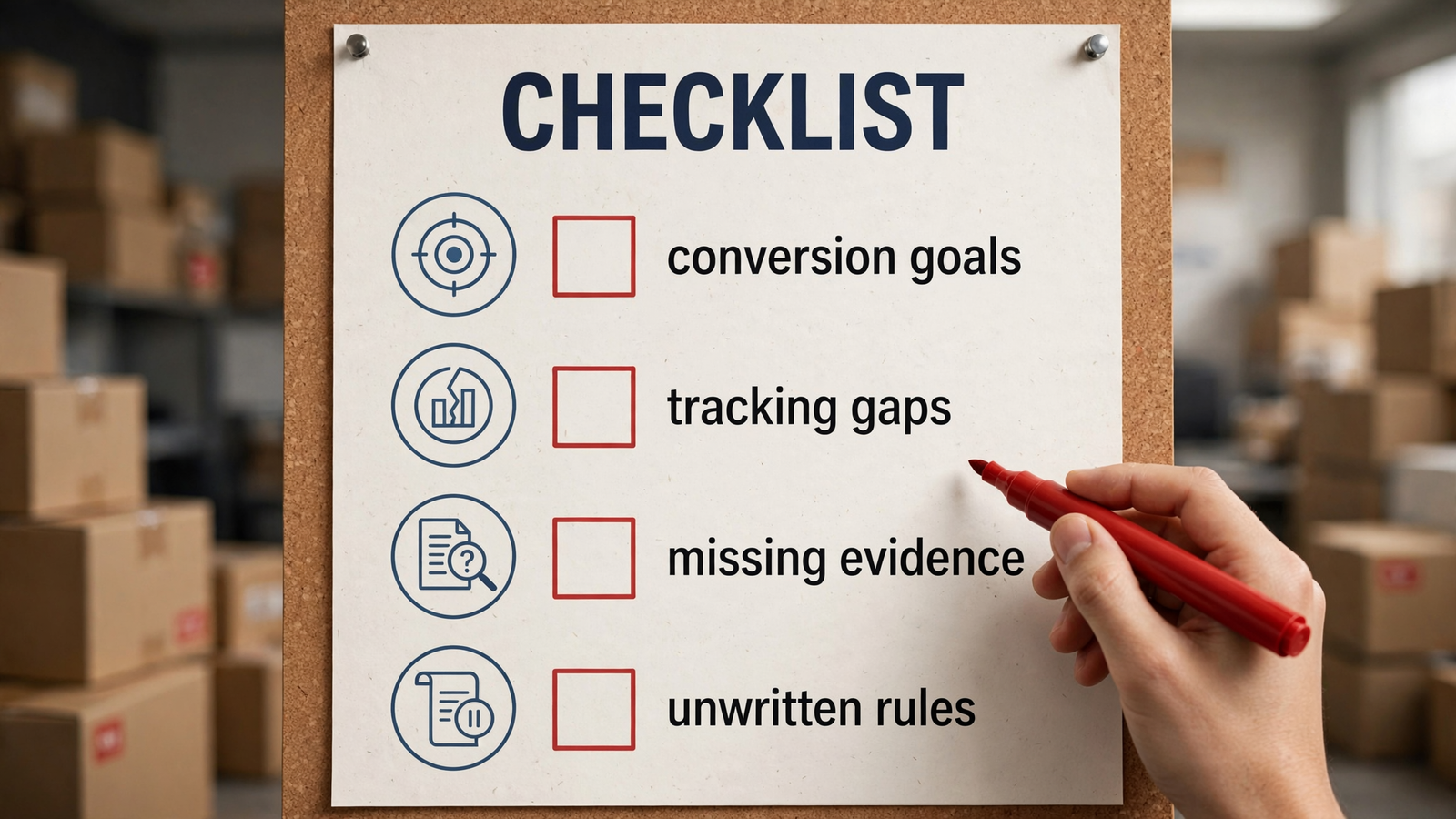
I keep the account read-only and make the delay useful. I ask ChatGPT to list the primary conversion actions and flag which should be secondary, reconcile the last 28 days against the interface, and draft the rules I’d need before letting it touch spend. If the totals reconcile but nobody has signed off on the budget ceiling, I’ve cleared one blocker, not both. The sale date tells me when the traffic arrives. It doesn’t tell me the tracking is clean, the goal is clear, or anyone has agreed to a limit. Until those are sorted: eyes open, hands off.
What do you wish people asked before peak?
What’s the smallest write scope that still helps? Most people ask whether to hand over the account or keep the AI out of it. I want the useful bit in between: one paused build, one capped budget move, one negative keyword cleanup, each approved separately. I can see what ChatGPT wanted to do, what I approved, and what actually changed. I don’t need to grant it the whole account to learn whether that loop works.
Say I’m spending $20,000 a month. ChatGPT drafts ten negatives from the last 60 days of search terms. I approve eight, it applies those eight, and I check the log. I’m looking for the eight I approved, not the ten it recommended. Next week it proposes moving $150 a day from a prospecting campaign with no conversions in 14 days into the branded search campaign that did convert. That’s a proposal, not a budget change. I approve the amount and the date it reverts before anything moves. Small, reversible, written down.
If that loop runs clean for two weeks, I can widen it. That doesn’t mean an approved keyword cleanup earns unsupervised control of the budget. It means I’ve seen enough to decide which permission I’m willing to test next. If the loop doesn’t hold up, I can stop at the draft or keep the next edit behind approval. For the distinction between work that can run alone and the four failure modes that still need a person, I’d start with what genuinely runs unattended before granting anything broader.
When the small edits hold up, widening access is a decision, not a deadline. Until then, I’ll take the analyst that never sleeps and the drafter that never clicks without asking. Traffic runs on the calendar. Write access runs on evidence and rules.


