LinkedIn

I’d let Claude stop a Meta ad at an agreed loss limit, even if it’s too early to tell whether the ad is bad. One advertiser in r/FacebookAds said they were losing $300 a day on Meta ads while commenters told them to raise budgets and wait. Should Claude pause the ad or give it more time? Smart operators disagree because one side sees money going out the door, and the other has seen viable ads get killed before all the sales came in. My line is stop the spend when the rule says stop. A short dip in return on ad spend (ROAS) doesn’t tell me the creative failed.
The case for pausing: a loss limit has to stop something
A boundary that only works when someone remembers to open Ads Manager at 9 a.m. isn’t much of a boundary. At $300 a day in losses, waiting a week costs $2,100. The pause side isn’t asking Claude to predict next week. It’s asking Claude to carry out a decision the business already made, without waiting for someone to notice a red number in a tab they haven’t opened.
The strongest version of that argument is a written if-then rule, not “pause whatever looks bad.” One example: pause an ad set when it spends more than twice the target cost per acquisition (CPA) in a three-day lookback and Meta attributes zero conversions to it for that period. Write down both conditions. The rule doesn’t fire just because the first numbers look ugly, or because one of the two conditions happens to be true. That’s the useful shape of a Meta stop rule: a condition Claude can check and an action I’ve already authorized.
Before Claude touches the switch, I want four answers from live data:
- How much did the ad or ad set spend?
- What results did Meta attribute to it?
- What reporting window do those numbers cover?
- Which exact rule did it breach?
If Claude can’t answer all four, it has no business touching the switch. If it can, the pause enforces the spending decision. It doesn’t predict what the ad would do tomorrow. That’s why I’d pause rather than delete. Pausing stops the ad from spending, keeps its history available for review, and leaves me the option to reactivate it.
That’s a decision I can defend to a founder or finance lead. We wrote down how much we were willing to risk before the numbers made everyone emotional. We didn’t promise a better CPA after the pause. We decided not to buy more evidence at that price.
The case for waiting: the sales report isn’t finished
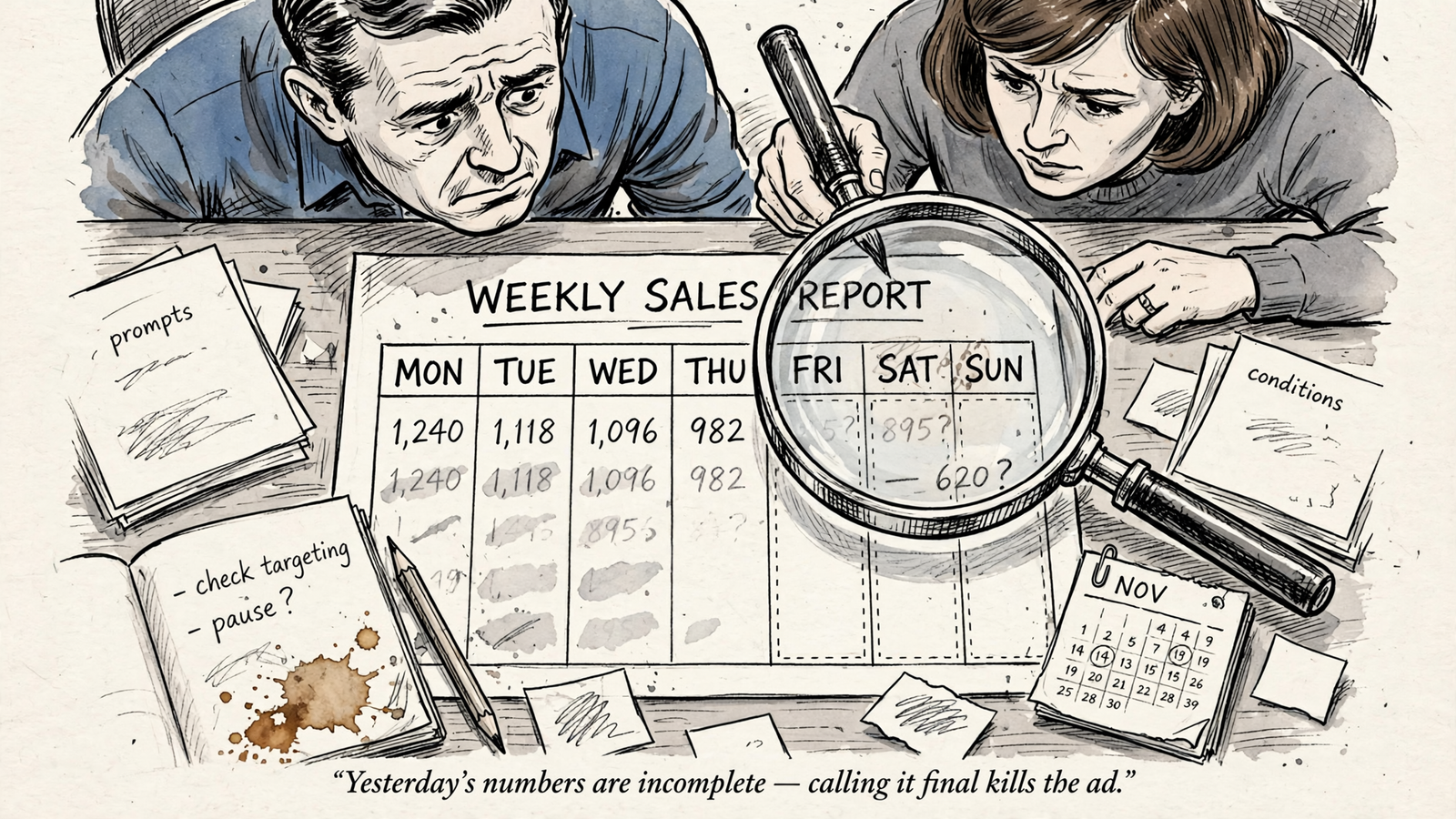
The waiting side starts with how Meta reports a sale. A conversion can show up against an earlier click or view, so the same reporting period can gain purchases after I first pull it. I’ve stared at a Tuesday report that looked terrible and a Friday report on the same Tuesday that didn’t. The reports didn’t contradict each other. The later one had results the earlier one couldn’t show yet.
That’s why I treat recent conversion data as a floor, not a verdict. If I’m judging performance, I want a period that’s had time for the full conversion window, not yesterday’s numbers dressed up as a trend. An incomplete report can make a viable ad look worse than it is.
Sparse results make that problem worse. One practitioner rule I use as a starting point is to look at what an ad has produced after spending three times its target CPA, rather than counting days on the calendar. At that spend:
- Zero or one conversion: lean toward a cut.
- Two conversions: allow roughly one more target CPA’s worth of spend, if the budget permits.
- Three or more conversions: keep it running.
It’s a starting point, not a law. Meta’s learning threshold of 50 optimization events in seven days gives you more results to work with, but at a $100 CPA that’s roughly $714 a day per ad set. I used to tell clients to give every ad a full week regardless of spend. I was wrong. A week at $300 a day is a commitment nobody signed. Counting days tells me how long an ad has been live. Counting spend and conversions tells me what I’ve paid to learn.
Waiting also gives me a chance to ask whether the ad is even the thing that changed. I want Claude to show me comparable periods, pull placement or campaign breakdowns where they exist, and flag a landing page swap, a price change, a change to tracking events, or a budget move. I’ve watched a Quality Score and an account sag because someone changed a landing page and said nothing. It’s easy to blame the ad when the report in front of you is an ad report.
The same caution applies to using Meta-only ROAS as a pause trigger. If Meta missed credit for sales, the report can make a profitable ad set look unprofitable. I’d compare the platform numbers with actual sales, using server-side tracking where available, before automating a decision on that signal. The best case for waiting isn’t “give it forever.” It’s “here’s what we still need to learn, and here’s what we’re willing to spend to learn it.”
Where each side overreaches
“Pause every ad above target CPA” sounds disciplined until you see what it treats as equivalent: a two-day-old ad with 800 impressions and a 21-day-old ad with 4,000 clicks. Or a $90 CPA against a $60 target on three conversions and the same $90 CPA on thirty. The same CPA doesn’t carry the same weight at three conversions and thirty. Spreading budgets so thin that ad sets barely convert, scaling after $200 of good ROAS, and keeping a 1.2x ROAS campaign running against a 2.5x target on hope are all versions of the same expensive habit: reading more into the numbers than they can tell you. A blanket cutoff makes that mistake in the other direction.
“Give it more time” fails just as cleanly when there’s no spending ceiling. At $300 a day in spend, a seven-day wait costs $2,100 whether the ad recovers or not. And more time doesn’t fix a bad diagnosis. Frequency alone doesn’t prove fatigue. I look for rising frequency, falling click-through, and rising cost per result on specific creatives while newer ads still perform. If every ad declines at once, I’d look at tracking, seasonality, or an auction shift before blaming tired creative.
I’d run the eight checks that beat a frequency cutoff before I let Claude write the word fatigue. Just as high frequency isn’t fatigue on its own, a ROAS dip without a settled window and a comparable period doesn’t tell me the creative failed. It may justify a closer look. It doesn’t authorize another week of spend.
My verdict: authorize the stop, not the diagnosis
For the advertiser who can’t afford to leave the cost of waiting open-ended, I side with the pause rule. One consideration decides it: buying more evidence requires spending more money. The business decides how much it’s willing to spend, not Claude. If an agreed stop rule fires before the evidence is good enough to judge the creative, I want Claude to pause the ad and leave the judgment open.
I keep the spending policy separate from the performance review. The policy needs four lines:
- Scope and spend trigger: which ads or ad sets the rule covers and how much they have to spend before it applies.
- Evaluation window: which reporting dates and attribution window count toward the rule.
- Evidence required: which results Claude must check alongside spend.
- Action on breach: whether Claude flags the ad for review or has permission to pause it.
Say you spend $20,000 a month and target a $75 CPA. I might start by flagging any ad set that spends $225 with zero attributed purchases for a reporting period whose seven-day click window has had time to settle. That borrows the three-times-CPA starting point without pretending it fits every account. At first, $225 is a review trigger. If I later authorize a pause on the same conditions, it becomes a stop rule, not a guarantee that spend can’t pass $225 before the pause. And neither version gives me grounds to judge the creative on the last three days alone. I’d tie the thresholds to your break-even CPA, not to an industry average. A 2.0 ROAS that clears your margin matters more than a 3.0 that misses it.
I’d give Claude with groas connected a read-only job first:
Against this written policy, classify each ad or ad set as eligible to pause, hold for review, or insufficient evidence. Show the supporting rows: spend, attributed purchases, window dates, and the exact rule breached, if any. Make no changes.
Then I’d look at the rows and approve specific pauses in chat, one by one. I’m checking whether Claude applied the rule I wrote, not whether it can make a convincing case for a different rule. Only after the policy has held up for two or three weeks would I switch on narrowly scoped autopilot rules for the pauses I’m ready to authorize. groas autopilot stays off until I enable it, runs within the rules I set, logs each change with its reason, and lets me undo it in one step. I automate the action I’ve approved. I don’t automate the conclusion.
What I’d tell finance after a pause
Finance doesn’t need my theory of the algorithm. It needs to know what I did, what the numbers showed, what I don’t know yet, whether spend continues, and when I’ll look again. If I’ve already authorized the $225 stop rule, I’d write it like this:
I paused Ad Set B after it spent $268 with zero attributed purchases in the period we evaluated, against a $225 stop rule. I used a settled seven-day click window and left the most recent three days out of the decision because the numbers aren’t complete. That’s enough to enforce the rule, not enough to call the creative a failure. No further spend while the ad set is paused. I’ll review it Friday, or sooner if delayed purchases post to the period I checked.
I’m reporting a stop, not a failed creative. If finance asks why I didn’t wait longer, I can point to the rule it already approved. If they ask whether the creative is dead, the honest answer is that I don’t know yet. I don’t need to spend another $2,100 just to make that answer sound more confident.
I’d keep the receipt with the decision: the rule, the rows Claude inspected, and who approved the pause. groas logs the action and its reason, so there’s a record to check against that receipt. I’d also write down what would reopen the call: two late purchases appear in the reporting period, server-side sales show Meta missed the credit, or a tracking break gets fixed. Those are reasons to move the ad back to review, not to turn it back on by reflex. “Give it another week” isn’t on the list.
That’s where I draw the line. When the agreed stop rule fires, Claude pauses the ad. Until the evidence earns a verdict, I leave the creative’s case open and the spend off.