

 LinkedIn

Should Claude pause a Facebook ad at 2 a.m., or leave it spending until I approve? Smart advertisers disagree because waiting can prolong a loss, while acting can kill an ad before its sales appear. My answer is asymmetric authority: let Claude execute narrowly defined protective pauses, but make it ask about ambiguous calls and new spending.
I used to tell clients I would check every pause by hand before anything changed. I was wrong about how often I would actually be there to check. But replacing an absent human with an impatient algorithm does not solve the problem. It just changes which mistake happens faster.
Asking Claude for a one-time cleanup inside a chat is also a different decision from letting groas autopilot act between chats. Most advice about AI pausing mixes those two up. That is where this debate starts.
First, define exactly what Claude can stop
A pause is not one action with one consequence. A campaign contains ad sets; an ad set contains ads. The level matters because pausing a campaign stops everything below it, while pausing one ad leaves the rest spending.
I want the lowest-level pause that matches the problem. One weak creative is not a reason to stop an entire campaign. The hierarchy sets the blast radius of every rule Claude receives.
The second distinction is authority:
- In chat: Claude reads the numbers through groas, proposes changes, and waits for approval.
- Between chats: groas autopilot acts under rules approved in advance. Every change is logged with its reason and can be undone.
An approval-first workflow can keep new campaigns, ad sets, and ads paused until approval. That is a sensible boundary for launching something new. It does not settle what should happen to something already spending while an approval request sits unread.
I separate permission to stop from permission to start. Otherwise, “ask me first” becomes a policy for two very different risks.
The strongest case for asking every time: the sales are not all in yet
The approval-first camp starts with the strongest objection to automatic pausing: an incomplete report can make a working ad look broken.
Meta’s 7-day click and 1-day view attribution setting defines which purchases can be credited to an ad. It does not mean every purchase appears immediately. A buyer can click on Monday and purchase later; iOS and SKAdNetwork reporting can add another delay. Tuesday’s report may not yet show the sales needed to judge Tuesday’s spend.
Pausing on same-day numbers is not discipline. It is grading a test before half the class has handed it in.
Learning adds another reason to wait. Meta needs around 50 optimization events to exit learning, and low-budget ad sets can take longer to accumulate them. A quiet stretch does not, by itself, distinguish a failed ad from an ad that has not produced enough evidence yet.
The approval-first buyer therefore wants more than a red CPA cell. Before accepting a pause, I want to know:
- Which conversion event is the ad set optimizing for?
- How much relevant spend has accumulated?
- Which conversions could still arrive or be reported?
- Is the ad set still learning?
- Would the proposed pause stop one ad or everything around it?
That is a real judgment call, not a ceremonial click on an approval button. The buyer may know something the report does not settle: the offer changed, the landing page changed, or the evidence is simply too thin.
The careful prompt is not indecision:
“Show the proposed pauses, evidence, and uncertainty. Change nothing.”
Claude lists the exact ads, the spend and sales behind each recommendation, and what remains unknown. I approve or reject. Nothing moves while I think.
For an account whose apparent failures are still inside the conversion or reporting delay, that restraint is the point. Do not automate a verdict the available evidence cannot support.
The strongest case for automatic pausing: an unread warning stops nothing
The automatic camp starts with an equally uncomfortable fact: a pause proposal sitting in an inbox does not pause anything.
Meta can spend up to 75% over a daily budget on a given day while pursuing opportunity (daily budget detail). An approval request is not a spending boundary. It is a request to the person who might enforce one, whenever that person returns.
Say an account spends $20k a month, roughly $650 a day. If one ad set goes sideways on Friday night and I do not open Claude until Monday, the approval requirement leaves it running through the weekend. I have not necessarily bought better judgment. I have bought more time before anyone acts.
The strongest automatic-pausing argument is not “let the AI decide everything.” It is “let the system enforce the loss limit I already decided.”
A working rule might use spend around 2 to 3 times target CPA with zero conversions, measured over a multi-day lookback. The point is not that this multiple magically identifies every loser. The point is that I choose an explicit boundary before the account reaches it, rather than improvising while losses accumulate.
That is different from killing an ad after a quiet morning or treating $40 of spend at $10 a day as a conclusive verdict. A protective rule needs enough history and a lookback that respects conversion delay. Otherwise, it is panic with a scheduler.
In chat mode, the assistant can show the exact proposed list and wait for approval. With autopilot enabled, the pre-approved rule removes that wait. The argument for automation is strongest when the evidence and response are already specified, and the only missing ingredient is someone being awake.
One advertiser described losing $300 a day on Meta ads while commenters debated whether to raise the budget and wait out learning. I read that as a report of the stakes, not a diagnosis. Without the conversion window, CPA target, and proposed pause level, nobody outside that account can say which pause would have helped.
Still, the operational problem is real: deliberation takes time, and live ads keep spending during it. If the decision is already written down, requiring someone to repeat it at 2 a.m. adds delay, not judgment.
Cross-examination: can Claude state the rule without guessing?
Neither side earns authority just by sounding cautious or fast. I want answers to three questions before either workflow touches the account.

- Which result counts, and when can I judge it? Name the conversion event at the ad set level. Then distinguish the attribution window from the time conversions take to happen and appear in reporting. A 3-day lookback is not automatically enough just because the rule says “multi-day.”
- What loss am I willing to tolerate before action? This needs a number, not “poor performance.” With a $40 target CPA, a threshold of 2 to 3 times target CPA gives Claude a defined line. Whether that line is appropriate still depends on the evidence window and the account’s learning status.
- What exactly can Claude pause? An ad, an ad set, or an entire campaign? The answer cannot be left implicit. A rule meant to stop one loser must not become permission to stop everything around it.
These questions expose the weakness in both slogans. “Always ask” does not specify how long a known loss may continue. “Pause automatically” does not specify what counts as known.
If Claude cannot state the event, the delay, the loss limit, and the level, it should not touch anything yet.
The verdict: narrow stopping power, not a blank check
My verdict is asymmetric authority. For an advertiser who cannot watch the account around the clock, I would grant narrow protective pausing and keep ambiguous judgments, relaunches, and new spending approval-only.
The deciding consideration is what the action can undo. Paused ads and ad sets keep their settings and history and can be restarted. A pause cannot recover money already spent, but it can stop further spend while I review the decision. A budget increase does the opposite: it authorizes more money to leave the account.
That does not make a pause free. Lost delivery is not restored by clicking undo, and restarting can carry learning consequences. Reversibility is a reason to permit tightly bounded stopping power, not permission to pause casually.
Narrow means written down, not understood. A protective rule needs four boundaries:
- Scope: the specific ads or ad sets it may pause, not the whole campaign unless explicitly authorized.
- Evidence: a defined spend threshold, conversion result, and lookback that accounts for reporting delay.
- Eligibility: enough consistent delivery to judge the result, with learning and uncertain cases excluded.
- Authority limit: how much daily spending the affected ad sets may represent before Claude must stop making further pauses and ask.
For example, a draft rule might propose 2.5 times target CPA with zero conversions on a 3-day lookback, after seven days of consistent spend. I would not approve that wording until the lookback fits the account’s conversion and reporting delay. Seven days is not a permission slip to ignore missing evidence.
Everything outside the approved boundary stays with me: budget increases, relaunches, new creative, and calls that depend on interpreting incomplete data. Autopilot stays off until I approve those lines.

Put the verdict into a groas rule, then audit it
I start with words, not with autopilot. With groas connected to Claude, the first request is:
“Draft protective pause rules for this campaign. Explain which cases still need my approval. Do not enable them yet.”
Claude should return the four boundaries: what it can pause, what evidence it needs, how much daily spending it can affect, and what it must bring back for approval.
Read that draft like a media buyer, not like a prompt. If it lets Claude stop a whole campaign because one ad had a quiet morning, reject it. If it cannot explain the conversion event and reporting delay it will respect, send it back. Polished wording does not rescue an incoherent rule.
I would run the proposed rules in notification-only mode for two weeks before allowing execution. That gives me a chance to inspect the proposed pauses and calibrate the thresholds without interrupting delivery. The same approval-versus-autonomy debate for Google Ads lands on the same boundary: narrow stopping power first, not unrestricted spending power.
Once I approve the wording and switch autopilot on, my job changes from approver to auditor. Every groas action lands in the log with its reason. I want to see:
- The exact ad or ad set paused.
- The spend and conversions behind the decision.
- The lookback and delivery history used.
- The approved boundary that authorized the action.
A useful entry reads like a buyer explaining a call: paused ad set X after $112 in spend with zero purchases on the approved lookback, after the required delivery period, within the authorized daily spending boundary. That only works if the rule’s CPA threshold and timing actually support the call.
A useless entry says “paused for poor performance.” That is a label, not an explanation. I rewrite the rule when I see it. This is where setting campaign guardrails before letting an AI ad tool make changes pays off: the guardrail makes the action checkable.
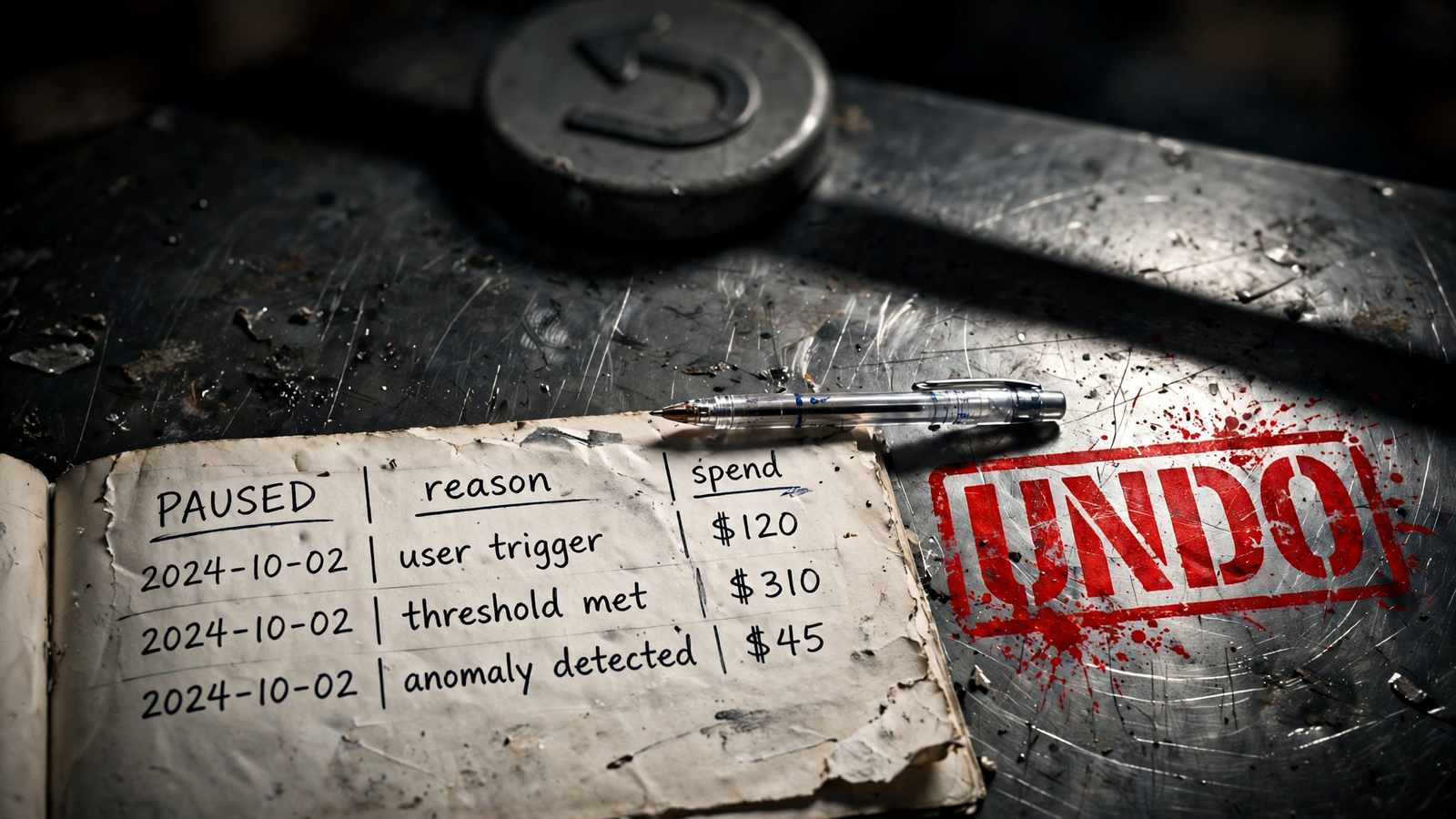
Restoration also deserves a check. Paused ads, ad sets, and campaigns retain their settings and history, but an ad cannot resume delivery while its parent ad set or campaign remains paused. If several levels were stopped, restore them from the top down.
The undo button restores status. It does not promise an instant return to the same performance. That is why I review the pause itself, not just whether Claude followed the syntax of the rule.
Protective pauses handle the clearly defined cases. Everything uncertain, everything still in learning, and every budget increase stays with me. Claude gets to pull the fire alarm. It does not get to rebuild the house.
I choose bounded automatic pausing, not approval for every pause. The reader I have in mind has a live account, a real loss limit, and other things to do at night. The deciding factor is that a narrow pause stops further exposure without authorizing new spending. That earns it limited autonomy, not a promotion to account owner.
Connect groas to Claude, draft the pause rule, run it notification-only until the thresholds hold up, then let autopilot enforce the line already approved. On a $20k-a-month account, one contained loser paused on Saturday beats three days of losses reviewed on Monday.


