

 LinkedIn

Say you spend $20k a month across Google and Bing, and Claude finds $4,000 going to Bing queries that have never produced a qualified lead. Should it add the negatives, or stop at the report? Smart operators disagree because read-only access keeps a bad recommendation from becoming a bad change, while a handoff can leave a good recommendation sitting there as the account keeps spending. I’d connect both reporting and execution, but I’d grant authority by decision type. Account access is not a spending policy.
Most of this hypothetical Bing account came from a Google Ads import years ago. Claude pulls the search-term report, checks it against the CRM, and finds what I’d have found at 1 a.m. with a spreadsheet: expensive terms eating the budget and campaigns without a sensible CPA target. The analysis takes minutes. It’s the Monday report with twelve recommendations and, on a good week, two that get done that I’m worried about. Microsoft’s own Microsoft Advertising MCP is read-only: it can retrieve campaigns, ad groups, ads, and keywords, but it never modifies account data. That’s a clean starting point. It’s not the verdict.
The case for read-only: a bad recommendation stays a recommendation
The reporting-only case isn’t fear of AI. It’s respect for what a wrong bid change costs. If Claude misreads a report, I’ve got an awkward call. If it acts on the misread, I’ve got whatever it spent before someone noticed. Read-only access keeps errors in the analysis from turning into changes to the live account.
Claude’s connector controls make that boundary practical. Connector owners can set tool categories to Always allow, Needs approval, or Blocked. If the connector offers write tools, I can allow reads and block writes, and Claude still can’t exceed the user’s permissions in the source system. Anthropic’s enterprise guidance recommends starting read-only and phasing in writes once the workflow has shown a need and the data-risk owner signs off. Unless Always allow is enabled, a member still confirms each write. The Claude MCP docs also describe tool annotations such as readOnlyHint and destructiveHint, which help distinguish reads from tools that can change data.
The strongest evidence for this setup is that the reporting work is worth doing on its own. In one r/ClaudeAI discussion, a manager describes cutting weekly reporting from three or four hours to about 30 minutes by putting Claude on top of centralized data. The division of labor is explicit: Claude drafts the summary; “I review and add recommendations.” In an r/PPC discussion, operators describe the other side of that arrangement: Claude can sound certain while getting ROAS or CPA math wrong, or inventing metrics altogether. They separate calculation from interpretation and require confirmation for budget shifts and bulk pauses.

My reporting prompt would be: “Read this Microsoft account only. Show the evidence, uncertainty, and proposed changes. Change nothing.” If a proposed negative rests on nine clicks and zero conversions, I want those nine clicks in the report. If conversion tracking is broken, I want that in the first line, not under a list of bids to change. A report I can defend to the budget owner line by line is useful work. It doesn’t need write access to be worth doing.
The case for execution: approval shouldn’t create another job
Here’s the best argument for letting Claude act: deciding and typing are two different jobs. Once I’ve approved a negative, somebody still has to open Microsoft Advertising, find the right campaign and ad group, enter it, check it, and document it. Then there are the other eleven items. For one small account, I might lose an hour. Across an agency’s Google and Bing accounts, that hour multiplies, and it gets harder to tell who owns the work. The 30-minute reporting example tells me who reviews the findings. It doesn’t tell me who applies them, or when. In the teams I’ve watched, “later” does a lot of work as a deadline.
The execution case isn’t “just go optimize it.” An operator in r/claude describes using Claude Code and Codex to pull search terms, compare them with CRM lead quality, and push some changes. The conditions are the interesting part: stage the actions, log them, and give a reason for each one, especially for negatives, budgets, bids, and conversion settings. The human still makes the call. The assistant does the work of turning that call into a specific, reviewable change and applying it after approval.
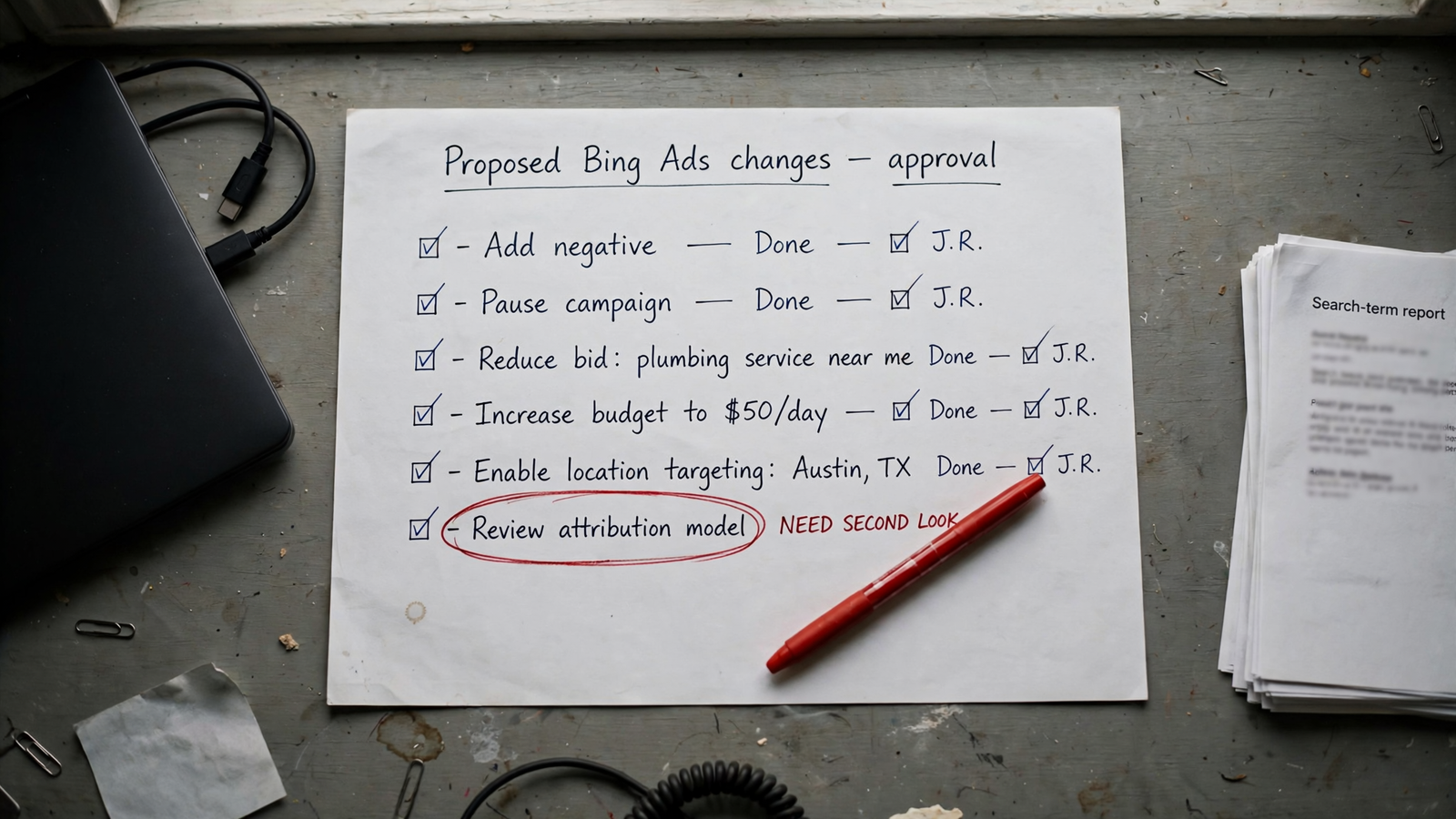
groas is how I’d put that into practice. Connect groas to Claude and Claude can read the Google and Bing numbers, prepare a change, and apply it in the same conversation. Each change is logged and can be undone in one step. I’d start with: “Prepare the exact Bing changes, affected campaign IDs, and reasons for my review.” That isn’t permission to optimize the account. It’s a request for a list I can say yes or no to. If Claude can’t show me where a change goes or why it belongs there, the proposal isn’t ready.
Other tools show why the draft comes before the write. AdKit keeps reporting read-only and stages campaign, keyword, and bid changes for approval. Supermetrics describes a review-then-confirm flow that creates new campaigns paused and warns that campaign removal can’t be undone. I’d use groas for this job: I want the recommendation, the approved action, and the recorded reason without opening a second screen to re-enter the decision. Review should end with a decision, not a data-entry assignment.
The line I’d draw: adding a negative isn’t the same as replacing one
If I can’t trust the inputs, I keep the account read-only. That means broken conversion tracking, no agreement on which CRM events count as qualified pipeline, or no CPA target the budget owner will stand behind. And I don’t assume the platform’s change history can settle every dispute after the fact: Microsoft’s change-history documentation warns that ChangeSource isn’t proof a human made the change and that previous values can be blank. In a Bing account imported from Google Ads and rarely opened, the first job is to build a record I can trust. A report can surface the neglect. It can’t fix it.
Once the inputs are sound, I judge the proposed action, not the connector. In Microsoft Advertising, I can’t update a negative keyword in place. To change its match type, I have to delete it and add it back. The available negative match types are Phrase and Exact, not Broad. If Claude proposes replacing an existing negative, I want to see the current value and explicitly approve the replacement. Adding a fresh negative for a term with zero conversions on $500 of spend is a different decision from removing a negative that’s already doing its job. Same account. Different authority.
I also draw a hard line between approved execution and autopilot. When I approve a change in chat, I’ve approved that change. With autopilot, I’ve granted standing authority to act within rules I’ve set, without reviewing each change that day. In groas, autopilot stays off until I switch it on, and each change is logged with its reason and can be undone in one step. I leave it off until I’ve written down the goal, the limits, and what still needs approval. Connecting the account isn’t that decision.
My verdict: connect both and grant authority by decision type
For advertisers and agencies with reliable tracking and a named budget owner, I’d connect reporting and execution and start with approval for each write. The deciding factor is the handoff. Read-only protects against a bad action, but it doesn’t protect against a slow one. In the opening example, those queries keep eating into a $4,000 monthly budget problem even after everyone agrees what to fix. I want the person who owns the budget making that decision. I don’t need them retyping it.
The reporting-only camp is right about one thing I won’t give up: a chat answer isn’t a durable record of who approved what. With groas, the change log records what Claude changed and why, and one-step undo gives me a way to restore the setting. But undo doesn’t refund the spend. The log tells me what happened; the approval gate limits what can happen in the first place. I’d put the control where it can still save the money.
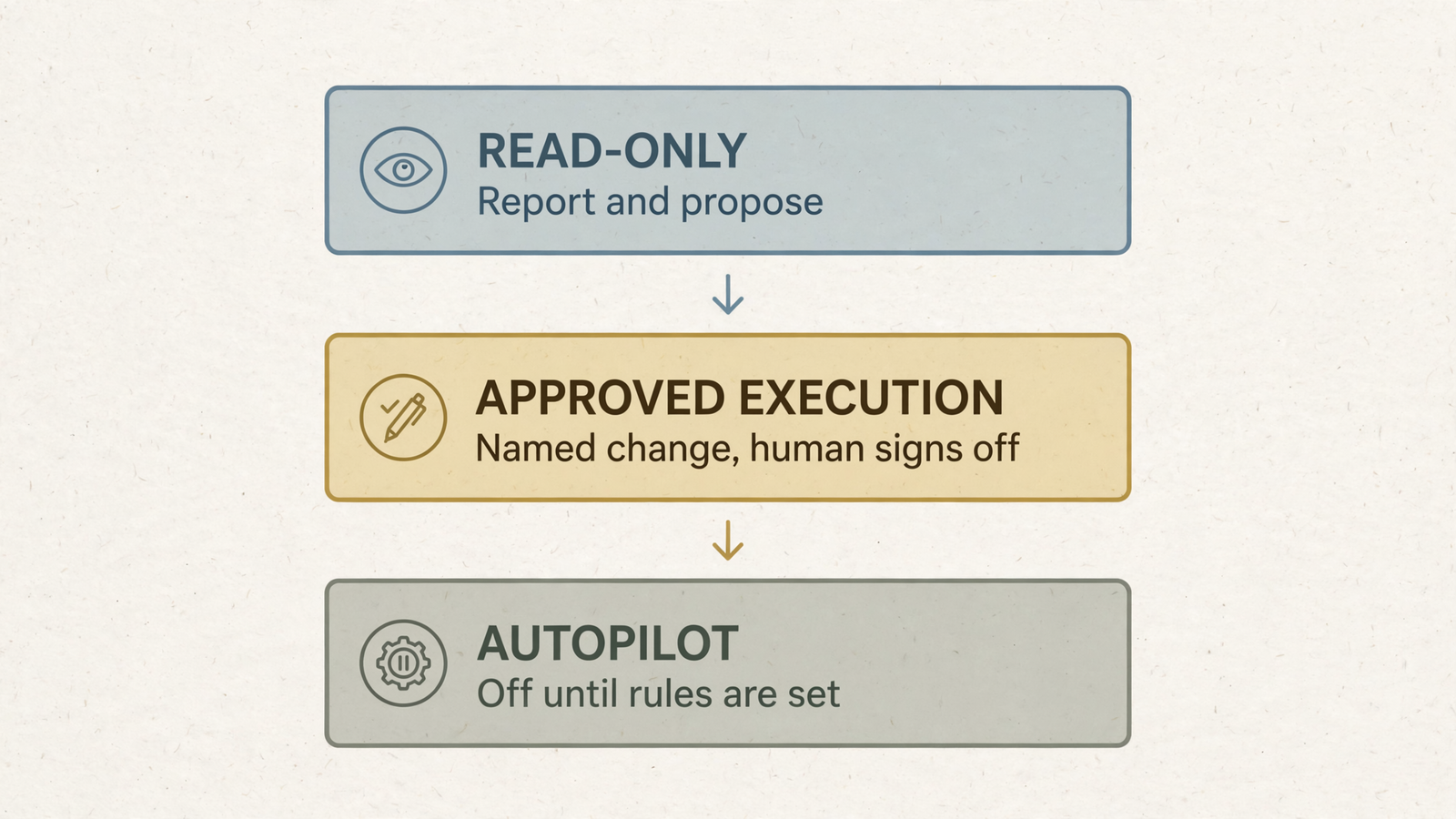
The tiers are simple:
- Read-only for investigation. Get the evidence, the uncertainty, and the proposed changes without touching the account.
- Approved execution for named changes. Specify the account, campaign, action, and reason. Get a human yes before the write.
- Autopilot only as a separate opt-in. Set the goal, limits, and approval requirements before granting standing authority.
I set those tiers when I connect the account, not after an incident. Even the setup for Microsoft’s read-only connector requires a separate Microsoft sign-in with access to the target accounts. On Claude Team and Enterprise, only an Owner or Primary Owner can add that connector. Adding it is an access decision. What Claude may do is a separate decision.
The five-line policy I’d take to the budget owner
Put the rules on one page. If the budget owner can’t tell who’s allowed to do what, the settings aren’t a policy yet. Here’s what I’d write down:
- Who approves: A named person, not a team. A team approving is nobody approving.
- What Claude may change without asking: Nothing at first. Later, a short, explicit list by decision type, as it earns the trust.
- What always needs sign-off: Budgets, bids, conversion settings, anything that deletes or recreates an existing entity, and any change to a new account or one under review.
- Where decisions are recorded: In the action log, with the reason. Link it from the report so the evidence and the change live together.
- When execution stops: Immediately if conversion tracking is broken or unverified, if the log can’t attribute a change, or if a week’s reported CPA disagrees with the platform’s numbers by more than the team can explain.
That last line is the one I’d steal first. “Keep an eye on the AI” isn’t an operating rule. Stop when the numbers don’t reconcile and nobody can explain why: that’s a rule a budget owner can enforce.
I don’t ask the log to replace the team’s task system. It records what changed and why. It doesn’t chase the landing-page fix or own the client relationship. I don’t ask undo to make mistakes free, either. I put sign-off before the changes I can’t afford to get wrong and keep a record of the ones that go through.
If I’m writing the operating rules for autopilot rather than for individual approvals, I’d start with the groas autopilot guide to set what it may change, within which limits, and with what approvals. Either way, my answer is the same: let Claude report on Bing Ads and let it make changes, but grant that authority decision by decision, in writing, with a named human who owns the outcome. Account access is not permission. Permission is a list, and you write the list.





