

 LinkedIn
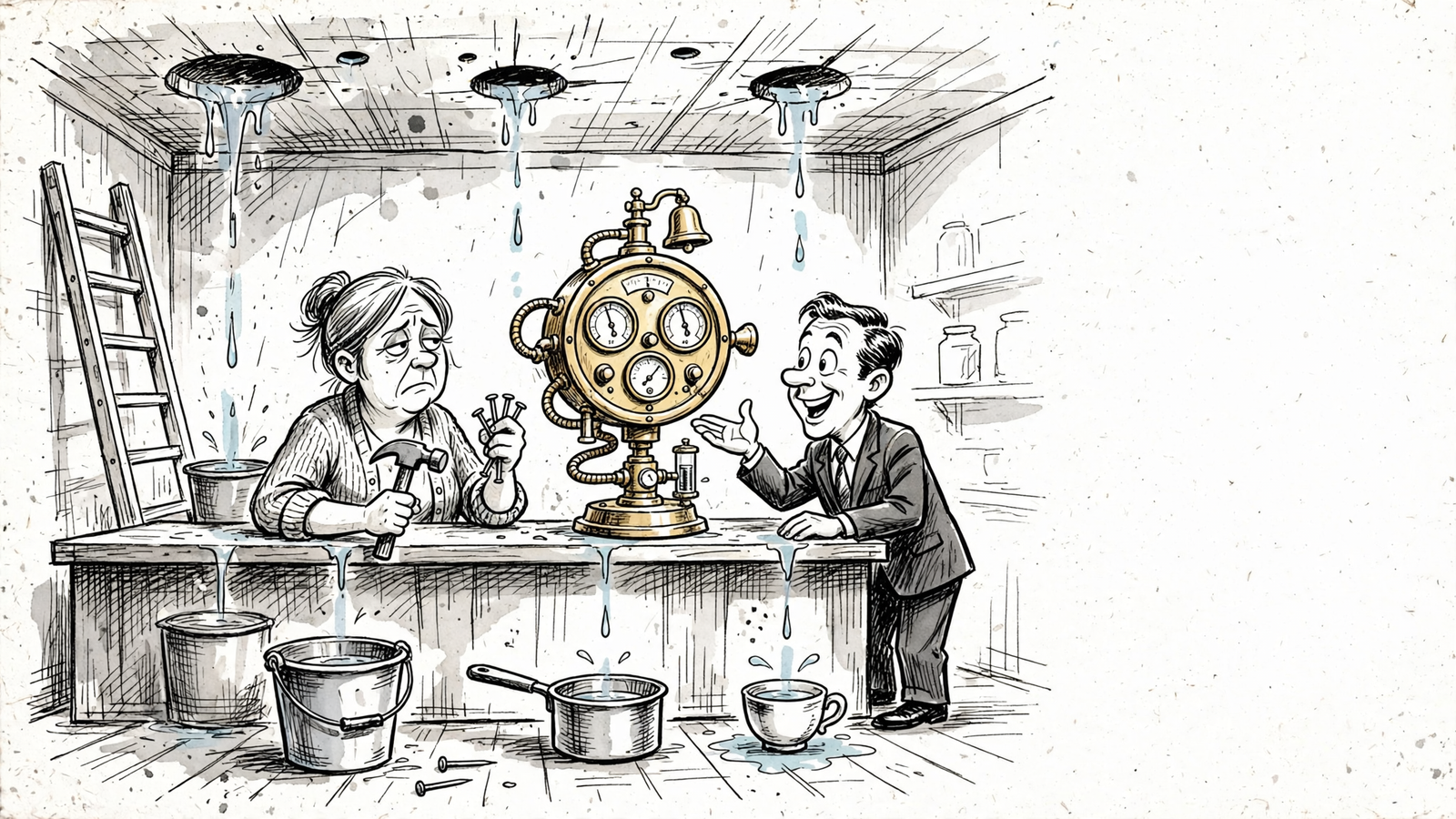
A tight-budget business should not buy AI search tracking until it can name the decision the data would change. So should the next dollar go to measurement or fixing the site? Smart operators disagree because manual checking consumes hours, while publishing the wrong page consumes the same scarce budget. My dividing line is actionable uncertainty, not whether GA4 already shows AI referral traffic.
One camp says to run twenty buyer questions through ChatGPT and Perplexity, record who gets named, and spend the money fixing what is visibly wrong. The other says those checks sample a moving target: repeated answers and cited sources can reveal which page deserves the work in the first place. They disagree less about whether evidence matters than about when to pay for it.
The cost gap runs both ways. One practitioner put a recurring ChatGPT-mention audit at about fifteen hours a month, before anyone acts on the log. Paid AI-visibility plans start near $27 a month and run past $540 for standard self-serve tiers. Per-prompt pricing adds up once you track fifty to a hundred prompts across a few clients.
Free is not free. Paid is not automatically useful. Here is the strongest case for each, followed by my ruling.
Position one: fix the obvious problems before buying measurement
The free camp starts with a blunt observation: knowing you are invisible does not fix the invisibility. A business that AI answers skip may already have plenty to correct: outdated product information, prices and specifications missing from readable text, or answers to buyer questions buried in a PDF instead of published on the site.
Those are page problems. Buying a dashboard does not make them measurement problems.
A practitioner in one of the sharpest threads on this put it plainly: for most small businesses, you can get 80% of the insight by running your own queries in fresh ChatGPT and Perplexity sessions, then spend the remaining time and money acting on what the answers reveal.
The routine is unglamorous:
- Choose 20 to 30 buyer prompts with no brand name in them.
- Run them monthly across ChatGPT, Perplexity and Google AI Mode.
- Record who gets named, their order in the answer, and the sources cited.
- Repeat prompts rather than treating one answer as a settled ranking.
- Use the log to identify corrections worth making.
Practitioners who do this say a simple named-in-X-of-20-answers line for an executive often does more work than a dashboard nobody can respond to. I wrote up the three-pass version, prompts and all, because repetition is the part people skip.
The free camp also has a sampling argument: breadth matters. SISTRIX analysed 10,826 daily measurement series across four AI models and eight countries. It found that querying 20 different prompts once lands within about ±9.5 points of a brand’s true mention rate, while querying one prompt on 20 days lands within ±34 points. Its estimate for reaching ±5 points was roughly 70 prompts.
That is a useful warning against confusing frequency with coverage. Rerunning the same narrow question every day does not tell you how a brand appears across the questions buyers actually ask. A spreadsheet can cover different buying situations. An expensive dashboard can still watch the wrong ones.
But what separates a casual check from evidence is the row you record:
- Exact prompt wording.
- Date and model.
- Brands named, in order.
- Sources cited.
- Results from repeat runs.
Not just a screenshot. A row you can compare with another row.
Exact wording matters because paraphrasing can shift the answer. Repeats matter because the answer itself moves. Zadoosh’s platform data from April to September 2026 found that two answers to the same prompt on the same day shared only about three in ten cited sites. The first brand named changed in about four of ten reruns.
A controlled ten-run test on nineteen real consumer prompts made the same problem visible another way: any two runs shared only 55% of recommended brands. Of the brands observed, 27% appeared in exactly one run out of ten; only 16% appeared in all ten.
The free camp’s strongest closing argument is therefore not “one ChatGPT check is enough.” It is that disciplined manual checks can answer useful questions while the business fixes defects it already understands.
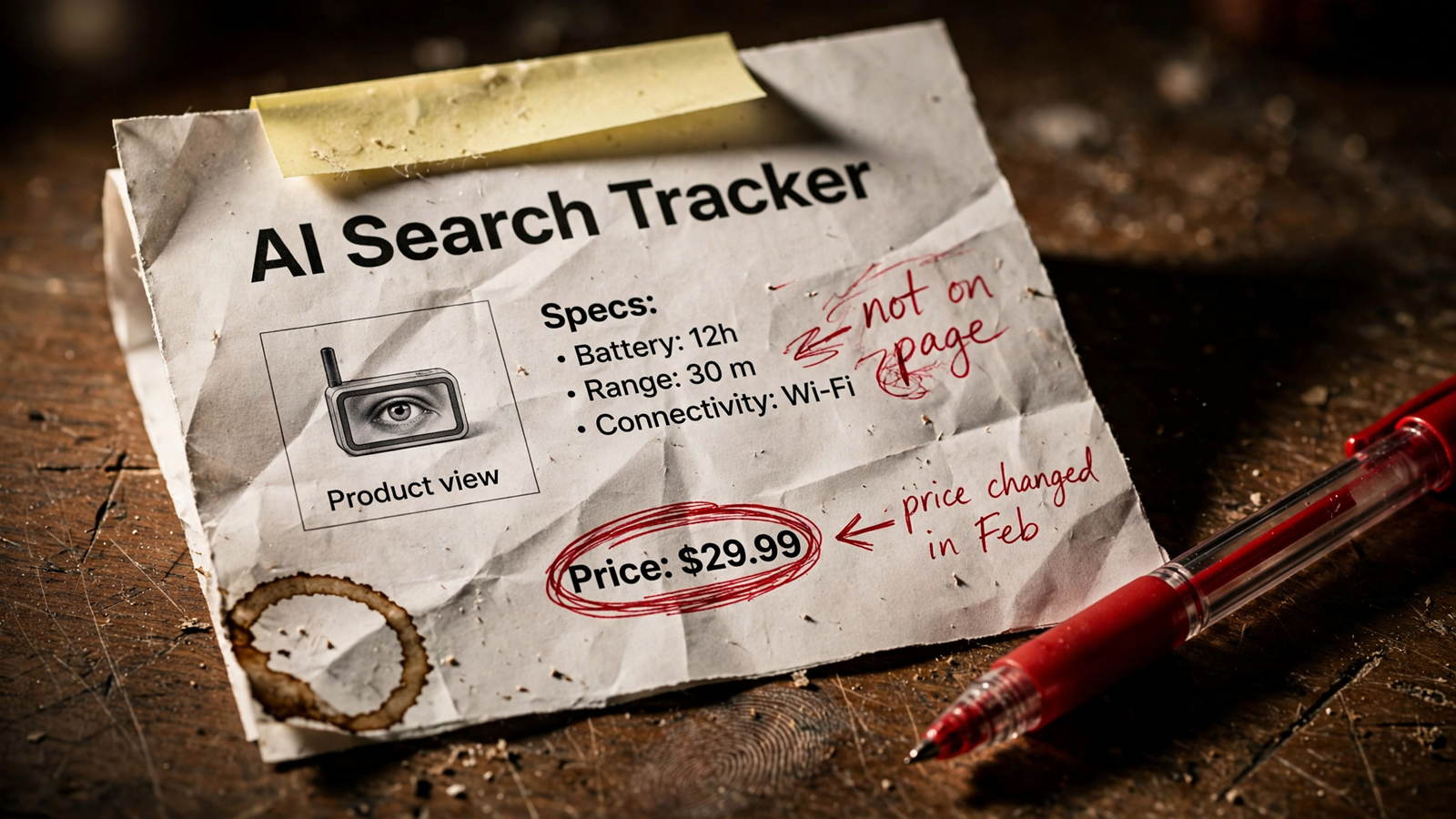
Last season’s price is still on the product page. The size chart is trapped inside an image. The site makes buyers hunt for basic specifications. None of those needs a visibility score to become a priority.
The rule: log your twenty prompts for two or three months and fix what is visibly wrong while you log. Learn what you need from a tool before subscribing to one.
Position two: publishing without citation evidence is expensive guessing
The paid camp’s strongest claim is not “more data.” It is this: choosing the wrong page to rebuild wastes the budget you were trying to protect.
Say you have one writer and eight hours a week. Four pages need work. The question is not whether you can inspect some AI answers for free. It is which page deserves the next eight hours.
A twenty-prompt check may not cover enough buyer questions to settle that choice. Broader, repeated measurement can show which competitor pages get cited for which questions and which sources support those answers. That gives the writer something more useful than “improve our AI visibility”: a page, a gap and evidence for putting it first.
The second argument is that referral traffic does not capture the whole decision. A 15.4-million-session study across 150 B2B SaaS sites found identifiable AI referrals made up under 1% of sessions. Yet among conversions associated with an earlier AI referral, 36.4% happened in a later session, and 83.7% of those arrived via direct or organic search.
An AI answer can introduce the brand, with the buyer returning later through a route the report credits elsewhere. Waiting for a large AI referral channel before investigating those answers can mean waiting for the wrong signal.
The third argument is the most useful: the cited sources matter more than the headline visibility score. One practitioner who bought a tracker called the percentage “a mood” and said the cited-source list was the only part that changed what they published.
That gives paid measurement a concrete job:
- Find buyer prompts where competitors get cited.
- Identify the pages and sources supporting those answers.
- Map the gaps to pages the business could actually change.
I keep twelve prompts for exactly that job. The point is not to collect a more impressive percentage. It is to stop choosing the next publishing task from a hunch.
This is the paid camp at its strongest: spend on evidence when it protects a more expensive content decision. If the work ends in a named page change, measurement has a job. If it ends in a chart, it has homework left.
Cross-examination: what would the evidence actually change?
My first question goes to the free camp: how quickly do you need to detect a change?
A monthly log can support a monthly publishing decision. It cannot tell you much about what happened between checks. The SISTRIX findings also show why a small sample needs care: a modest movement in the headline number is not automatically a meaningful change.
Glen Allsopp’s 70,000-answer study over 28 days found that the core of an AI answer barely moved day to day, but the tail turned over 78% daily. ChatGPT and AI Overviews agreed on the most-present brand for the same prompt only 27% of the time.
A monthly spreadsheet cannot reliably distinguish a persistent absence from an unlucky snapshot. Repeated checks help, but they take time. If a correction depends on catching a shift within days, the manual routine starts consuming the hours it was meant to save.
My second question goes to the paid camp: which page would you change next?
Not “what would the dashboard show.” Which page, with what edit, justified by what evidence?
If the answer is “we would probably rebuild the pricing page,” and the pricing page already contains stale information, the dashboard has not decided anything. The defect did.
If there are three candidate pages and citation evidence determines which goes first, that is different. Now the measurement resolves a choice rather than decorating one already made.
The same distinction applies to traffic. The SEO Works’ twelve-month GA4 benchmark across 95 sites found that AI assistants sent 39 times fewer visits than organic search. Five percent more organic traffic would outproduce doubling AI traffic.
That is a serious argument against diverting scarce resources merely because AI search is the fashionable line on the reporting deck. It is not a reason to ignore evidence that could improve the next page. The benchmark describes the traffic balance; the business still has to decide what work the measurement would change.
The paid camp does not get to skip that decision by pointing to a growing category. The free camp does not get to skip it by pointing to a small referral channel.
Both camps overreach when they sell certainty. A citation guarantee promises control the volatility data does not support: models reroll answers and cite different sources. But dismissing citation evidence altogether throws away information about which competitor pages appear for the questions you want to answer.
The useful standard is narrower: does this evidence distinguish between actions you could take, on a timetable that matters? Name the action before buying the data.
The verdict: stay manual until measurement can change the work
For a tight-budget business, I rule against buying AI search measurement by default. Stay manual until a specific publishing or correction decision depends on evidence the manual routine cannot reasonably supply.
The deciding consideration is actionable uncertainty. Not the number of AI referrals. Not whether the dashboard looks serious. Whether better evidence changes what gets done next.
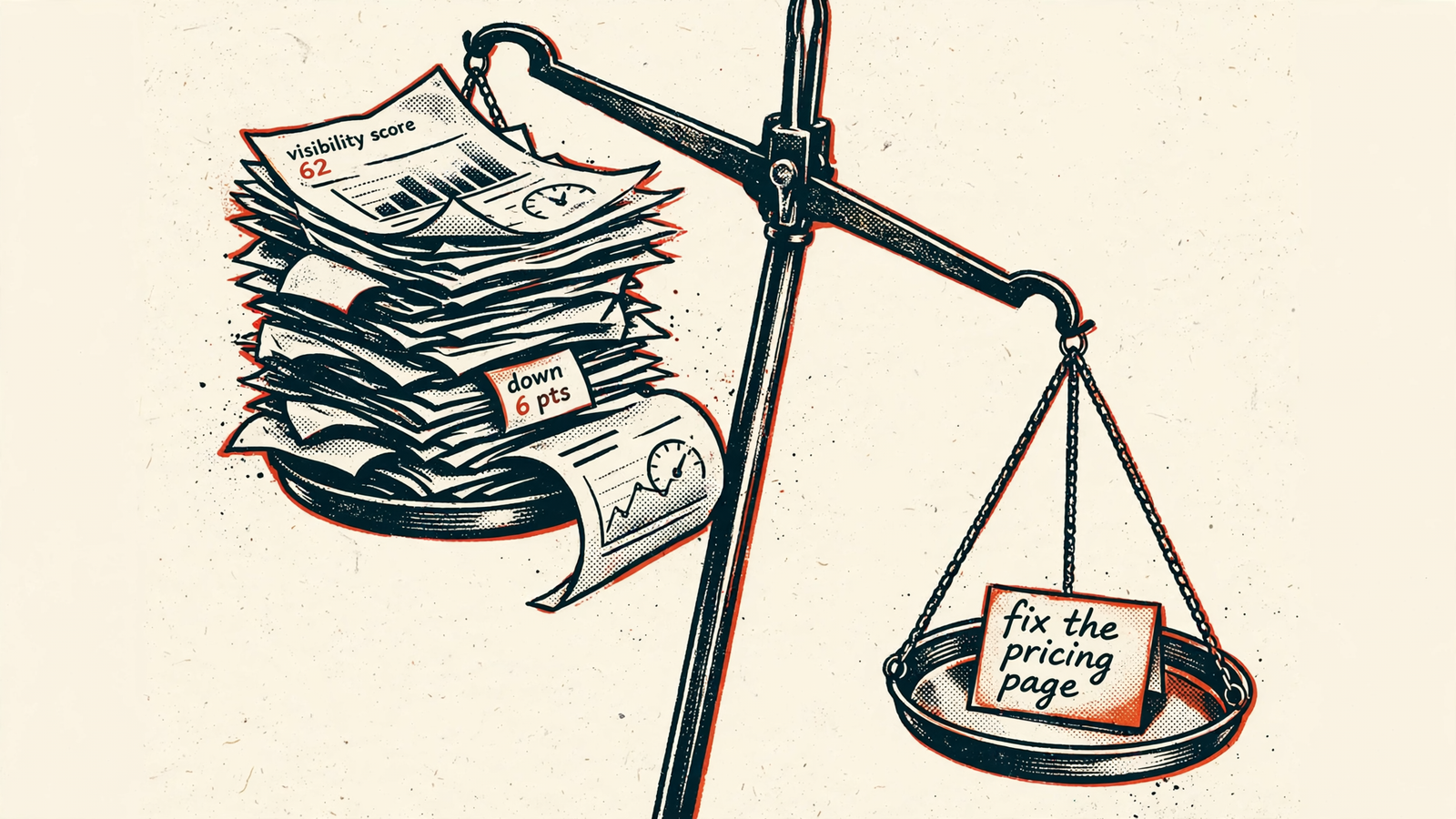
A twenty-prompt log that ends in “rewrite the size-chart section on the product page” has done its job. A $540 dashboard that ends in “visibility is down six points” has not, unless someone can explain what that movement means and what it should trigger. Nobody on the hook for revenue can publish a percentage.
Here is where I draw the purchasing line:
- The correction is obvious: stay manual. Fix the stale price, unreadable specifications or missing buyer information this week. Start logging twenty buyer prompts in parallel so you have a baseline.
- The priority is genuinely unclear: consider broader measurement. Three candidate pages, one writer and no honest way to rank them is a real decision. A cited-source list across a few hundred buyer prompts can show which competitor pages appear for which questions.
- The decision needs faster evidence: price the recurring manual work as work. A free routine that consumes the hours needed to make the correction is not saving the business much.
I have argued the paying question at greater length before. The shorter test is enough here: finish the sentence “If the evidence shows X, we will change Y.” If you cannot, keep the money.
When measurement does earn its place, a score alone is the wrong thing to buy. The useful chain ends in a page change. This is where the visibility-dashboard market leaves too much unfinished: it sells the chart and leaves the writing as homework.
groas costs $19 a month, flat, for a whole team. It connects Claude to your ad accounts, your site, and data beyond a plain connector: competitors’ ads and full funnels, Reddit research, AI answers, and SEO data from Semrush and Ahrefs. There is no free plan, and you pay for whichever assistant you plug in. That is the pricing story.
The useful difference is bringing the citation gap and the demand into the same conversation, so the request can end in an approval rather than a deck:
Compare these citation gaps with our actual search demand. Propose one page change, explain the evidence, and wait for approval before publishing.
If you cannot fill in “these citation gaps” from your own log, stay manual. If you can and you still do not know which page goes next, that is the measurement worth paying for. Everything else is a mood with a subscription attached.


