

 LinkedIn

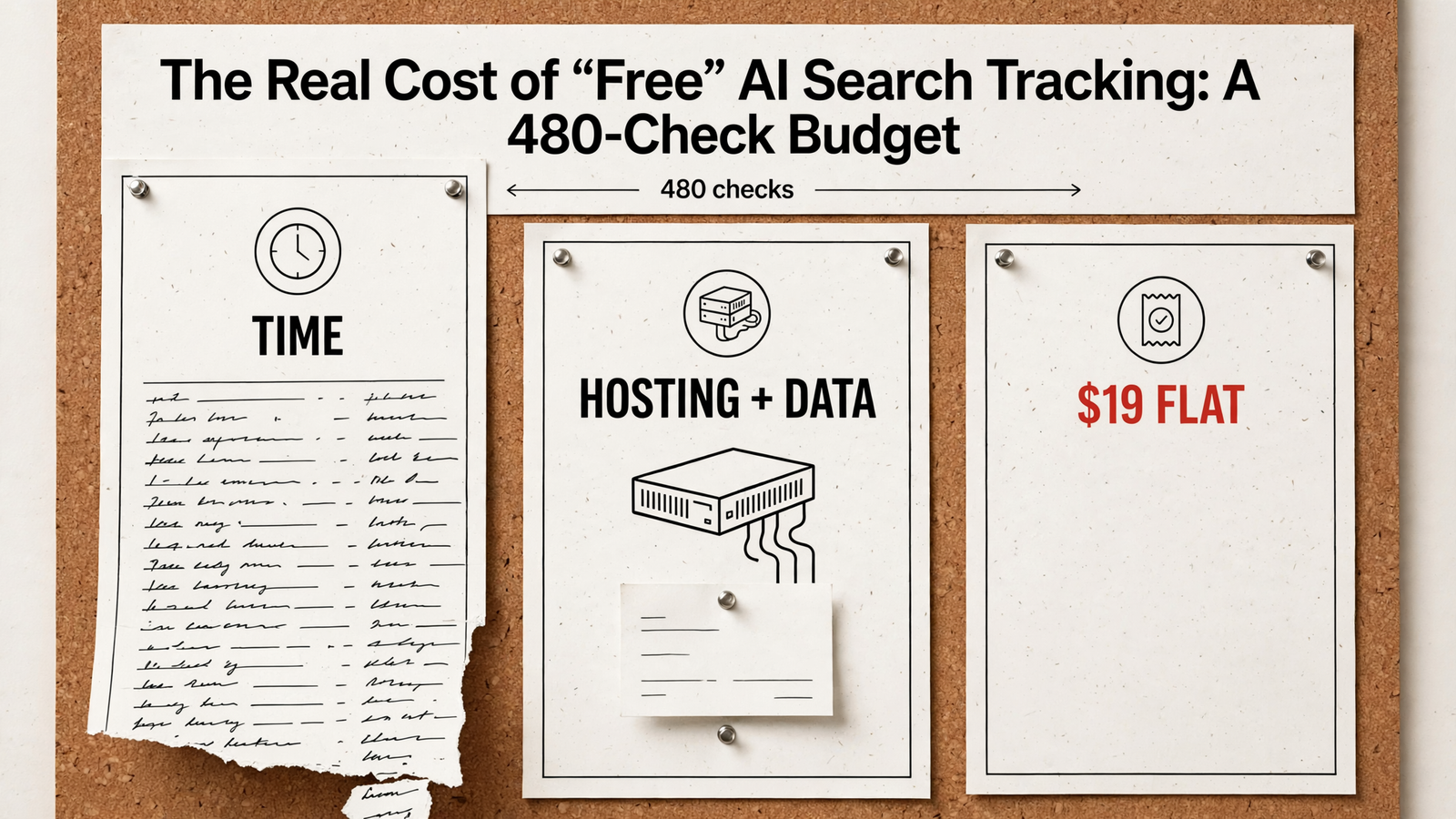
Free AI search tracking starts at $0 for software. It does not end there. For 30 buyer prompts across four answer engines, checked four times a month, I would budget roughly 20 hours for manual collection using the benchmark below. A self-hosted tracker adds hosting, maintenance and answer-collection costs to its $0 license. groas Unlimited costs $19 a month flat, with SEO and AI visibility features included, plus review time and any assistant subscription.
Those are starting points, not interchangeable totals. A free MCP server can give Claude a connection without giving it the answers, citations or history needed to measure anything. And a paid plan belongs in this comparison only after its coverage matches the workload.
Here is the bill before the sales deck gets involved.
| Cost line | Manual collection | Self-hosted free tracker | groas Unlimited | Source or pricing basis |
|---|---|---|---|---|
| Software, recurring | $0 for the tracking worksheet; assistant or engine access separate | $0 self-hosted license | $19/month flat for the whole team | Elmo’s self-hosted license terms; groas pricing |
| Setup, one-off | Build the prompt list and logging sheet | Install, configure and test collection | Connect the relevant accounts and confirm coverage | Setup time depends on the workflow; price it separately |
| Hosting, recurring | No separate tracker hosting | Your infrastructure bill | No separate self-hosted tracker to run | Your hosting bill; distinguish existing capacity from new expense |
| Collection, recurring | Roughly 20 hours for this workload if the cited manual pace carries over | Depends on automation, failed runs and engine access | AI visibility data included; confirm the specified engines and cadence | Manual benchmark: 47 prompts across two engines took four hours to log; groas pricing |
| Maintenance and answer access, recurring | Any assistant or engine access required | Updates, troubleshooting and whatever produces the answers | Any assistant subscription; confirm workload coverage before budgeting | Actual subscriptions, infrastructure and maintenance time |
| Verification, recurring | Review hours × hourly value | Review hours × hourly value | Review hours × hourly value | Your review process, illustrated below |
| Research, editing and publishing | Separate project cost | Separate project cost | Separate project cost | The work required by the finding, not the tracker’s subscription |
The manual estimate is a planning number scaled from somebody else’s logging pace, not a timed test of this exact workload. The self-hosted total has no honest fixed range without knowing the infrastructure and collection method. A blank cost cell needs an estimate, not a zero.
Define the 480 checks before comparing prices
My workload is deliberately specific:
- 30 buyer prompts: questions a customer would actually ask before buying.
- Four answer engines: say ChatGPT, Claude, Gemini and Perplexity.
- Four observation rounds per month: roughly weekly.
- One consistent location: changing geography changes what is being compared.
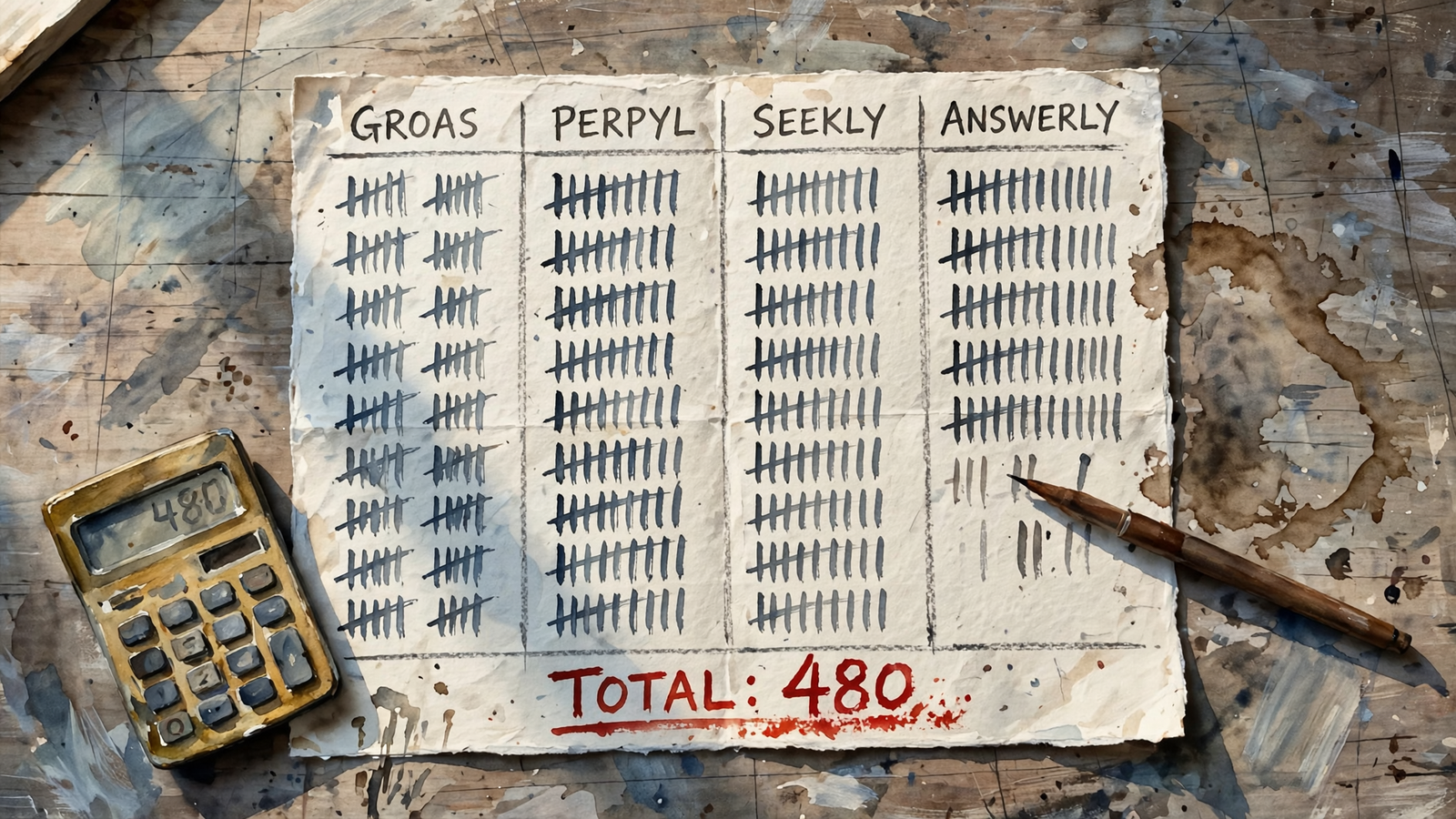
That gives 30 × 4 × 4 = 480 checks. It is my budgeting workload, not a vendor allowance or a published groas entitlement.
A check means one prompt run once in one engine, in one location, on one date, with the full answer and every citation URL saved. An answer with no citations still counts if that absence is recorded. An answer nobody saved does not.
Repeated checks matter because the same prompt can produce different wording and quality across runs. In the manual tracking account behind this budget, the same prompt also produced different answers on Tuesday and Thursday.
Four rounds do not magically remove that noise. They stop one screenshot from doing the work of a month’s evidence. I want to know whether a pattern repeats before I let it dictate a page change.
Agree on the definition of a check before comparing anyone’s price per prompt. Otherwise, the cheap quote and the expensive quote may be selling different things.
Line 1: Separate the free license from the running costs
Elmo describes its self-hosted tracker as free forever on your own infrastructure, without per-seat or per-prompt license fees. That is a license price. It is not an operating budget.
I read “on your own infrastructure” the same way I read an insertion order: the important part is usually after the attractive number. The server needs somewhere to run. Someone needs to configure it, update it and notice when collection stops working. The observations still have to come from somewhere.
I split that bill into four cells:
- License: what the software itself costs.
- Hosting: the infrastructure it runs on.
- Maintenance: hours spent keeping it working, multiplied by an hourly value.
- Answer access: whatever the collection method requires to obtain the engine responses.
Setup belongs outside the monthly total. Updates and troubleshooting belong inside it. Combining them makes the first month look expensive and every later month look suspiciously effortless.
If I already pay for Claude or have spare server capacity, I do not count the same expense twice. But I do not present that existing capacity as free to someone who still needs to buy it.
A $0 license is useful. It is not proof of a $0 workflow. A quote that omits the running costs is a parts list sold as a car.
Line 2: Pay for the answers, not just the connection
An MCP connection lets Claude interact with a connected service. It does not, by itself, produce 480 observations from four answer engines.
Something still has to run each prompt, preserve the response and collect the citation links. If the connected service does that, good. I want to see the records. If it does not, the collection work remains on my side of the invoice.
The manual benchmark is blunt: 47 prompts across two engines took four hours just to log mentions, before analysis. Scaling that pace to this workload lands at roughly 20 hours a month. Actual time depends on the logging process, answer length and how much citation detail gets saved. I would use the benchmark to plan, then replace it with my own measured time.
Free platform reports can add context, but a report is not automatically a substitute for the answer-level trail. I need to see what the engine said, not merely a number derived from it.
After a collection run, I give Claude a narrow instruction:
Which observations do we actually have, and which are missing? Do not estimate missing answers. List the prompt text, engine, geography, date, full answer text and citation URLs for every recorded check.
That instruction is an audit, not a collection method. Claude cannot reconstruct evidence the workflow never saved.
If the vendor cannot show the underlying observations, I have priced a connection—not a measurement. Missing checks stay missing until something actually runs them.
Line 3: Verification is a recurring cost on every route
Collection is not the same as verification. One engine names the brand outright. Another links to a reseller. Another mentions a company with an almost-identical name. The next round contradicts the last one.
Someone needs to decide what counts, and the rule needs to stay consistent. Otherwise, a change in the spreadsheet may be a change in judgment rather than a change in visibility.
I budget verification as review hours × the value of that time. As an illustration, suppose I value my time at $100 an hour and spend 30 seconds per check confirming the mention and inspecting the citation. Across 480 checks, that is four hours before resolving anything ambiguous.
That is an illustrative allowance, not a promise that every answer takes 30 seconds. Some are obvious. Others require opening the source and checking whether it supports the apparent mention at all.
The same line belongs in all three budgets: manual, self-hosted and groas. Included data does not make every interpretation correct, and automation does not make review unnecessary.
Do not make the paid option carry a review cost while quietly assigning the free option none. That is not a comparison. It is accounting with a favorite.
Line 4: Keep the fix outside the tracking subscription
Measurement is not the fix. The fix is a page changed because the evidence points to a specific gap.
Through groas, I ask Claude to examine the collected answers and citation links, identify a gap where competitors get cited and the brand does not, and propose a page change with the supporting observations attached. The instruction starts with the evidence. It does not start with “write more content” and go looking for an excuse.
Then I price the follow-through separately:
- Research needed to understand the gap.
- Drafting or editing the page.
- Editorial review.
- Publishing approval.
Those are project costs. Their size depends on what needs changing, not how many prompts the tracker monitors. A small correction and a substantial rewrite do not become the same job because both began in a dashboard.
This is why I separate the cost of a repeated check from the work it triggers. Tracking can tell me where to investigate. It does not eliminate the investigation.
If a quote bundles tracking and fixing, ask what work the fixing actually includes. A subscription price is not a publishing budget.
Build the monthly worksheet without hiding the labor
Before comparing totals, I put the costs into two groups. Setup happens once. Collection, maintenance and review keep coming back.
One-off costs
- Define the buyer prompts and engines.
- Establish the location, schedule and logging format.
- Configure the tracker or manual workflow.
- Test that answers and citation URLs are actually being saved.
Recurring costs
- Software and hosting.
- Assistant or engine access where required.
- Collection and failed-run handling.
- Maintenance.
- Verification.
- Any approved research, editing and publishing work, listed separately.
For groas, the listed software price is straightforward: Unlimited is $19 a month flat for the whole team, with every feature included. That makes it the stronger starting point than assembling a “free” stack solely to avoid a license fee: the SEO and AI visibility data are included, rather than another collection problem to source separately.
But I still confirm the actual engines, observation detail and cadence against this workload. “Data included” is not a reason to invent an allowance. The 480 checks remain my specification, not a promise I can infer from a flat price.
The useful comparison is the monthly bill after setup, with the same evidence standard and review requirement applied to each route. That is where a free license either earns its keep or starts charging in hours.
The purchase rule: no observation trail, no credible comparison
Before paying, I ask for a sample of the records and compare it against the workload:
- Which prompts are checked?
- Which engines are covered?
- How often do the checks run?
- What geography is used?
- Are dates, full answers and citation URLs saved?
- What happens when a run fails or an answer is missing?
A score without that trail is not enough to price the job. Neither is a connector description that says nothing about collection.
I also check the commercial terms. groas has no free plan, and the $19 plan is nonrefundable. No tool here guarantees a citation. Those points belong in the buying decision, not in the footnote after someone has paid.
For anyone looking for a free Semrush alternative or a free combined MCP setup, my answer is simple: free code exists. The collection, verification and follow-through still need an owner. I would compare groas’s $19 data-inclusive starting point against that whole workload, not against the license line alone.
Price the system that produces usable evidence, not the cheapest component in it. Then choose the workflow that will actually get run for all four rounds.
The cheapest mistake—and the most expensive one
The cheapest mistake is running the 30 prompts once, seeing the brand mentioned and relaxing. The immediate bill is small. The false comfort is the problem: one round cannot show whether the result holds.
The most expensive mistake is committing to a year of software—or rewriting money pages—because a single round appears to show progress or decline. If the next round reverses it, the publishing bill does not reverse with it.
I would rather discover a missing observation than manufacture certainty from one. Spend enough to repeat the checks before spending heavily on what they seem to mean. The cheapest mistake wastes a little collection time. The most expensive one turns a noisy answer into a business decision.


