

 LinkedIn

More permission is the wrong Black Friday upgrade
The best AI PPC setup for Black Friday is not the one authorised to make the most changes. It is the one that can watch Bing spend climb and still say: I don’t know whether you can fulfil the orders this campaign is paying to bring in.
I used to tell clients to automate early and review in December. I was wrong about the order. In October, the job looks tidy: cap spend, set a CPA threshold, pause the losers. By Black Friday week, the failures that cost real money don’t always show up as failures in the ad account. A tag goes quiet. A feed gets disapproved. A setting switches on. A bestseller runs out while the ads keep sending people to it.
Give ChatGPT permission to change bids before it knows which problem it is looking at and it can make the wrong adjustment faster than you can open the account. I want it to show me what changed, tell me what it can’t verify and stop there until someone can answer for the missing information.
The stockout the dashboard couldn’t explain
In a r/PPC thread about how hands-on operators get during BFCM, one practitioner describes a bestseller selling out around 7 a.m. The Shopping feed updated once a day, so the campaign kept spending on a product the business no longer had. That’s an unverified account, not a benchmark or a Bing case. But the failure is easy to recognise: the campaign could still buy clicks after the business had run out of something to sell.
Another operator reports a campaign spending a few hundred dollars on a sold-out Shopify SKU before someone caught it. A spend cap can limit the bill in either case. A CPA threshold can tell you the traffic isn’t converting. Neither can tell you that the product is gone. If ChatGPT only has bids, budgets and conversions in front of it, it has enough data to suggest a bid change and not enough to know whether that change makes sense.
Connect ChatGPT to Bing. Give it a reporting job first.
ChatGPT on its own hasn’t seen your Bing account. An export can tell it what happened in the period you exported. It can’t show what changed since. Microsoft’s own Advertising MCP server is read-only: it retrieves campaigns, keywords, ads, performance metrics and change history, but it doesn’t modify the account. That makes it a reporting connection. I want a connection that can report now and carry out an approved change later, without confusing those two jobs.
I’d run that setup through groas. Connect Microsoft Advertising once, add groas to ChatGPT and start with a brief that calls for no changes. groas Unlimited costs $19 a month flat for the whole team, with unlimited teammates, ad accounts and websites. The connection can also reach Google Ads and Meta Ads. Changes are logged and undoable, and autopilot stays off until you switch it on. The reason I’d pay for it is live account access now and the ability to act later, on my terms.
My first prompt:
Read our Bing campaigns and compare recent spend and conversions with the baseline. Show data timestamps and anomalies. Make no changes.
I want the baseline period named, the latest data timestamp and a table of campaigns where spend moved without conversions moving, or vice versa. “Performance fell” is not a finding I can act on. Show me which campaign, against which dates, and how fresh the numbers are. Keep Google and Bing in separate tables. A finding from Google Shopping does not become a finding about Bing Search because both fit on the same slide.
Zero conversions is a reason to investigate, not to touch bids
When spend jumps and conversions sit at zero, check delay and tracking before you talk about bids. Otherwise you’re trying to fix a number before you know what it measures.
- Check conversion delay. Microsoft reports conversions by click date. Recent days can look worse than they are because some of those clicks haven’t converted yet. The conversion delay column shows how many days it takes to collect 90% of conversions for that segment. If that window is three days, judging yesterday’s campaign on yesterday’s conversions is impatience dressed as data. I want ChatGPT to state the window it used and compare dates that have had the same time to collect conversions.
- Check UET status and reconcile the numbers. Unverified means no UET activity. Tag inactive means no activity in 24 hours. No recent conversions means the tag was seen but hasn’t recorded a conversion in seven days. Even Recording conversions can sit next to an empty column on a short report. If clicks keep coming and conversions fall to zero, I want the platform numbers checked against orders or CRM records. A removed tag, a consent change or a broken thank-you page calls for a tracking investigation, not a new bid strategy.
- Check availability at the source. Ask: “Which of these campaigns are sending traffic to products whose current availability is confirmed by our authorised inventory source, and which are unknown?” If you can’t name the source, the answer is unknown for the lot. Send that question to someone who can check stock. Don’t send ChatGPT back into the bids looking for a more satisfying answer.
groas doesn’t include a stock feed, an inventory integration or automatic stockout detection. It gives ChatGPT live spend and campaign data, plus a log of what it changes. Fulfilment still lives in your business system. That’s why unknown belongs in the report as a finding, not in the footnotes as an excuse. Until someone resolves it, no bid fix.
Give ChatGPT an intervention ladder, not a blank cheque
Once ChatGPT has shown me the timestamps, the delay window and the tracking status, it can make a proposal. If it still can’t verify availability, that proposal is to escalate, not to adjust the campaign. Once the evidence supports a change, I use a second prompt:
Separate evidence from hypotheses. Propose the smallest reversible action, with the affected campaign, budget exposure and reason. Ask for approval before changing anything.
I want the evidence in one column and the guess in another. “Conversions are at zero past the delay window” belongs in the first. “A bid change will fix this” doesn’t. A buyer guide for AI PPC tools makes a better case for evaluating permissions than counting features: what can the tool do, what evidence triggers it, who approves it, and can the change be audited and reversed? You don’t need a head-to-head performance test to ask those questions before you hand over an account.
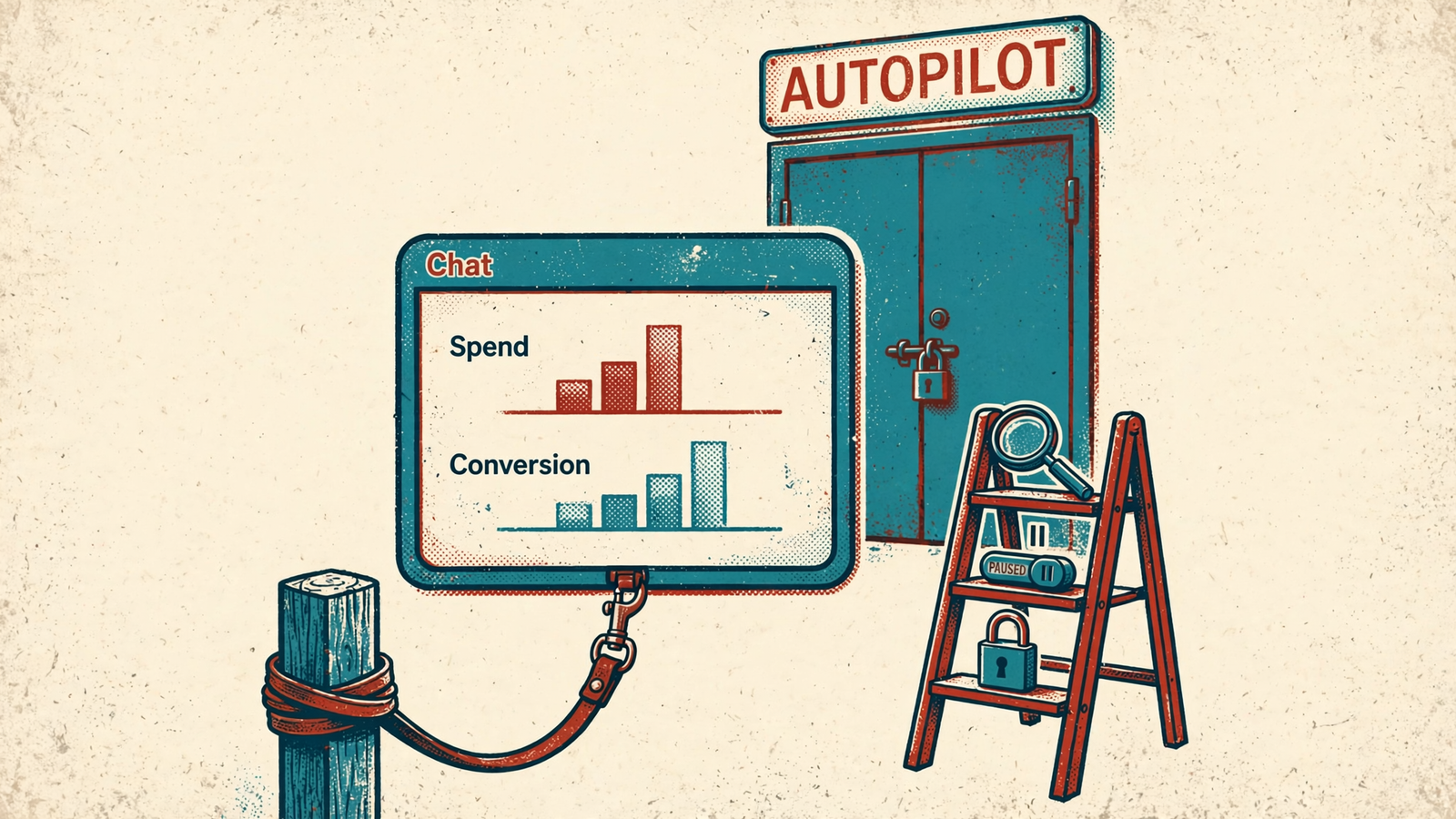
I’d write the ladder before the sale, not while someone is asking why spend is up. One practitioner building on Microsoft’s MCP leaves campaign launches, budget moves, pauses on high-spend campaigns, billing and user permissions out of the agent’s toolset. I’d borrow the instinct: if a change can silently lose money, make a human own the decision. Here’s where I’d draw the lines:
- Propose only. Bid changes, budget moves and new campaigns stay with a human. ChatGPT drafts the change and explains why. I approve it or I don’t.
- Act within a ceiling. Allow a pause on a single named campaign or product group when spend crosses a number I’ve set and conversions stay at zero past the delay window. That permission doesn’t override unresolved tracking or unknown stock. Those go to a person.
- Keep a human in the room. Billing, permissions and any campaign carrying the hero offer during peak hours stay outside that standing permission.
A reversible pause on one campaign is a different bet from moving budget across an account during a stockout. Write separate ladders for Google and Bing. Don’t copy a Google Shopping rule into Bing and assume the auction, conversion delay and inventory overlap will behave the same way. The companion piece on reading live Bing spend against a budget ceiling shows what the pacing side looks like when the evidence comes first.
Leave autopilot off until the exceptions are written
Autopilot is the feature every demo leads with and the one I’d leave off longest. groas keeps it off until you switch it on. Before I do, I want the exceptions written in plain English. If I can’t write them down, I don’t have guardrails. I have a hope with a login.
I’d make the list specific enough to settle an argument mid-sale:
- Allowed actions: Pause one named campaign, lower a single daily cap by a set percentage or flag a product group for review. Name the action, not the objective.
- Budget ceilings: Write the actual number for each action. “Spend less” is a direction, not a ceiling.
- Protected campaigns: Name the hero offer and any promotion you can’t fulfil at volume. Don’t leave ChatGPT to infer which campaigns are off limits.
- Escalation triggers: Zero conversions past the delay window, a change in tracking status or availability marked unknown. Put those in the brief as reasons to get a human involved, not as permission to improvise.
Microsoft’s read-only MCP examples get this part right: flag a drop, check change history, report the anomaly. For that job, flagging the drop is the work, not a failure to finish it. I’d carry the same distinction into an account where the connection can actually make changes.
Every change groas makes is logged with its reason, and you can undo it in one step. Keep that in proportion. Undo restores the setting. It doesn’t hand back the spend, un-send the customer who clicked or clear the refund queue. The log tells me what happened. The ladder limits what can happen while I’m asleep.
Buy the connection that can admit what it can’t see
When I compare Black Friday tools, I want an answer to one question: What happens when availability is unknown? A pitch built around the number of campaign changes tells me how often a tool acts, not whether those actions should have happened. A change count is usage. It isn’t evidence of better CPA or revenue.
groas is my pick for this job because I can read live Bing data through ChatGPT, ask for the smallest reversible change, see the reason for any change that gets made and leave autopilot off until I’ve written the exceptions. The missing stock data stays missing. I’d rather see that in the report than get a confident recommendation from a tool that treats the contents of the ad account as the whole business.
The order is the point. Connect ChatGPT to Bing through groas. Run the reporting brief and make it show timestamps and anomalies. Check conversion delay and UET status before anyone mentions bids. Confirm availability from an authorised source or send the question to someone who can. Only then hand over the intervention ladder, campaign by campaign, with Google kept separate from Bing.
The same discipline applies to retiring bad CPA rules in report-only mode. A stale rule and a stockout can both sit behind a campaign that looks like it’s doing its job. I want ChatGPT quick with the numbers, honest about what’s missing and quiet until it has something worth saying. Give it permission to act before it knows whether you can fulfil the orders, and you haven’t fixed Black Friday. You’ve made it easier to spend the weekend paying for orders you can’t ship.





