

 LinkedIn

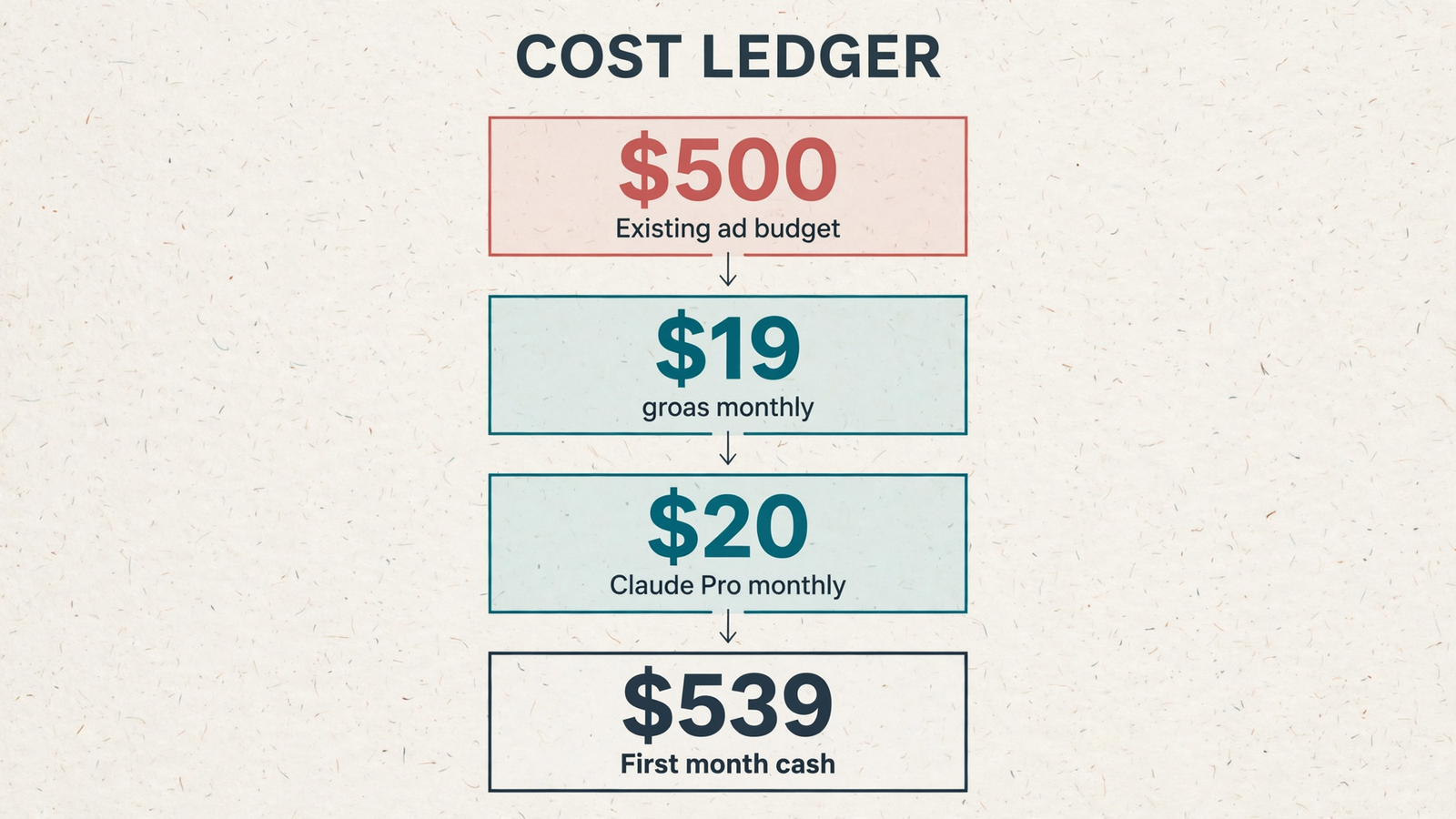
Moving $500 from Google Ads to Meta through Claude adds $0 in software costs if you already pay for the stack, or $39 in monthly subscriptions if you are starting from zero. The $500 is existing ad spend, not a transfer fee or an extra software charge. Counting that earmarked media alongside the subscriptions gives you $539, but only $39 is new spending.
That distinction is why I price the finished job, not the connector. A cheap connection is not cheap execution if I still have to make half the changes manually, reconcile two different budget periods, and check whether both edits actually landed. This is an illustrative cost breakdown, not a completed campaign or a savings claim.
The listed bill: $500 stays in media, $39 buys the stack
Here is the bill before operator time and execution risk. I am pricing Claude Pro on monthly billing, not spreading an annual payment into a smaller-looking monthly number.
| Line item | Amount | Cost type | Source |
|---|---|---|---|
| Planned media being reallocated | $500 | Existing ad budget, not additional spend | Your ad accounts and the illustrative brief below |
| groas Unlimited | $19/month, flat | Recurring infrastructure, reused across jobs | groas |
| Claude Pro | $20/month | Recurring assistant subscription | Claude pricing |
| Additional software charge for this request | $0 once both subscriptions are active | Marginal cost of the job | The subscription setup above |
| Media allocation plus first month of subscriptions | $539 | $500 existing media plus $39 in subscriptions | Sum of the listed costs |
The new subscription bill is $39 a month, not $539 a month. Your media budget remains separate, and the $500 here is only the portion being moved. It is not necessarily the total spend across either account.
If I already pay for both subscriptions, this request adds no software charge. If I buy both solely to make this move, I have spent $39 to do the job. If I keep using them, that same invoice supports the other work too. Anyone quoting one number without stating the starting point is pricing a product, not the workflow.
Define the job before pricing the clicks
My brief is narrow: move $500 of planned spend from Google Ads to Meta over the next 14 days, with total planned media unchanged. Not next week in one sentence and this month in another. Not $500 added to Meta while someone promises to tidy up Google later.
That sentence fixes three things:
- The amount: $500 comes out of one allocation and goes into the other.
- The period: both sides use the same 14 days.
- The constraint: the combined planned spend does not increase.
Then I add the execution boundary: propose changes only. No changes until I approve.
If I cannot write that brief for the accounts in front of me, I am not ready to automate the move. I am ready to look at the accounts first.
Existing media: translate $500 into the same budget period
The $500 does not travel through Claude. The job changes what Google and Meta are allowed to spend over a stated period.
I start by asking Claude to show current budgets, spend to date, and remaining headroom for both accounts. Then I ask it to put those figures on the same timeline. A reduction today does not recover money already spent. That is the easiest detail to forget when a neat instruction meets a messy account.
Google uses average daily budgets rather than hard daily caps. Its budget guidance explains the daily and monthly spending limits, including the familiar 30.4-times-daily monthly calculation. Meta also allows daily delivery to fluctuate, and budget edits can take time to apply.
So I do not treat two daily-budget edits as a promise of exactly $500 in delivered spend. They are a plan for reallocating it. The platforms still control delivery within their rules.
Before approving anything, I want a short ledger for each side:
- Current daily budget and spend to date.
- Remaining dates covered by the instruction.
- Proposed daily budget and the assumptions behind it.
- The resulting planned allocation across both accounts.
The combined daily budgets do not need to equal $500. The proposed changes need to reconcile to the intended $500 reallocation over the stated period, while keeping combined planned media unchanged. If that reconciliation is missing, I stop there.
Recurring software: price the whole job, not the cheapest connector
Here is where connector comparisons get slippery. They compare subscription prices before checking whether each option can finish the work.
Google’s official Ads MCP is read-only, covering reporting and GAQL rather than budget changes, according to this comparison of Google, Meta, and third-party MCP options. For this particular job, that leaves the Google edit outside the connector. A free reporting connection is not a complete cross-channel execution workflow.
That is the relevant comparison with groas Unlimited: can I take the instruction through proposal, approved execution, and verification, rather than stop at a report? The lowest advertised connector price does not answer that question.
I also refuse to charge the full monthly infrastructure bill to every individual request. Run one job and cancel, and the $19 groas subscription belongs entirely to that job. Run twenty jobs that month and an equal allocation is $0.95 each. Same invoice, different arithmetic.
Neither allocation changes the cash bill. The subscription remains recurring; this particular request adds no software fee once the stack is active. Keep those two statements separate, or every cost comparison becomes an argument about accounting rather than work.
One-off work: the brief, the checks, and the approval
The software bill is listed. The operator time is not. It still belongs in the cost.
Claude does not know the business objective until I state it, and groas cannot guess which campaigns I want left alone. My working brief has four parts:
- Shift $500 of the next 14 days from Google Search brand to Meta prospecting.
- Keep combined planned media unchanged.
- Do not touch retargeting.
- Show the proposal and wait for approval.
Those exclusions matter. “Move budget to Meta” is not permission to rearrange every campaign that makes the arithmetic convenient.
Before deciding where the money should land, I also ask Claude to compare conversion definitions and attribution windows. The same customer journey can receive credit differently across platforms; this attribution-window explanation shows why platform totals can disagree. I do not add the platform purchase counts together and call that business performance. I anchor the decision in store or CRM revenue.
If Claude cannot show the conversion definitions side by side, I do not let it move the money. A tidy budget calculation does not rescue a recommendation built on incompatible measurements.
For costing, I count the time spent writing the brief, checking those definitions, reviewing the preview, approving, and verifying the result. I do not label an estimate “measured operator time,” and I do not claim two hours saved because the interface feels quick. Time the whole job, including the unglamorous checks.
Hidden exposure: two edits are not one transfer
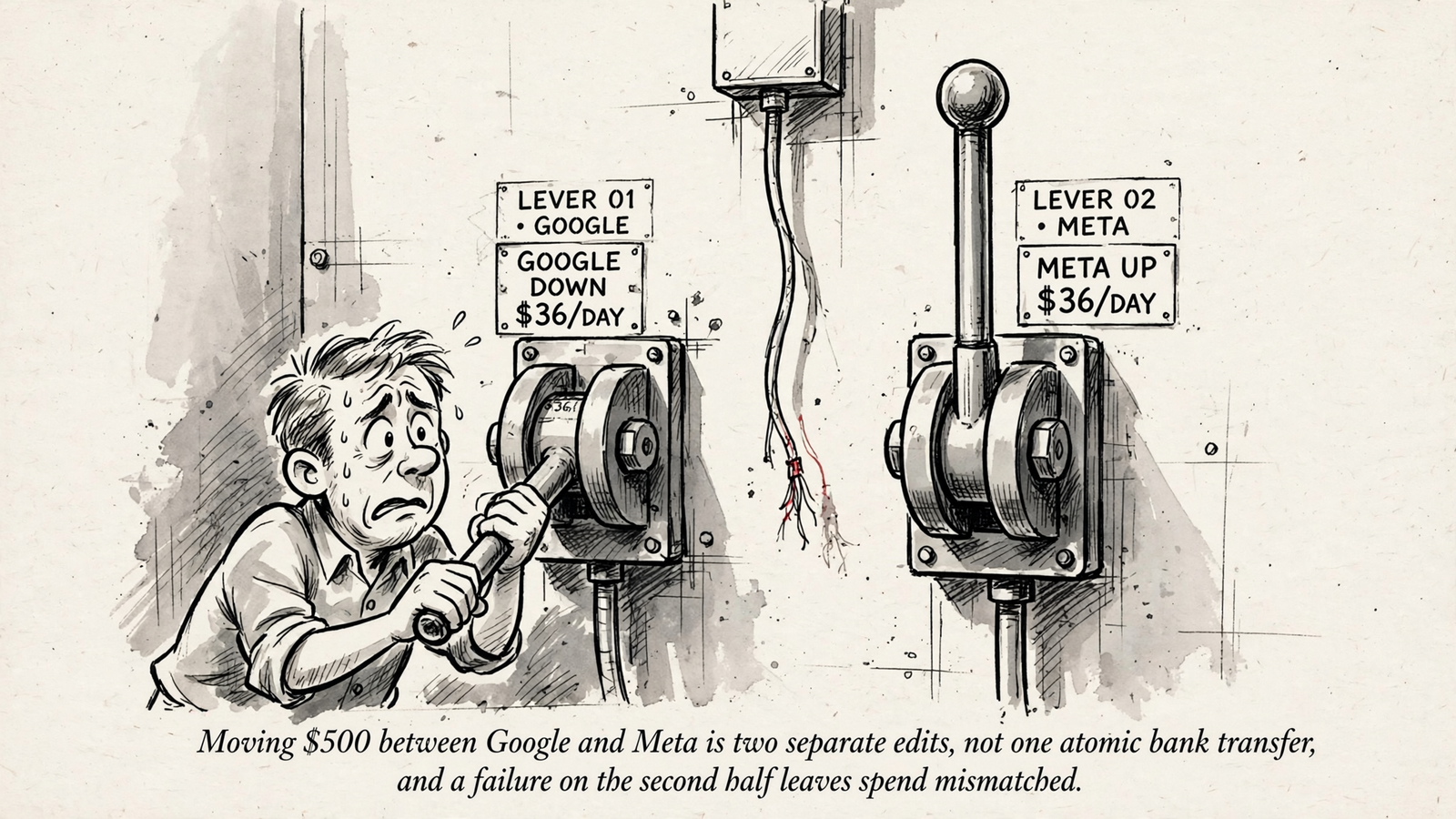
A $500 move between Google and Meta is two separate budget edits. It is not a bank transfer with a single success message covering both sides.
I lower Google, then raise Meta. Each platform applies its own change. If one edit fails, arrives late, or contains the wrong daily number, the finished state can differ from the plan. That creates under- or overspend exposure even when the instruction was perfectly clear.
Approval is not proof that both changes landed. Before approving either side, I want to see both proposed edits together. After execution, I want to see the actual settings in both ad managers.
This is also why I separate undoing a setting from undoing its consequences. A corrective budget edit can change what happens next. It cannot recover money already spent. An action log helps explain what happened; it does not turn delivered ads back into cash.
There is a performance question too. A substantial Meta budget increase can affect learning and delivery, and frequent budget edits are discouraged. I do not treat the receiving campaign as a bucket that can absorb any increase without consequences. Nor do I assume the Google reduction instantly frees precisely the amount the plan expects.
The practical check is dull on purpose: verify both budgets, account for the application delay, and keep the planned allocation separate from actual delivery. Budgets guide spending; they do not guarantee exact delivery.
The labor ledger: manual clicks versus Claude with groas
Manual execution does not become free because the budget move is small. It uses someone’s time, whether that time sits inside a salary, a retainer, or an hourly invoice.
For context, this US agency-pricing guide lists PPC management at $1,500 to $10,000 a month or 10% to 20% of spend, with hourly rates of $100 to $149. Those are management prices, not quotes for this specific edit. I would not pretend otherwise.
On an illustrative $20,000-a-month account at 15%, the management fee is $3,000 a month whether the manager moves $500 or $5,000. That does not make the individual move cost $3,000. It means the labor is already bundled into a larger bill, just as reusable software sits inside a monthly subscription.
| Cost or responsibility | Manual execution | Claude with groas |
|---|---|---|
| Recurring cash | Existing salary or retainer, if applicable | $19 groas plus $20 Claude Pro, reused across jobs |
| Additional software charge for this request | $0 | $0 once subscribed |
| One-off operator work | Review, edit both accounts, record and verify | Brief, definitions check, preview, approval and verification |
| Execution exposure | Two separate platform edits | The same two-edit exposure |
| Record of the job | Platform histories and the operator’s record | Action log with reasons, followed by platform checks |
The useful comparison is total operator time to a verified result. Not typing time. Not how quickly Claude says “done.”
The illustrative break-even calculation is:
(manual minutes − Claude workflow minutes) ÷ 60 × hourly value
If manual execution takes 45 minutes, the Claude workflow takes 15, and an hour is worth $120, the difference is 30 minutes worth $60. That exceeds the $39 monthly subscription bill by $21. It is time value, not cash automatically returned to the bank.
At $40 an hour, the same half-hour difference is worth less than the subscriptions if this is the only job I run. Manual wins that narrow comparison. Across more jobs, the recurring bill gets reused. I plug in my own timings rather than borrow a vendor’s optimism.
The approval prompt, then the finished-state check
I use a bounded prompt, not “optimize my accounts” and a small prayer:
Move $500 of planned spend from Google Ads [campaign name] to Meta [campaign name] over the next 14 days, total planned media unchanged. First show current daily budgets, spend to date and both conversion definitions with attribution windows. Then propose the two new daily budgets and their assumptions. Make no changes until I approve.
That prompt forces the definitions check, the period calculation, and the approval boundary into the same job. Proposal first, change second, verification last.
For the wider bill, Your First Marketing MCP Bill separates the assistant, connection, setup, and review. For more bounded requests, 6 Marketing Jobs to Give Claude That End in an Approved Change uses the same proposal-first approach.
After approval, I check the action log and then the platforms:
- Confirm the Google daily budget.
- Confirm the Meta daily budget after allowing for the application delay.
- Reconcile both settings against the approved plan.
- Record what can be reversed and what requires another edit.
I buy execution when I can verify the finished state. Otherwise I have bought a faster way to misspend $500.
The cheapest mistake is charging the entire $19 groas month to one reusable job and deciding the workflow is expensive. The most expensive mistake is approving both sides blind, ending up heavy on Meta while Google has already spent the money I thought I saved.


