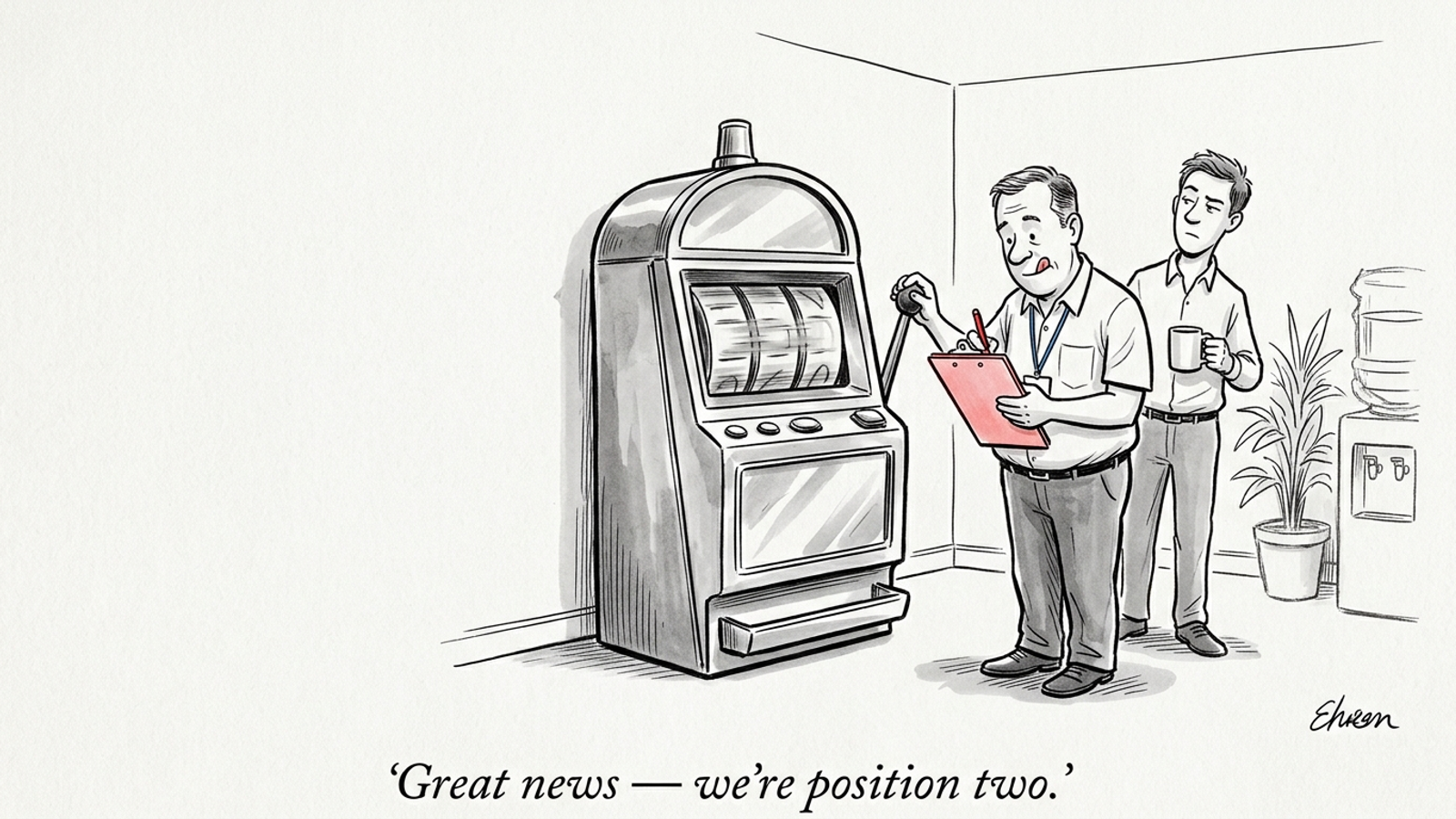
Most Google Ads audits are structurally incapable of diagnosing why your account is underperforming. That is not a soft claim. It is the central argument of this piece, and the reasoning is straightforward: the standard audit model is designed to find surface-level symptoms, package them as findings, and convert you into a paying client. It is a sales tool disguised as a diagnostic tool. A Google Ads audit is a checklist-driven review of an advertising account that typically evaluates quality scores, wasted spend, match types, and ad disapprovals, but almost never examines the structural root causes that actually determine performance. If your Google Ads audit problems keep repeating themselves, or if fixing every finding on the report never moves your numbers, the issue is not execution. The issue is that the audit itself was never built to find what is actually wrong.
This matters whether you are an agency trying to win new clients, an in-house team evaluating your own work, or a founder wondering why three different auditors all found different “critical issues” in the same account.
What Most People Believe About Google Ads Audits
The conventional wisdom goes like this: a Google Ads account audit is worth it because an expert pair of eyes can spot inefficiencies you have missed. Agencies offer free audits because they genuinely want to help. The findings surface real problems. Fixing those problems improves performance. The audit-to-engagement pipeline is a win-win: you get actionable insights, they get a qualified lead.
This view is not entirely wrong. A competent auditor reviewing an account can identify obvious waste. Broad match keywords bleeding budget into irrelevant queries are real. Broken conversion tracking is real. Campaigns running without negative keywords are real. These things exist, and pointing them out has value.
The problem is not that auditors are incompetent. Many of them are quite skilled. The problem is structural. The audit format itself, the way findings are selected and presented, the time constraints, the commercial incentive, all of these shape what gets surfaced. And what gets surfaced is almost always the stuff that looks alarming on a slide deck, not the stuff that actually explains why performance is stuck.
When someone tells you “your account has $14,000 in wasted spend,” that number does real work. It creates urgency. It justifies the engagement. But it rarely tells you whether fixing that waste would move your target metric even a fraction, because waste and root cause are different categories entirely.
The Business Model Behind Free Audits Is Lead Generation, Not Diagnosis
Every free Google Ads audit exists to generate leads. That sentence should not be controversial, but it reframes everything that follows. When the purpose of the exercise is conversion, the incentive is to find problems, not to find the right problems.
An auditor spending 45 minutes on your account is not performing differential diagnosis. They are scanning for the findings most likely to create a reaction. High wasted spend numbers, poor quality scores, low impression share, disapproved ads. These are the items that make a prospect say “we need to fix this.” They are selected for emotional impact, not diagnostic accuracy.
This is why Google Ads grader tools produce scores that do not predict performance. The scoring methodology rewards surface compliance, not structural health. An account with perfect quality scores and a clean negative keyword list can still hemorrhage money if its campaign structure feeds the wrong signals to Smart Bidding. A grader will never catch that.
The audit-to-engagement model is broken by design because the auditor has no access to your business context, your margin data, your customer lifetime value, or your actual conversion quality. Without those inputs, every finding is context-free. And context-free findings lead to context-free recommendations.
Quality Score Is A Symptom, Not A Cause
Almost every Google Ads audit flags low quality scores. It is the easiest finding to present because Google literally assigns a number, and lower numbers look bad. But quality score is a lagging indicator. It reflects relevance signals that are themselves downstream of decisions about account structure, landing page architecture, and keyword-to-ad alignment.
Telling someone their quality score is low is like telling a patient their temperature is high. It confirms something is off. It tells you almost nothing about what. An account can have mediocre quality scores and excellent profitability because the keywords it targets have high commercial intent and strong conversion rates. Another account can have quality scores of 9 and 10 across the board and lose money on every click because the landing page converts at 0.4%.
The audit fixation on quality score is a direct consequence of the format. Quality score is visible, numeric, and easy to benchmark. Root causes like “your campaign structure trains the algorithm on the wrong conversion actions” are not visible in the interface and require actual investigation to surface.
Wasted Spend Reports Ignore Structural Root Causes
“You wasted $22,000 last quarter on irrelevant search terms.” This is the auditor’s strongest card, and it is almost always misleading.
Yes, irrelevant queries consume budget. Yes, a healthy negative keyword system matters. But the wasted spend number in an audit is typically calculated by pulling the search terms report, flagging every term that did not convert, and summing the spend. That methodology treats every non-converting click as waste, which ignores how learning phases work, how Smart Bidding explores, and how multi-touch attribution distributes credit.
More importantly, wasted spend is usually a symptom of structural misalignment, not a standalone problem. If your campaign structure forces broad match keywords to compete across intents, you will always generate irrelevant queries no matter how aggressively you add negatives. The root cause is structure. The wasted spend is just where the structural problem shows up in the numbers.
Fixing the symptom (adding negatives) without fixing the structure (rebuilding campaign segmentation around intent) produces a temporary improvement followed by a return to the same pattern. This is why signs your Google Ads agency is not delivering often include a cycle of “we cleaned up the account” followed by the same problems three months later.
Match Type Red Flags And Impression Share Gaps Miss The Real Issue
Audits love to flag broad match keywords as a problem. Sometimes they are. But in accounts using Smart Bidding with sufficient conversion data, broad match is often the correct choice because it gives the algorithm room to find high-intent queries the auditor would never think to target. Flagging broad match as inherently wasteful reveals a misunderstanding of how modern Google Ads bidding works.
Similarly, impression share gaps appear in nearly every audit. “You are only capturing 34% of available impressions.” That sounds alarming until you understand that impression share includes every possible auction, including ones where the click would have been unprofitable. Bidding for 100% impression share on a head term with mixed intent is not ambitious. It is reckless. Without context on market size, competitive density, and your margin per conversion, impression share is a meaningless metric.
Disapproved ads that were already paused round out the classic audit padding. They look like findings. They fill slides. They change nothing about performance.
What A Useful Performance Diagnosis Actually Examines
If audits focus on the wrong things, what does a real diagnosis look like? It starts with the things most audits never touch.
Conversion Tracking Integrity
The single most impactful question in any Google Ads account is: are you measuring what you think you are measuring? A broken or misconfigured conversion setup does not just give you bad data. It trains the algorithm on the wrong signals. Every automated bid, every audience expansion, every Performance Max asset group optimizes toward what you told it was a conversion. If that definition is wrong, the machine gets better and better at producing the wrong outcome.
Bidding Strategy Fit For Current Conversion Volume
Most accounts are on the wrong bidding strategy for their current volume. Target ROAS with 8 conversions per month does not give the algorithm enough signal to optimize. But audits rarely check whether the bidding strategy matches the conversion volume reality because that requires understanding how the learning phase actually works, not just reading a dashboard.
What The Algorithm Has Actually Been Trained On
This is the diagnostic layer no standard audit reaches. Every Smart Bidding strategy builds a model based on historical conversion data. If your account spent six months optimizing for the wrong conversion action, or if a Performance Max campaign cannibalized your search campaigns and muddied the signal, the algorithm’s learned model is corrupted. No amount of negative keyword cleanup fixes a corrupted learning history. Sometimes the right answer is a full rebuild.
Why Fixing Audit Findings Rarely Moves Performance
The difference between an issue and a root cause is the difference between a tactical fix and a strategic realignment. Issues are surface-level: a keyword that should be paused, an ad that needs a new headline, a bid cap that is too aggressive. Root causes are structural: a campaign architecture that sends mixed signals to the algorithm, a conversion setup that rewards the wrong user actions, a ROAS target that crushes volume before scale becomes possible.
Most audit-to-engagement handoffs fail because the engagement begins by fixing the issues from the audit rather than diagnosing root causes from scratch. The new agency or freelancer spends the first 30 days implementing the audit recommendations, sees modest improvement, then hits the same ceiling the previous manager hit, because the ceiling was never about the findings. It was about the structure underneath.
This is why the middle ground between agency and in-house management often fails. Neither approach forces a structural reckoning. Both default to tactical adjustments because tactical adjustments are easier to execute and easier to report on.
How groas Eliminates The Audit Cycle Entirely
The audit cycle exists because the traditional management model is reactive. A human reviews an account periodically, spots problems, makes changes, and waits to see what happens. When results stall, someone requests another audit. The cycle repeats.
groas replaces this cycle with continuous, autonomous execution. The proprietary engine, trained on over $500 billion in profitable ad spend, does not audit your account once and hand you a report. It runs your account around the clock, adjusting bids, testing creative, refining audiences, and optimizing structure in real time.
For businesses that want Google Ads fully handled, groas operates as a fully managed service where a dedicated senior strategist owns your entire account. That strategist does not hand you findings. They own outcomes. If the account structure needs to be rebuilt, they rebuild it. If landing pages are the bottleneck, groas builds new ones. If the conversion setup is corrupted, they fix it before it costs you another month of misdirected spend.
For in-house teams that want to stay in control, the DWY model pairs the engine with a senior strategist who works alongside your team. You keep the driver’s seat. You get the diagnostic depth and execution power that no periodic audit can match.
For agencies managing client accounts, the DIY model gives your media buyers direct access to the groas engine so they can run client accounts with superhuman execution underneath, without adding headcount.
In every case, the model is month-to-month. No onboarding fees. No lock-in contracts. groas earns the next month by performing, not by packaging findings into a compelling deck.
Manual management models are structurally limited by what one person can physically get through in a week. An engine trained on hundreds of billions in ad spend, paired with a senior strategist who owns strategy, does not have that ceiling.
What To Do Instead Of Requesting Another Audit
If you are considering a Google Ads audit, ask yourself five questions first. These surface more about your performance ceiling than any audit will.
- What conversion actions is your bidding strategy optimizing toward, and are those the actions that actually generate revenue?
- How many conversions per campaign per month are you generating, and is that above the minimum threshold for your bidding strategy to exit the learning phase?
- Has your account structure changed significantly in the last 90 days, and if so, did the algorithm have time to relearn before you evaluated results?
- Are you measuring performance on the attribution model your bidding strategy uses, or on a different one?
- If you removed every campaign that is not profitable on a standalone basis, would the remaining campaigns have enough volume for Smart Bidding to function?
If you cannot answer all five with confidence, you do not need an audit. You need a partner who can answer them for you and act on the answers. That is the difference between a report and a result.
Google Ads audits are not worth the paper (or the PDF) they are printed on when the goal is genuine performance improvement. They find what is easy to find, recommend what is easy to fix, and leave the structural problems untouched because structural problems do not fit on a slide.
Stop auditing. Start fixing. If you want groas to own Google Ads end-to-end, including the structural diagnosis that audits skip, apply for DFY and let the team figure out the right plan on a call. If you have an in-house team and want the engine plus a strategist alongside you, get started with DWY. If you are an agency ready to scale client accounts without adding headcount, start your 7-day free trial of the DIY product. The audit cycle ends when continuous execution begins.