

 LinkedIn

For marketers preparing next season in ChatGPT, the Windsor.ai versus groas MCP decision comes down to what happens after the plan. I would choose groas for approved seasonal execution, not just a document someone still has to launch.
That is not a read-only-versus-write-access comparison. Windsor supports write actions, including pauses, enables, budget changes and campaign creation. groas connects ChatGPT to Google, Meta, Bing and ChatGPT Ads, adds competitor evidence, and logs changes with one-step reversal. Both can move beyond analysis. The difference is how much of the seasonal job stays together: evidence, approval, execution and revision.
I judge them on four things: what ChatGPT can read, what approval can launch, how clearly preparation stays separate from spending, and what happens when the offer changes. Windsor can be enough for an analysis-led brief. For the person responsible for getting approved work live and taking it back cleanly, groas wins.
The brief: six weeks to peak, no permission to launch
Say you are spending $20k a month and peak hits in six weeks. I would start either connection with the same instruction:
Review the connected accounts for seasonal preparation. Separate observations, proposed changes and missing evidence. Make no changes.
That wording matters. It asks ChatGPT to distinguish what it read from what it recommends and what it still needs to know. A confident paragraph is not evidence, and a useful suggestion is not permission to spend.
Seasonal planning guidance recommends starting four to six weeks before peak and ramping budgets in steps. The useful point here is the runway: leave time to review the plan before the launch becomes urgent. I want budget dates, proposed pauses, new copy and promo campaigns laid out while there is still room to say no.
The first test is not whether ChatGPT produces an impressive plan. It is whether the workflow respects “prepare this” and “launch this” as different instructions. Keep that boundary in place through every round below.
Round 1: account history versus account history plus market context
Windsor.ai: performance data for the planning conversation
Windsor’s starting point is moving marketing data into BI tools, spreadsheets and AI chats. Its Basic pricing starts at $23 per month on monthly billing, or $19 per month billed annually, for three sources.
That reporting heritage is useful in seasonal prep. ChatGPT gets prior performance to reason about, rather than asking you to paste another export into the conversation. For a brief centered on your connected data, that is a sensible starting point.
Windsor has also moved beyond reporting. Its write-capabilities page documents pauses, enables, budget changes, and new campaigns and ads through AI tools including ChatGPT. Its MCP setup guidance covers enabling and pausing Google Ads and Facebook Ads campaigns. I would not describe that as a reporting pipe with no hands.
But account performance is only part of the seasonal brief. It tells me what happened in my accounts. I also want to know what offers those accounts will compete against next.
groas MCP: the accounts and the market around them
Through groas, ChatGPT can read your accounts alongside competitor ads on Google and Meta, their hooks and offers, landing pages and funnels, Reddit customer language, AI answers, and SEO data from Semrush and Ahrefs. That data is collected around the clock.
This is the work that otherwise spreads across browser tabs: an ad library here, a rival landing page there, search terms somewhere behind both. The tedious part is not opening the tabs. It is bringing the evidence back into the decision.
When last season’s CPA and current rival offers sit in the same planning conversation, ChatGPT has more to work with than historical performance alone. I can ask it to separate a proposed budget change from an offer problem instead of treating every disappointing number as a bidding problem.
groas wins the evidence round because the market context comes with the connection. For seasonal prep, I want the plan to account for what I am walking into, not just what I spent last time.
Round 2: what approval actually gets live
I would ask both setups for the same proposed output:
- Revised budgets with dates.
- Campaigns proposed for pausing.
- New keywords and fresh ad copy.
- A separate promo campaign that can be paused and reused.
- Missing evidence that needs review before launch.
Then I would stop admiring the answer and count the remaining work. Which items can become account changes? Which need another tool or a manual build? Which are deliberately parked for review?
On the Windsor route, new Google and Meta campaigns and ads start paused, and write calls require confirmation in chat. Budgets, pauses and enables are available too. That is real execution, not a list of suggestions masquerading as account management.
Starting a build paused is not a flaw. It is a review boundary. But it does mean a finished build and a live campaign are different milestones, and I would keep both visible in the seasonal checklist. “Created” is not the same as “launched.”

On the groas route, approved instructions can become changes to bids, budgets, keywords, ads and campaigns across Google, Bing, Meta and ChatGPT Ads in the same chat. The MCP connection exposes account actions and records every change with its reason and a one-step undo.
That is why I prefer groas for the broader seasonal brief. The same connection brings in the rival offers, supports the approved account work, and keeps the change record. I am not choosing it because Windsor cannot touch an account. I am choosing it because more of the job stays in one workflow.
My definition of ready is blunt: the plan distinguishes proposed work, approved work, paused builds and live changes. If those states are blurred, the document is ahead of the account. Count the unfinished transitions, not the paragraphs ChatGPT produced.
Round 3: permission needs a scope, not just a yes
Execution access only helps when launch boundaries are explicit. “Get us ready for peak” is a brief. It is not a useful spending authorization.
Before approving anything, I want ChatGPT to show:
- The account and campaign affected.
- The exact proposed change.
- The budget implication.
- The intended date.
- What must remain paused or untouched.
Both routes put a confirmation step between conversation and action. Windsor requires confirmation for write calls, and AI-built Google and Meta campaigns and ads start paused. In the groas ChatGPT connection, ChatGPT asks for confirmation before each change.
Confirmation is the gate; scope tells me what I am opening it for. A yes to reviewing new copy should not get bundled with a yes to raising spend. A yes to building a promo campaign should not quietly become permission to launch it.
The difference is the work that approval can authorize. Windsor covers documented budget moves, pauses, enables and builds. groas supports the wider set of account actions across the four ad platforms, alongside the market evidence used to propose them.
That makes groas more useful for my stated reader: the person who owns the approved seasonal rollout. It also makes clear instructions more important, not less. Access to more actions is not an argument for handing over a vaguer brief.
I would put the limits in writing before the first approval: these accounts, these campaigns, these dates, these budget caps. Everything else stays out of scope. Buy execution access for the work you intend to approve, not as permission to stop paying attention.
Round 4: when the offer changes, can I unwind the work?
Seasonal plans do not stay tidy. The offer changes, margin moves, a supplier misses, and half the approved list is suddenly wrong. At that point, I care less about the original recommendation than about seeing what went live and taking back the right parts.
For Google Ads work, Google’s change history keeps two years of changes and supports undo for most change types within the last 30 days; bulk undo reverts the changes in a row together. That gives the Windsor workflow a platform-level place to inspect and reverse eligible changes.
The work is connecting those rows back to the seasonal decision. Which budget increase belonged to the promo? Which pause was unrelated? Which useful change should survive the cancellation? A history of account activity is useful, but I still need the reason behind it.
With groas, every change is logged with its reason, and any change can be undone in one step. The action and its rationale stay together. That is a stronger fit for a plan expected to change after approval.
The instruction I want to give is specific: pause the promo campaign, restore the previous budgets, keep the new negatives that are working. I do not want “undo the season” to mean erasing every useful adjustment made along the way.
groas wins this round on the connection between action, reason and reversal. For seasonal work, judge the tool by how cleanly you can revise the launch, not just how quickly you can approve it.
The side-by-side: count work left after the plan
| Decision | Windsor.ai in ChatGPT | groas MCP in ChatGPT |
|---|---|---|
| Evidence for the plan | Connected marketing performance data; competitor research remains a separate part of this workflow | Account data plus continuously collected competitor ads, funnels, Reddit language, AI answers and SEO data |
| Approved execution | Pauses, enables, budget changes and campaign/ad builds; new Google and Meta builds start paused | Bids, budgets, keywords, ads and campaigns across Google, Bing, Meta and ChatGPT Ads |
| Launch boundary | Chat confirmation for write calls; paused AI-built campaigns and ads | Confirmation before each change in ChatGPT; explicit scope still matters |
| Revision and reversal | Google Ads history provides platform-level review and eligible undo | Changes logged with reasons and one-step undo |
| Entry price | Basic: $23 monthly, or $19 per month billed annually, for three sources | $19 monthly, flat, for unlimited teammates, accounts and websites |
Windsor’s execution lane matters. Pause, enable and budget changes are available on every Windsor plan with MCP included, so those seasonal tasks do not automatically require another tool.
Still, groas is the better fit for the complete job this comparison starts with: use account and market evidence to prepare the season, turn approved work into changes, then revise those changes when the offer moves. The unit of value is completed, reviewable work—not access to a longer answer.
Verdict: groas for the rollout, Windsor for an analysis-only brief
If I own seasonal spend and someone has to launch the approved list, I choose groas. It brings the accounts and rival offers into the conversation, supports execution across four ad platforms, and leaves a reasoned change log with one-step reversal. That covers the job I am buying for: prepare, approve, launch, revise.
Pick Windsor anyway if the brief stops at analysis. An analyst with sources already flowing through Windsor, whose job is to hand over findings rather than own the rollout, has a narrower need. Windsor can serve that brief and support its documented write actions without pretending the analyst has become responsible for the whole launch.
But that is not my recommendation for the seasonal operator. If I am accountable for getting the work live, I want groas’s execution, evidence and reversal in the same workflow. I make the same distinction in connecting ChatGPT to Bing Ads: analysis access and approved account work are different purchases.
I would run the first week in three steps:
- Read only. Ask for observations, proposed changes and missing evidence. Make no changes.
- Define the boundaries. Name the accounts and campaigns in scope, budget caps, dates and anything that must stay paused.
- Approve individual changes. Review the action and its spending implication before confirming it. Keep unrelated decisions separate.
Small approvals take longer to type than “do all of it.” They also make it much clearer what I agreed to when the plan needs revising.
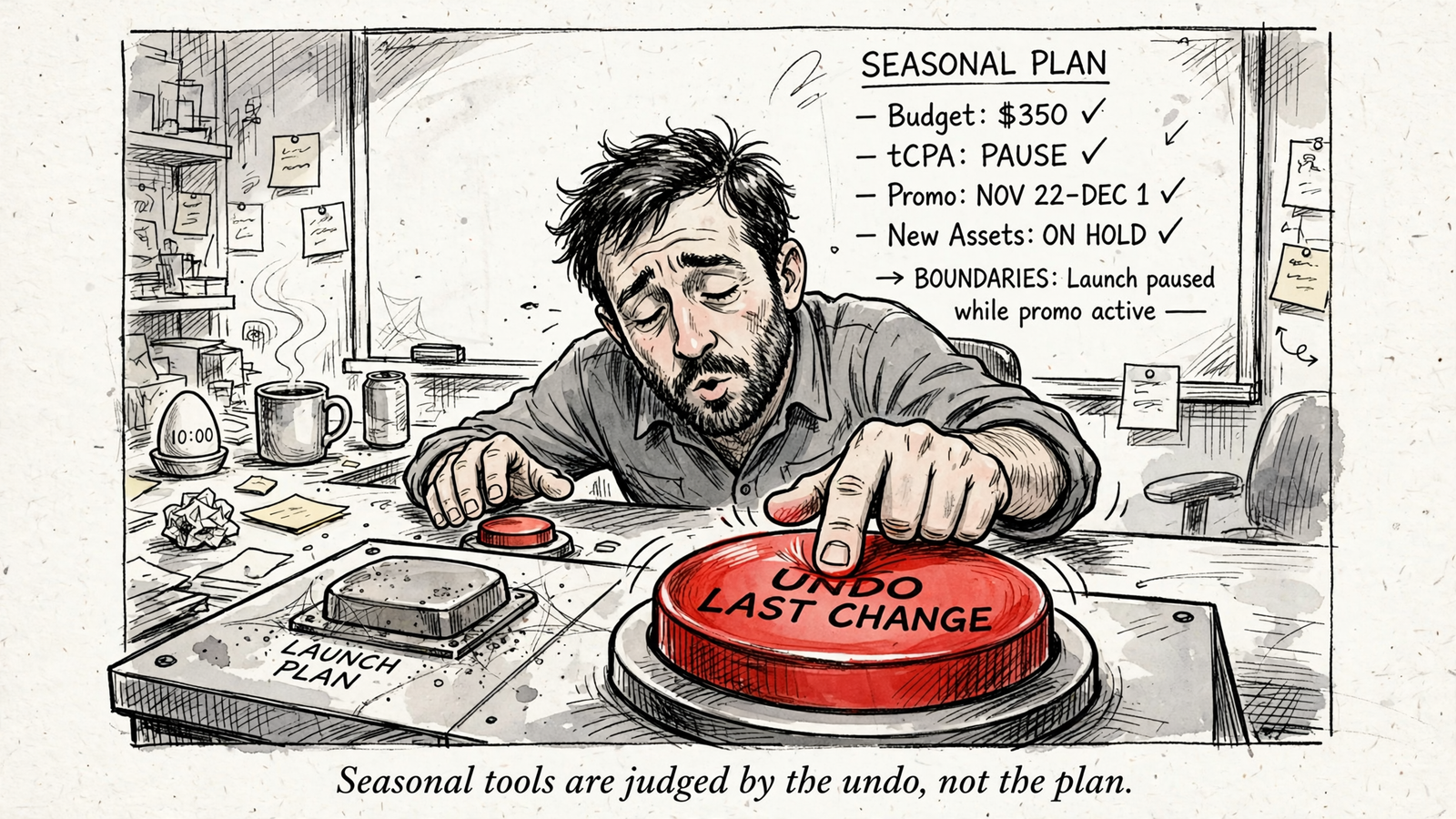
Next season’s plan can look great in either setup. Both can act, but I choose groas for the person who has to carry the plan through launch and revision. If the job ends when the document is done, the data-in route can be enough. If the job ends when CPA holds through peak, buy the connection that puts approved changes, rival evidence and one-step reversal together.
The chat writes the plan. Someone still has to own the launch. That should be me, in plain English, with limits attached.


