

 LinkedIn

A brand can appear in an AI answer while a rival gets the recommendation. A mention, a linked citation, and an actual recommendation are three different observations; one rising visibility score can hide the difference. I use the checklist below when setting up tracking in Claude, with groas supplying the captured answers. Work through the ten checks in order, keep the underlying evidence, and do not let “recommended” become a label nobody can explain.
Before you start: connect the evidence, not a promise
- Connect groas to Claude: Claude reads the tracked answers, compares them, and drafts proposed fixes; groas supplies the collected answers and citations underneath that work.
- Confirm what is connected before asking for a report. Claude does not watch AI answers on its own; groas collects the evidence around the clock and supplies your account and website data when you connect them.
- Check the buying terms: groas Unlimited is $19 a month, flat, for a whole team with unlimited accounts and websites; there is no free plan.
- Set the expectation correctly: no tool can guarantee that ChatGPT will recommend or cite the business. The purchase is inspectable evidence of tracked answers, not a promise of placement.
Check 1: Make sure the tracker means the right business
- Give Claude the exact brand name, domain, legal name, and core product names before approving any prompts; save that identification alongside the tracking setup.
- List lookalike names and the businesses buyers confuse with yours. Common mistake: assuming “everyone knows who we are.” An answer about a different Acme is not a win for this Acme.
- Ask Claude to confirm which business the setup refers to, using the domain and products rather than the brand name alone; correct any ambiguity before collection begins.
- Keep that confirmation available when reviewing results, so a familiar-looking name does not slip into the report without anyone checking whether it belongs to the right business.
- Flag answers whose identity remains unclear rather than counting them as positive results; a matching name is not enough when the surrounding description points to another business.
Check 2: Separate discovery questions from branded questions
- Ask Claude: “Suggest 5 to 10 questions a buyer would ask before choosing us. Separate branded questions from unbranded ones, and wait for approval.”
- Use branded prompts to check how the business is framed when its name is already in the question; use unbranded prompts to check whether it appears without that help.
- Approve the exact wording before tracking starts, and keep the two groups separate in reporting. Common mistake: tracking only “tell me about [Brand]” and calling the resulting mention rate discovery.
- Keep the distinction visible: in one sample of 5,519 answers, small brands appeared in 99% of branded answers but only 20% of non-branded answers. Blending the groups hides that gap.
- Label the purpose of each approved prompt: checking the description of a known brand is useful, but it does not answer the same question as checking whether buyers discover it.
Check 3: Save the conditions behind every result
- Save the exact prompt, answering assistant, capture date, and available location or language context for every answer. Write “unknown” where groas has no signal rather than leaving an unexplained blank.
- Keep the assistant that produced the answer distinct from Claude’s role in reviewing it; a ChatGPT answer analyzed in Claude is still a ChatGPT result.
- Show how many answers sit behind every percentage. A result without its denominator makes a small sample look just as settled as a much larger one.
- Preserve changes in collection conditions alongside the results. Common mistake: comparing March’s approved prompts with April’s paraphrases and presenting the difference as a change in visibility.
- Require the report to answer three plain questions before accepting a comparison: what was asked, which assistant answered, and when was the answer captured?
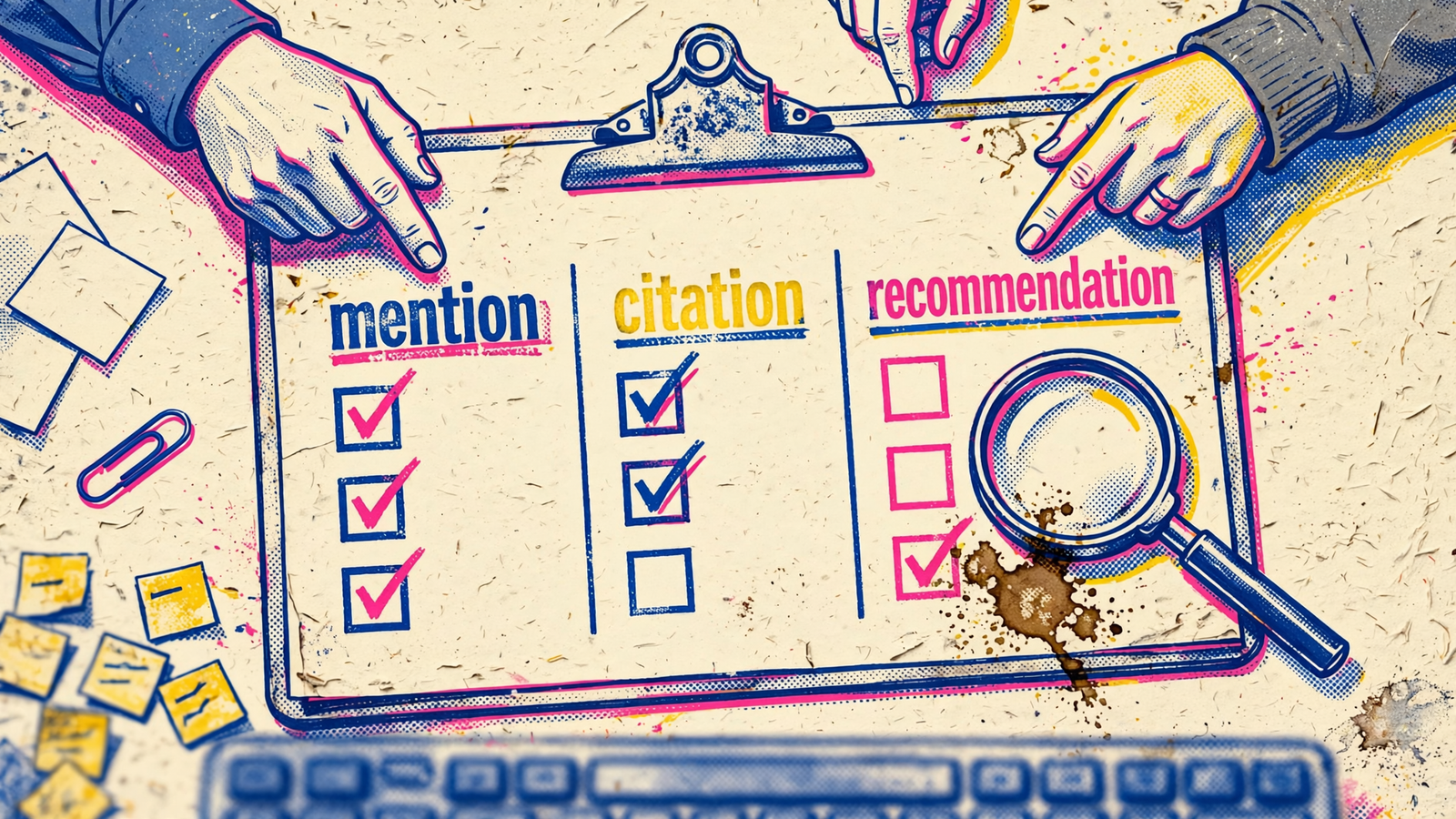
Check 4: Keep the answer, not just its score
- Keep the full captured answer behind every result. A summary is not a substitute: the original text contains the wording needed to challenge a label later.
- Retain the passage naming the brand, the sentence favoring a rival, and the links supplied with the answer; do not save only the flattering excerpt.
- Store the answer somewhere it can be reopened next month. If Claude presents a number with no answer attached, mark the result as failing this check.
- For a manual baseline, run each prompt three times in fresh chats and keep the wording fixed; save each response rather than replacing the earlier one with the latest.
- Use Does ChatGPT Recommend Your Business? Run This 3-Pass Check for the fuller version of that routine. The useful habit is preserving evidence, not collecting screenshots nobody reopens.
Check 5: Record mentions and recommendations separately
- Mark whether the brand is mentioned in each answer, then record whether the answer recommends it; keep the citation field separate for Check 6.
- Define a mention as the brand being named in the text, and a recommendation as the answer favoring it as a fit for the buyer’s stated needs.
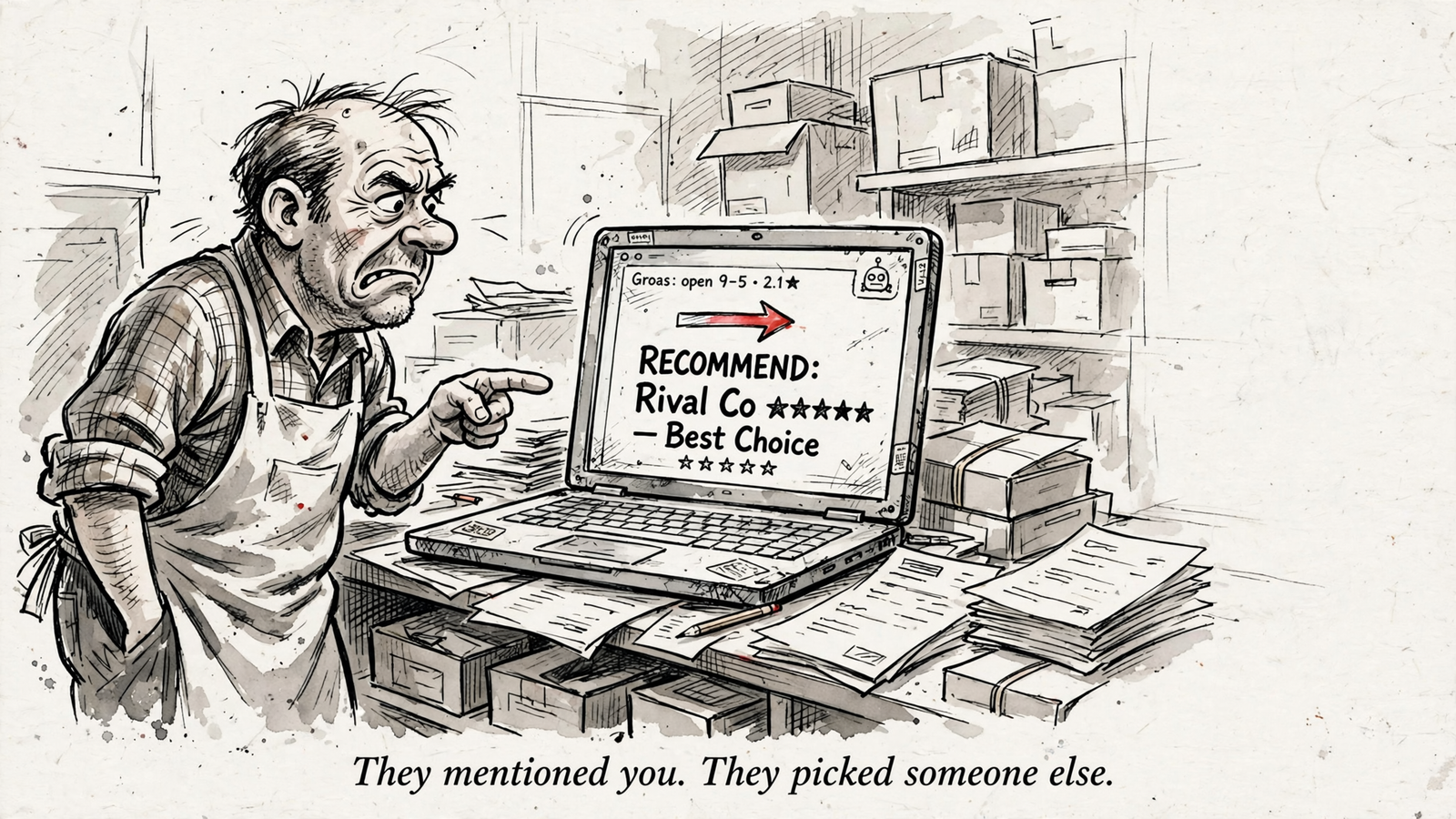
- Require the supporting quote for every recommendation label. Common mistake: treating any appearance of the brand name as an endorsement, including an answer that ultimately recommends someone else.
- Look for a stated reason for fit, such as price, rating, or use case; a recommendation needs more than a name appearing in the answer.
- Mark ambiguous cases explicitly instead of forcing a positive label. These are separate observations, not interchangeable signals; if Claude cannot quote the recommendation, it does not count as one.
- Keep any condition attached to the recommendation in the supporting quote; “a fit for this use case” should not become “the recommended brand” after the report drops the qualification.
Check 6: Give citations their own field
- Record the citation URLs and destination pages supplied with each captured answer; do not infer a link from an unlinked brand name or a remembered source.
- Separate links to the business’s own domain from links to third-party pages discussing it, while preserving the other cited sources needed to understand the answer.
- Keep the four possibilities visible: mentioned and cited, mentioned but not cited, cited but not mentioned, and neither; Citino’s breakdown makes the distinction concrete.
- Treat citation changes separately from recommendation changes: mentions and citations move through different pipelines, so the evidence may point to different fixes.
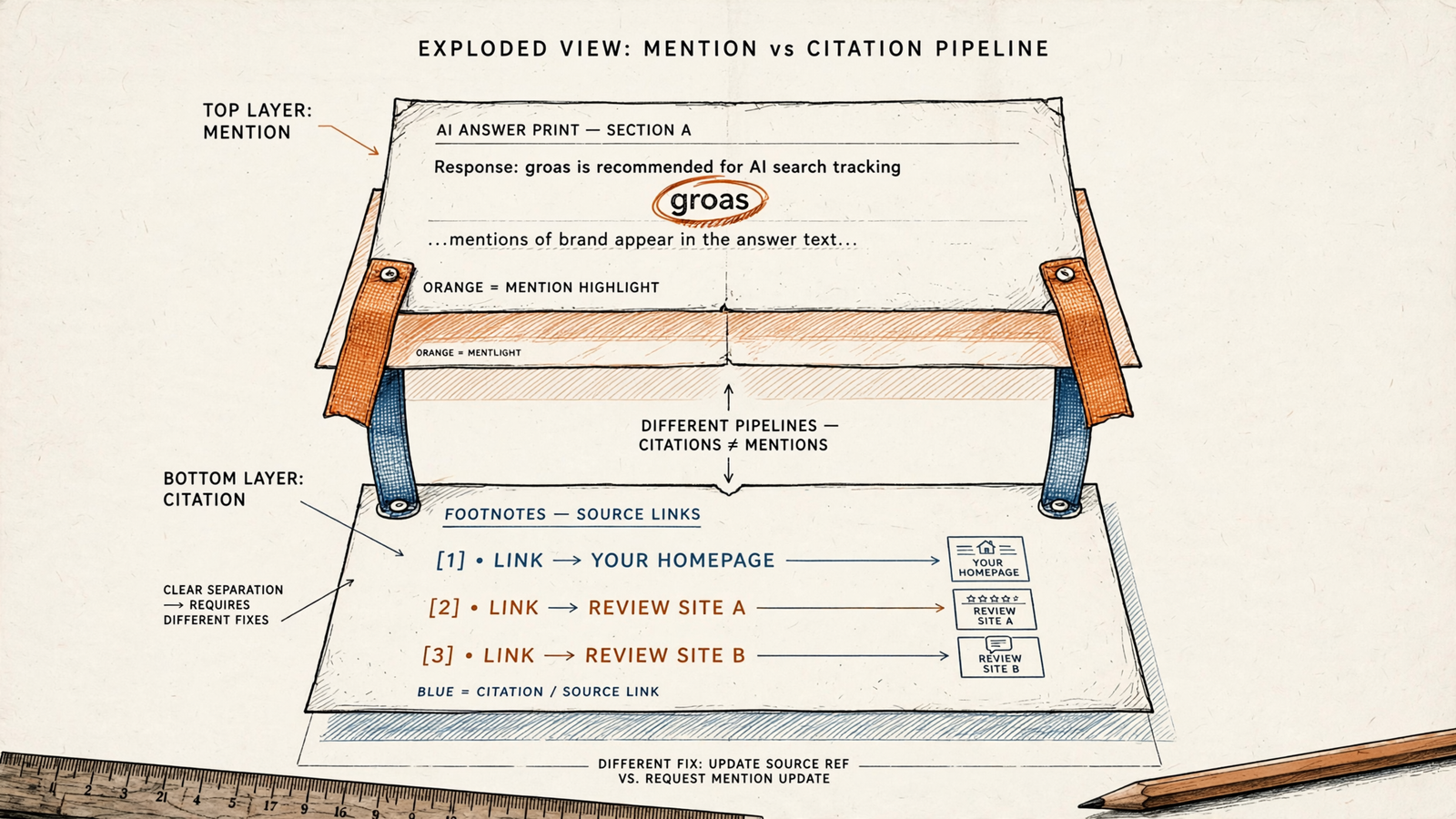
- Do not count a citation as a recommendation. Common mistake: celebrating a link to the pricing page while ignoring the sentence recommending a rival. A citation is a link, not a compliment.
Check 7: Identify who gets the recommendation instead
- List the competing brands named in each captured answer, then distinguish those merely mentioned from those actually recommended; apply the same standard used for the tracked brand.
- Attach the quoted recommendation and the sources cited alongside it. Keep the record tied to that answer rather than assembling a rival list from unrelated runs.
- Reject any rival recommendation Claude cannot quote from the saved answer. Common mistake: allowing a plausible competitor from memory to become part of the evidence.
- Keep the useful unit intact: this prompt, this answer, these rivals, these links. The buyer receives an answer, not the tracker’s average across a month.
- Use that record when considering a missing comparison page, weaker third-party coverage, or a pricing page the model cannot parse; the proposed fix should point back to the evidence that prompted it.
- Keep the observation separate from the proposed explanation: record what the answer recommends first, then identify which potential fix deserves investigation rather than treating it as a proven cause.
Check 8: Show results by assistant before showing a total
- Keep results for ChatGPT, Perplexity, Gemini, and Google AI Overviews identifiable wherever they are tracked; mark unavailable coverage rather than treating it as a measured absence.
- Show each assistant’s results before presenting a blended number. Common mistake: reporting a rising overall line while one assistant still never names the business.
- Keep the prompt and answer counts visible within each assistant’s results, so the reader can see which observations contribute to the headline rather than guessing what it contains.
- Do not treat assistants as interchangeable: they search and cite differently. A combined score can conceal where the brand is appearing and where it is still absent.
- Make every part of a combined report inspectable: assistant, approved prompt, captured answer, mention field, recommendation field, and citation URLs. If the parts disappear, the headline fails this check.
Check 9: Repeat the same test before calling it a trend
- Repeat the approved prompts at a fixed cadence, with the same wording and assistants. Common mistake: seeing a rival once and rewriting the website that afternoon.
- Preserve each run, including answers that disagree with the previous result; changing outputs are part of the record, not inconvenient duplicates to clean away.
- Treat the visibility score as a sample, not a ranking. It moves when the sample moves, so a single answer is not a trend.
- Expect variation: in one test of 2,961 runs, fewer than 1 in 100 repeats returned the same brand list. Keep that variability visible when comparing periods.
- Compare like with like across weeks, preserving changes in collection conditions; do not silently swap the prompt set and keep drawing the same line on the chart.
- Label a revised prompt set clearly, so the next report distinguishes a changed test from a changed answer; keep the earlier runs available instead of overwriting the baseline.
- Run the pass-or-fail test: can the report trace a label through its quote to the full answer, exact prompt, assistant, date, citations, and repeat runs? If not, I would not trust the chart yet.
Check 10: Approve the action separately from the tracking
- Ask Claude for one content proposal tied to one specific captured answer, with the supporting passage quoted; request a proposal, not an instruction to publish it.
- Check that the proposed fix addresses what the answer actually shows, rather than treating every missing mention, absent citation, and rival recommendation as the same problem.
- Set scope and approval rules before enabling website autopilot. With groas, it stays off until switched on; every change is logged with its reason and can be undone in one step.
- Use this starter prompt once groas is connected: “Here is my brand and domain. Propose 8 buyer prompts, half branded and half unbranded, and wait for my approval. For each tracked answer, retain the exact prompt, answering assistant, date, available location or language context, and full text. Record mentions and recommendations separately, with supporting quotes; log citation URLs and rivals from that same answer. Mark unknowns and ambiguous labels. Keep results separate by assistant. Do not publish changes.”
- Require one proposal, the answer it comes from, and explicit sign-off before deciding whether autopilot earns a wider brief; tracking permission is not publishing permission.
- Keep tracking from rolling straight into publishing. This is the most often skipped item, and it costs the baseline the checklist is meant to protect: once pages change without a clear record and approval boundary, the next score movement becomes harder to trace. A rising chart is not worth losing the explanation.


