
The AI-Search Glossary: What AEO, GEO, Citations, and Visibility Actually Mean
A practitioner's glossary of AEO, GEO, prompt tracking, AI citations, and brand visibility—and the sales-deck spin that blurs them.
September 24, 2026
•
min read



I keep hearing the same five AEO questions from agency owners. Most answers blur the distinction that matters: watching a client disappear from AI answers is not the same as doing the work to get them cited.
Almost everything sold as AEO software falls into one of two buckets. The first watches. It tracks prompts across ChatGPT, Perplexity, and Gemini, checks whether your client gets cited, and sends you a chart. The second does the work: publishes content, addresses technical gaps that keep crawlers from reading the site, and pursues the third-party mentions that can give an answer a reason to cite the client.
Both can be useful. They just belong on different lines of your staffing plan. Ask which bucket you are buying before you ask what it costs.
I made this mistake with early PPC automation. I bought dashboards that flagged wasted spend and called it management, while my team still did the 1am negative-keyword mining. The software found the chore. We did the chore. If an agency sells clients execution, a better list of chores does not replace the people who carry them out.
That is the distinction I would put in front of any AEO vendor. Can it show what it published, what it fixed, and what third-party references it secured? Or does it show where the client stands and recommend what your writer and developer should do next? The second answer may be worth paying for, but I would not budget for it as labor I no longer need. If the software does not do the work inside your retainer workflow, you are buying reporting and staffing execution yourself.
I push back on the first half of this question because white-label too often means a logo on a PDF. A logo does not save you hours. What matters is who actually touches the account, who speaks to the client, and whether your team can show work without rebuilding the vendor’s report into something presentable.
The agency setup I want is straightforward: connect the client’s ad accounts and website, choose paid or organic search for that client, and get delivery under the agency’s name with branded weekly reports the team can forward. A strategist contact stays behind the scenes rather than stepping in front of the client. Invisible delivery and forwardable proof matter more than dashboard colors.
Then ask the developer question without accepting “easy to implement” as an answer. Does publishing require an edge proxy, a Cloudflare worker, or a dev sprint? Who handles technical fixes when the client’s site creates a problem? What can the vendor do without waiting for someone on the client side to pick up a ticket?
I used to tell clients a technical change would be “easy for your dev.” I was wrong. It could sit in a backlog for six weeks while everyone agreed it was easy. AEO has the same trap. A report can identify a page that needs work today; if shipping that work depends on an overcommitted developer, the report has not shortened the delivery cycle. It has documented the delay.
Ask for the handoff in plain language before you sign. If the vendor finds a crawl problem, who makes the fix? If it drafts a page, who publishes it? If your team has to coordinate both, include those hours in the cost. Otherwise, your supposedly white-label AEO product is a ticket queue wearing your logo.
Prompt caps can hide the real cost of AEO for an agency. Tracking whether a client appears for 50 prompts is not the same job as writing pages, addressing schema and crawl issues, and pursuing mentions that might change future answers. A plan can sound broad while charging extra for more prompts, another domain, or every strategist who needs access.
Run the numbers against your book of business, not the vendor’s smallest example. Say you manage 12 local-service clients and collect $20k a month in total retainers. If each added domain costs $300 and a prompt pack costs $150, your delivery cost climbs as you add clients or expand what you track. That may still be a workable purchase, but it is not predictable merely because the first invoice was. It is 2015 percentage-of-spend thinking with a different meter.
I would ask for the flat-rate cost per domain and exactly what “uncapped” covers. Does it cover the prompts you need to track? Does the price include content and technical execution, or only visibility data? Can more than one person on your team inspect the work without another seat charge? Get those answers in writing before you quote a client.
Here is the appeal of a genuinely fixed delivery cost. If you quote a client $1,500 a month for AI visibility, you can plan the margin without wondering what prompts 51 through 500 will cost. You still need to know what work the fee covers; uncapped prompts are not the same promise as uncapped publishing. But at least your pricing does not punish you for asking more buyer questions. Buy by domains and work you can resell, not prompts you have to ration.
This is the question that decides whether an agency has bought capacity or another screen to check. Monitoring tells you where a client stands in AI answers this week. It follows buyer questions, records citations, and shows movement. Useful. But the chart is not what a client hired you to deliver.
Execution gives those answers something new to draw on. That means publishing content around the questions buyers ask, dealing with technical obstacles that make site content hard for crawlers to read, and securing relevant third-party mentions. A client can have a page that performs in Google search and still struggle to appear in an AI answer. A visibility chart can reveal that gap; it cannot publish a clearer page or repair a blocked crawl path. The work has to ship before you can judge whether citation share moves.
I test a tool with a 30-day question: if I change nothing on my side for a month, what still gets done? If reports pile up while my team writes articles and chases dev tickets, I am looking at an audit tool with a subscription. That split is what I wrote about in Adalysis versus managed execution. One surfaces issues. The other fixes them and records what it did and why. Neither label is mysterious once you inspect the labor.
So in a demo, ask to see an account after 30 days in which nobody on the agency team logged in. Do not settle for a line going up. Ask which page was published, which technical gap was closed, which outside mention was secured, and when each action happened. Then look at what happened to citations. If the vendor shows only a prettier graph and a to-do list for your content writer, the agency still supplies the hours.
I would want an action log written in ordinary language: pages published around buyer questions, missing schema or blocked crawl paths addressed, category mentions secured, and the subsequent citation movement shown alongside them. That is an illustration of the record to request, not a promise that every action earns a citation. If a vendor cannot show the actions, do not infer execution from the results chart.
The PPC equivalent is familiar. A script that emailed me about wasted spend gave me something to do in the morning. A system that paused bad keywords, moved budget, and recorded why did the work. Ask for the work log before you ask for the price sheet.
I would not start by selling AEO as a separate hourly project. Put it in the retainer as a tier, and make each tier honest about what the client receives. The distinction between monitoring and execution needs to survive the sales call; otherwise, the agency ends up promising pages while paying a vendor for charts.
The ladder I discuss with agencies has three rungs:
The margin depends on the middle rung. Say you charge $2,000 a month for AEO execution and your delivery cost is fixed at $600. That leaves $1,400 before your other costs. In month six, when the client asks why the work continues, you should be able to point to the weekly record of pages shipped, gaps closed, and citations earned. A visibility score alone is a harder renewal conversation. So is a vendor bill that grows every time you track another prompt.
Fixed cost still needs a clear scope. If a client needs four pages one month and fourteen the next, find out what the vendor’s fee actually includes before you build those numbers into a retainer. “Flat” is only useful when you know what stays flat. The point is not to promise unlimited work at any price. It is to avoid selling a predictable monthly service on top of delivery costs you cannot predict.
I watched agencies run a version of this play with PPC. Those that used automation as an execution layer kept strategy in-house and let the system handle repetitive delivery. Those that bought another dashboard added reporting cost and kept the labor. I would make the same distinction in an AEO retainer: keep the strategy and the markup; do not quietly keep every production task too.
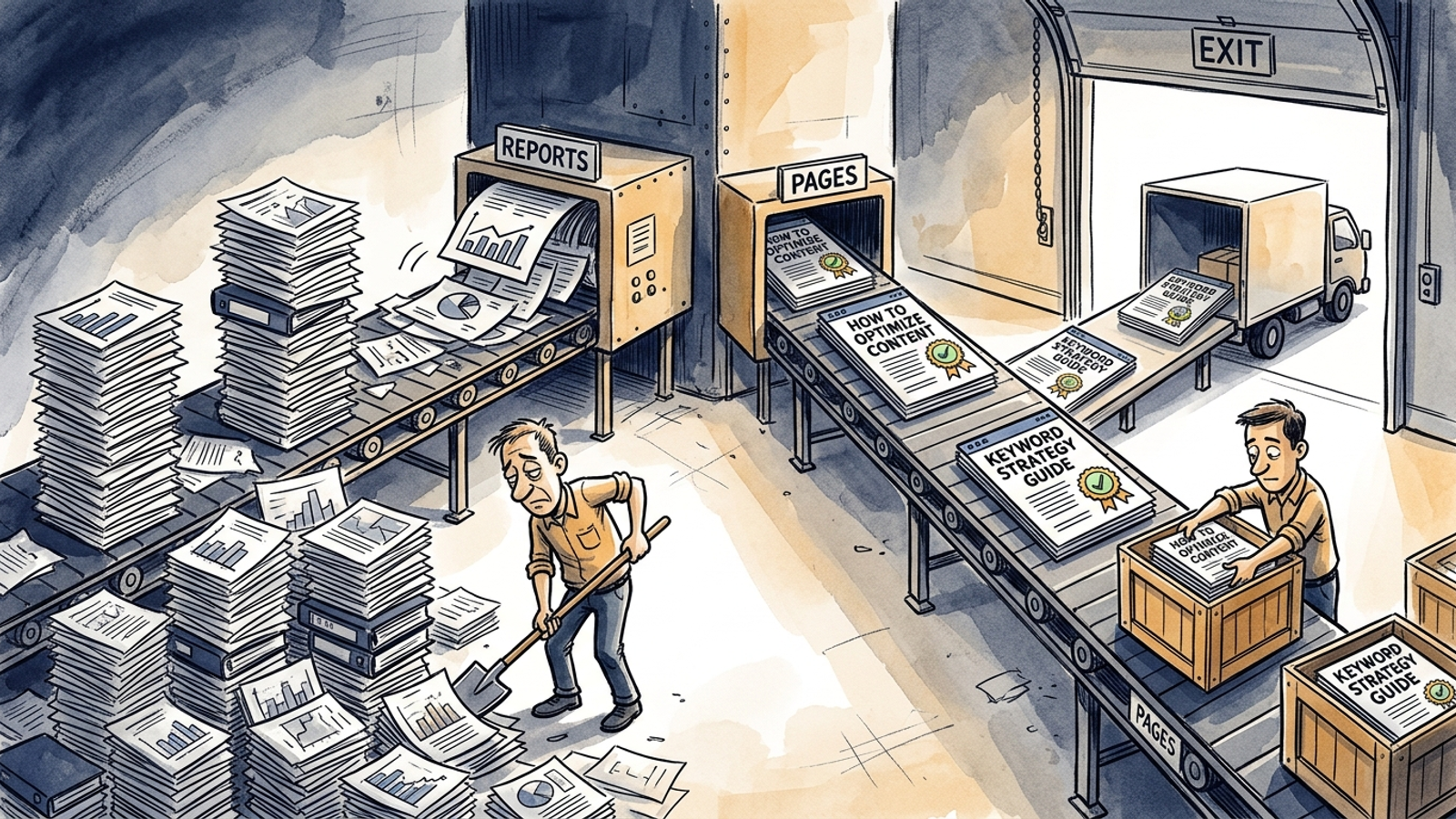
Before rolling that tier across your whole book, run a pilot on three clients, not thirty. Pick one that already ranks but rarely gets cited, one new site with little authority, and one in a competitive category where someone else owns the answer. Give it 60 days. Judge work shipped per client per week, not just a visibility score: pages published without your writer, technical blocks cleared without a dev ticket, and outside mentions you can click. If week three looks like week one with a new chart, do not expand the rollout. One account should prove the service survives your absence before you sell it across the agency.
That is why I point agencies toward groas when they ask what I would put inside a retainer. Its model fits the way agencies bill: connect the client, choose paid or organic search, and run delivery under the agency’s name with branded weekly reports. A named strategist stays behind the scenes. Actions come with plain-language reasoning, so the team can show the client what happened instead of writing a fresh summary from scratch.
There is a tradeoff. You give up some of the theater of a custom dashboard with your colors on every tab. I would take that trade for pages shipped, crawl issues addressed, citation work recorded, and a person accountable when citations slip. For a shop collecting $20k a month in retainers across a dozen domains, a fixed delivery cost per client makes more sense to me than per-prompt metering. It lets you quote the service without hoping the work stays light in month two.
This is the question I wish agencies asked first. Everyone asks about prompts tracked and domains allowed. Fewer ask who answers for a drop after the client has signed.
A monitoring tool can tell you citations fell 14 points and suggest more content. That leaves the agency holding both the explanation and the work. An execution setup should show what changed, what page or mention may have lost weight, what it repaired or republished, and what happened afterward. It should also give you a human who owns the next fix.
Ask that on the sales call. If the answer is a ticket queue and a help article, you now know whose hours fill the gap. If the answer is a record of work done and someone accountable for what happens next, you have something you can put your agency name on.