LinkedIn

My ten-page AI search budget starts at $469 before Claude and extra rework: $450 in labour and the full $19 groas subscription. I allow $0–$200 a month for a Claude plan, but the number I care about is what I spend per page I actually check, publish and measure, not what I spend per draft.
I’m pricing one website, a fixed set of buyer prompts, ten proposed pages, human approval before publication and a follow-up window. I start with 45 minutes of human work per page at an illustrative $60 an hour. That’s a budgeting assumption, not an editing benchmark. If I already pay for groas, I can allocate the $19 to show the full cost of the cycle, but starting the cycle doesn’t put another $19 on my bill. It does put work on someone’s calendar. That’s the part I check first.
The ten-page budget, line by line
I split the budget into what shows up on the invoice and what shows up on the calendar. The invoice is easier to read. That doesn’t make it the bigger bill.
| Line | What I’m paying for | Figure used here | Source of the figure | When it recurs |
|---|---|---|---|---|
| 1. Infrastructure | Full groas Unlimited subscription | $19/month | groas pricing | Monthly |
| 2. Assistant | Claude plan or API usage | $0–$200/month for the plan; API cost varies with usage | Claude pricing or my API bill | Monthly or by usage |
| 3. Research and drafting | Briefing, finding sources and checking the draft against them | Part of 45 min/page | Illustrative allowance; I replace it with actual time | Per proposed page |
| 4. Fact-checking and editorial review | Body, title, description, structured data and alt text | Part of 45 min/page | Same allowance; Google’s guidance informs the scope, not the timing | Per page reviewed |
| 5. Publishing QA and rework | Change previews, rejected drafts and corrections | Varies with what needs another pass | My CMS log and timesheet | Per cycle |
| 6. Measurement | Indexing, search performance, citations and attributable visits | Part of 45 min/page | Illustrative allowance; I time the work using Search Console and groas data | Per follow-up window |
The one-off setup for this cycle is to confirm what the existing connection covers, settle on the prompt set and capture the baseline. The subscriptions recur monthly. Research, approvals, fixes and follow-up recur with the work. The 45 minutes in the table is one shared allowance, not 45 minutes for each line that mentions it. I wouldn’t add a fresh setup charge to each page, and I wouldn’t call review a setup task just because I’d like to pay for it once.
Line 1: Count the $19 once
groas Unlimited is $19 a month flat for the team. It isn’t a per-page fee or another charge for each site. The plan covers unlimited teammates, ad accounts and websites, along with the data and publishing connection I use in this cycle. If I assign the full subscription to this batch, as I do here, I don’t also add separate lines for the Semrush and Ahrefs data, AI search answers or competitor research that come through it.
The groas MCP connection is how Claude gets to that data and publishing workflow. I ask Claude to inventory what the connection already covers for the site before I shop for another tool. If a vendor is selling me a second view of the same prompts, engines and answers, I don’t need a second invoice to confirm the first one works.
Line 2: Use the actual Claude bill
Claude is a separate cost. groas is the hands and the data; Claude is the brain. I record the plan I’m on, not the cheapest tier on Claude’s pricing page and not the one I’d buy if I were starting over. The $0–$200 range is for planning. The bill is what goes in the budget.
On a free plan, the limit matters more than the sticker price. The model, chat length and size of the source files all affect how far the allowance goes. A page count doesn’t tell me whether ten briefs and their source documents will fit. On API billing, I track the cycle’s usage and price it from the bill. Until I have a month of my own usage, I’d rather carry a range than put down $0 because the drafts arrived fast.
Line 3: Kill weak pages before drafting them
I used to tell clients a good prompt was half the work. I was wrong. The prompt is quick. Checking whether the page deserves to exist is the work. Before Claude drafts anything, I want a brief that answers three questions:
- Which buyer prompt is this page supposed to answer?
- What evidence on the site can support the answer?
- What do competitors’ pages, Reddit threads and AI answers already say about it?
That last question isn’t a request to remake whatever’s already out there. It’s a check on whether I have anything worth adding. If I can’t point to evidence for the proposed answer, a clean draft just gives me more sentences to check. And if the demand isn’t there, I’d rather cut a line from the plan than send a whole page through review. I count the time spent making that call even when the page never gets drafted. The saving is the work I avoid after that decision, not the time I already spent making it.
Line 4: Review the whole page, not just the copy
Google’s guidance on generative AI content informs what I look at, not how long I spend looking. In this budget, human approval covers the body, title, description, structured data and image alt text. For structured data, I also check the relevant feature-specific policies.
An automated check can tell me there’s a meta description. It can’t tell me whether the price in it still matches the offer. The same goes for a claim in the body that sounds right until I open the source and find it says something narrower. That’s why I budget for both an evidence pass and an editorial pass. One asks whether I can back up the claim. The other asks whether I’ve said it plainly without changing what the evidence supports. If I narrow a claim in the body, I check that the title and description aren’t still making the broader promise. I don’t approve the page until it passes both checks.
Line 5: Keep rejected drafts and corrections in the budget
I ask Claude for a change preview and hold publication for human approval. That’s the last cheap place to catch a mistake. Once the page is live, a correction means reopening it and checking the change. And if I bin a draft at review, I don’t get the briefing or fact-checking time back.
This is the cost a vendor can leave off the price card without misprinting a single number. If three of ten drafts die in review, seven pages carry the cost of ten attempts. I leave the time already spent on those drafts in the cycle and add any extra QA or corrections that the original allowance didn’t cover. I don’t charge for the same review twice, and I don’t move the failed drafts to another tab so the published pages look cheaper.
Line 6: Measure outcomes separately
I capture the baseline before publishing, then ask Claude to compare the follow-up numbers using Search Console and groas’s AI visibility data. I use the same buyer prompts at follow-up so I’m not comparing one set of answers with a different set of questions. Published is a status, not a result. I keep four things separate:
- Whether the page was indexed.
- How it performed in search.
- Whether AI answers cited it.
- Whether I can attribute any visits to it.
A published page can sit unindexed. An indexed page can go uncited. A citation can show up without a visit I can attribute. Lumping all that into visibility makes for a tidy report and a lousy decision. I budget a slot to check the outcomes against the baseline and decide whether the page needs a rewrite, an internal link or a quiet retirement. If I skip that slot, all I know at the end is how much copy I ordered.
The arithmetic: what an approved page actually costs
Ten pages at 45 minutes of human work each and $60 an hour come to 10 × 0.75 × $60 = $450 in labour. Add the full $19 groas subscription and the subtotal is $469, or $46.90 per approved page if all ten ship, before Claude charges and extra rework. That’s the illustration with the assumptions showing. It isn’t a rate I’d quote for the next batch without looking at the time this one took.
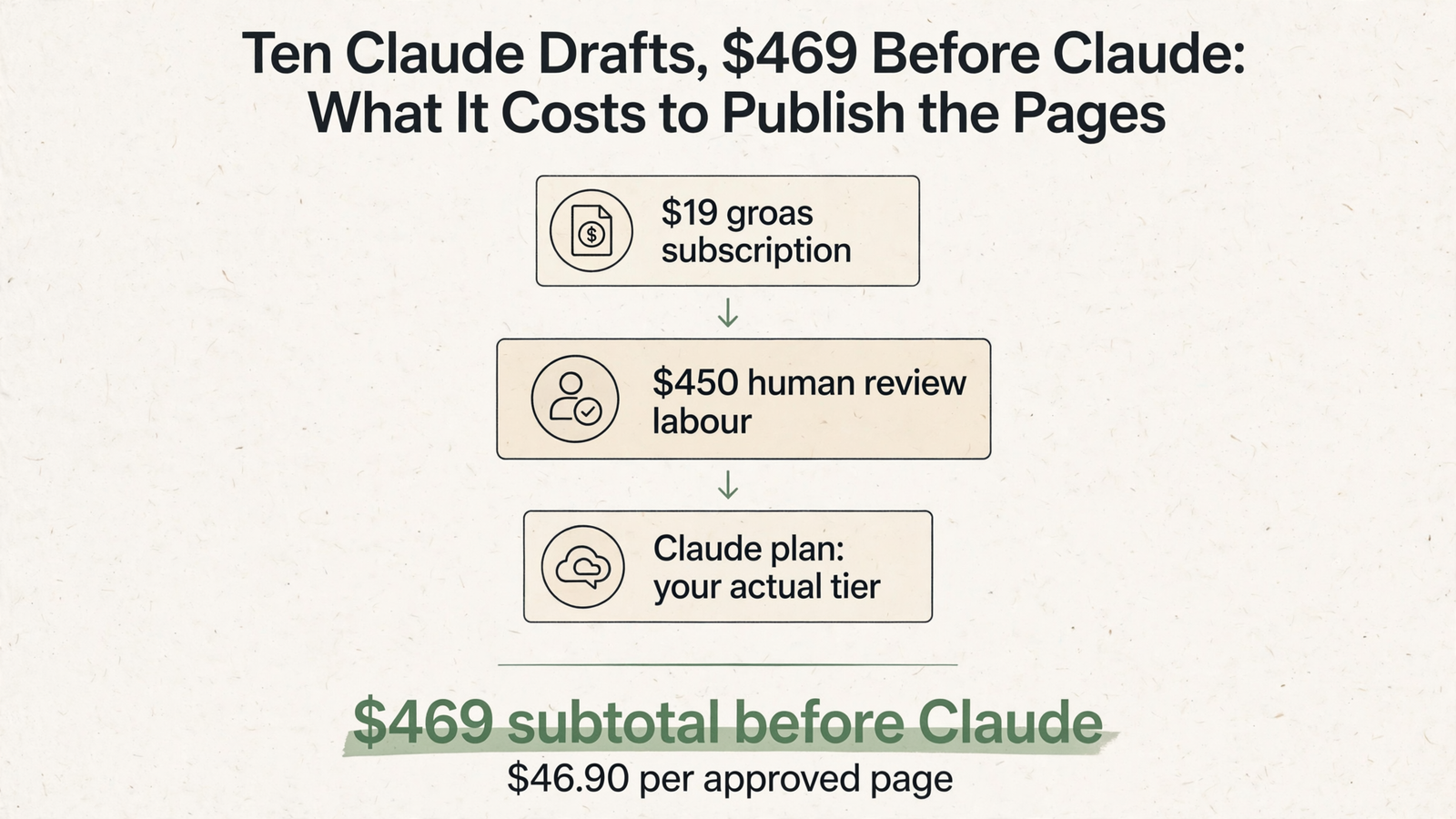
When I close the cycle, I divide total cycle cost by the number of approved pages that actually went live. I include the follow-up work in the cost and keep indexing, citations and visits in the results. If seven pages ship, seven is the denominator. I don’t take a page out because it didn’t get cited, and I don’t call the budget finished before I’ve done the follow-up. I want the cost figure to tell me what I paid to get a page live and measure it. I want the results to tell me whether that was worth doing.
If the per-page number comes in high, I want to know why. A higher hourly rate, a slower review and more rejected drafts can all make the same cell look bad. They aren’t the same problem. Publishing six pages instead of ten can reduce the work if I cut the scope before drafting. Cutting four after review doesn’t reverse the time I’ve already spent. And dropping review makes the spreadsheet look better by leaving the next round of corrections out of it. If weak briefs are what send drafts back, I apply the evidence check earlier. I cut the page count before I cut the evidence.
The cheapest mistake and the most expensive one
The cheapest mistake is dividing by drafts. It costs nothing to get the formula wrong. It just tells me a ten-page cycle worked when seven pages shipped, three died in review and the follow-up never happened. Buying duplicate visibility data is another easy way to make the budget worse. If I already have AI search visibility and share of voice alongside SEO in groas, I count the $19 once and skip the second vendor selling a narrower view of the same answers.
The most expensive mistake is removing review to make the per-page number look good. An unverified claim in the copy, title, schema or alt text doesn’t get cheaper once it’s live. Now I’m paying someone to find it, correct it and check the correction. The invoice records the hours. It doesn’t give me back the reader’s trust.
I keep the infrastructure line, record the actual Claude bill, count the rejected drafts and hold publication until a human approves the page. Then I measure indexing, search performance, citations and visits separately. Before the next cycle, I ask Claude for the cost per approved, published page, with the follow-up included. If that number rose, I cut the page count. I don’t cut the evidence.