LinkedIn

By November 2028, serious AI marketing workflows will require repeated AI search samples before an agent can edit a live page in response to a visibility change. A single ChatGPT answer is a guess with publishing rights.
I spent years watching people make the same mistake in Google Ads. A campaign looked bad on Tuesday, someone panicked, budgets moved, and by Friday the data had changed its mind. The fix wasn’t a better dashboard screenshot. It was a rule: don’t act until you have enough observations to tell whether anything changed. AI search needs the same rule. When researchers asked ChatGPT the same questions twice on the same day, only 41% of cited domains overlapped between runs, according to Axios’s coverage of the study. That doesn’t mean ChatGPT got it wrong 59% of the time. It means you can ask the same question twice and get a different set of sources without touching your website.
Before I let an agent tell me what moved, I want it to keep three measurements separate:
- A mention means the answer names your brand.
- A citation means the answer links to your content as a source.
- Share of voice is your share of category mentions, often weighted by position, as Semrush defines it.
You can lose citations while keeping mentions, gain mentions while your site goes uncited, or watch share of voice swing because a competitor got named twice in one run. Roll those into one score and an agent can sound perfectly sure about the wrong fix. That’s what I expect a minimum-evidence rule to stop.
Prediction 1: Visibility reports will show repeated samples, not snapshots
A dashboard can show me a wobbly number and leave me to shrug. Give an agent publishing access and that same wobble can become a page edit. The rule I expect to stick by November 2028: start with three to five runs for each unchanged prompt in the same assistant, and show the range rather than a single number. That’s a starting rule, not a guarantee that the sample can settle the decision.
In one four-run citation study, researchers ran 28 questions four times each on the same day. Of the sources cited, 55.9% appeared in exactly one run and just 11.8% appeared in all four. In AskedAbout’s three-week sampling, only 7.4% of ChatGPT’s cited domains appeared in all three runs of the same set of 12 buyer questions. Different methods, same practical lesson: one screenshot isn’t a trend, and it isn’t a reason to edit a page.
If I want to see how my share of voice stacks up against competitors in ChatGPT or Claude, I start with a fixed set of buyer questions. I repeat them on a schedule, keep the wording frozen, and report mentions, citations and share of voice separately for each engine. Change the prompt and I’ve changed the experiment. Compare ChatGPT in March with Claude in April and I’ve changed the engine as well as the month.
The engine matters. Across 40 million responses, Muck Rack’s October 2026 report put same-prompt overlap at 41% for ChatGPT, 45% for Gemini, 56% for Claude and 94% for Perplexity. Pool those into one score and I can’t see which engine moved or how steady its answers were to begin with.
With Claude connected through groas, I wouldn’t ask, “Did our visibility go up?” I’d ask: “Show the observations behind this share-of-voice change, including dates and missing coverage.” I want to see which prompts never ran, which answers returned no citations and how wide the range was. A missing run and a run with no citations aren’t the same thing. If the agent can’t show me the difference, I don’t let it interpret the movement, let alone act on it.
What proves me wrong: If single-run snapshots are still the default evidence behind agent publishing decisions in November 2028, this prediction fails.
Prediction 2: Publishing proposals will carry an evidence record
Repeated sampling tells me whether I’m looking at a pattern. It doesn’t tell me whether a specific edit makes sense. Today, an agent can summarize a citation gap, draft a page and hand me a recommendation that sounds decisive. By November 2028, I expect serious workflows to keep that recommendation attached to the observations behind it. If the evidence record is missing or thin, the proposal stays in draft.
I’d expect that record to contain four things a reviewer can inspect:
- The buyer questions that triggered the proposal.
- The saved answers and cited sources from repeated runs.
- The dates those answers were collected.
- The specific gap the proposed edit is meant to close.
The reason is accountability. Once an agent can send, spend, publish or edit a live system, someone has to answer for the change. A marketing ops approval policy describes a named reviewer seeing the exact change and the evidence behind it. A controlled publishing workflow makes the same distinction through permissions: reading, drafting, scheduling and publishing aren’t interchangeable. If I’m the person signing off, I want to see what will change and why. A polished recommendation is not a substitute for either.
Here’s what I’d ask Claude through groas: “Separate a recurring content gap from a one-off missing mention. Draft only. Do not publish.”
A recurring gap looks like this: I run the same buyer question several times. The answer usually cites a competitor’s comparison page or a Reddit thread, never cites my page, and my page doesn’t answer the question in the first place. Now I have something specific to draft. A one-off missing mention looks different: my brand drops out of a single answer while the citations go to aggregators. Or nobody gets cited at all. In either case, I want another round of measurement, not another page.
I’d build the share-of-voice report in Claude first and have the agent propose edits from that record. If I can’t trace the proposed edit back to the gap, it doesn’t go live.
What proves me wrong: If publishing workflows in November 2028 still routinely execute recommendations without supporting observations a reviewer can inspect, this prediction fails.
Prediction 3: “Insufficient evidence” will count as a finished answer
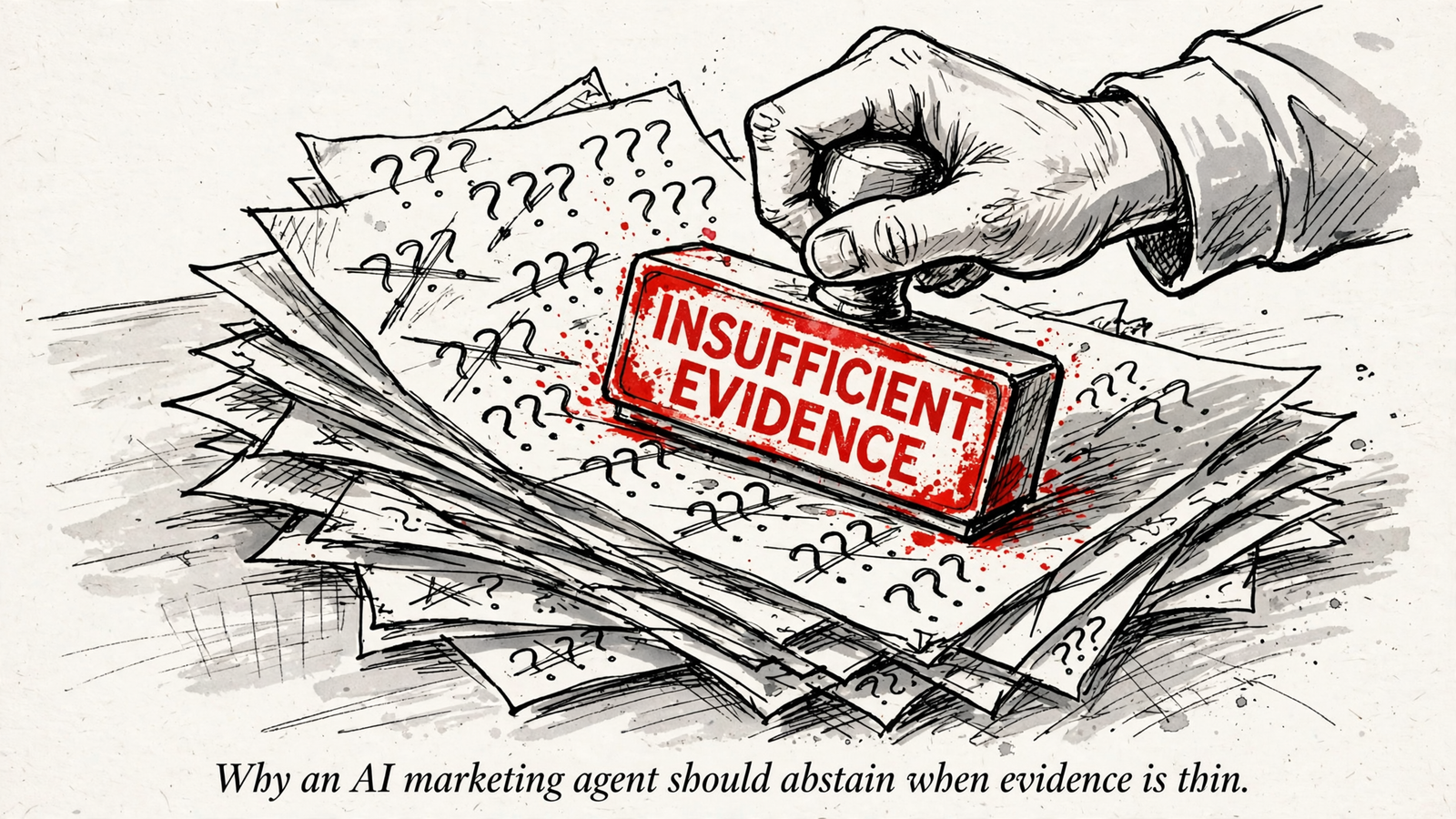
This is the prediction I expect vendors to resist longest. A product that declines to recommend an action can look less capable than one that always has a plan. That’s an easy trade to make when the output is a report. When the output can be a live edit, the agent starts manufacturing work from fluctuations. By November 2028, I expect the best workflows to treat “insufficient evidence” as a finished answer, not a failure to finish the task.
In SISTRIX’s analysis of more than 10,000 measurement series, 70% of brands that appeared for a prompt showed up on fewer than one day in five. Only 6% appeared on at least four days in five. A replication study with 4,320 observations found that with 12 prompts, the smallest difference it could resolve between two periods was 25 to 36 points. The fact that a dashboard can display a smaller change doesn’t mean that sample can distinguish it from noise.
I can use Claude or ChatGPT to track whether a brand gets recommended, but I want a rate across repeated runs, not a screenshot. And I want recommendations tracked separately from citations. EWR Digital’s analysis of 28,752 answers found that brands were named about 1.25 times as often as they were cited. The same study revised its sampling guidance from seven or eight runs to 14 to measure within plus or minus 10 points. In Zadoosh’s B2B SaaS tracking study, ChatGPT named a brand again on a same-day rerun just 50% of the time. Average error against monthly share fell from 19 points with one run to nine points with ten.
That’s why I’d give the agent two distinct jobs:
- A measurement request asks for more runs, more prompts or a longer window. I’d make that cheap and automatic.
- A content change request asks to publish, rewrite or delete. I’d require the evidence record from Prediction 2, plus named human approval for deletions and major rewrites. If the draft makes a competitive claim the record doesn’t support, stop the draft. Don’t dress up the claim in softer copy.
When the record can’t support a decision, the agent’s job is to say so and leave the page alone. More measurement may be useful. More copy isn’t the default.
What proves me wrong: If serious workflows in November 2028 still turn every reported visibility fluctuation into an action recommendation, this prediction fails.
What I’d configure before giving an agent publishing access
Use groas for the data and tools. Put the evidence threshold in the agent’s operating instructions. I’d connect Claude to groas so it can work from my accounts, my site and the AI search answers groas collects around the clock, rather than a screenshot I pasted into chat. groas also brings in competitor ads and the landing pages and funnels behind them, Reddit research and SEO data. That gives the agent more to work with. It doesn’t decide how much evidence is enough to change a page.
I’d write the rules in the order the agent should follow them:
- Measure on a fixed prompt set. Keep the wording identical and start with three to five runs per prompt. Show the range by engine and report mentions, citations and share of voice separately.
- Tie the proposed change to saved answers. Show what kept recurring and what the current page doesn’t address. If the evidence can’t support the change, say so and stay in draft.
- Approve the exact edit. Keep website autopilot off until the publishing boundaries are explicit and in writing. Draft permission isn’t publish permission. Send material revisions back for review, and require a named reviewer for deletions, major rewrites and claims about competitors.
- Log the edit and measure again. Attach the evidence record to the approved change, then run the same prompts and report what moved. Don’t claim the edit caused a citation. The engine may have sampled differently or dropped a competitor’s page from the answer that day.
Here’s the test I’d run this week. Pick five buyer questions you care about. Run each one five times in the same assistant on the same day, without changing a word. Record brand mentions and citations separately, and note which domains get cited. Look at how much share of voice moves across those runs before you decide what any one answer is worth.
Then connect the assistant through groas, hand it the dataset and give it the two jobs from this article: show the observations behind the change, and separate a recurring gap from a one-off missing mention. Judge it on whether it can show its work, decline to act on a thin record and stay in draft until you approve. An agent that always has a plan is just a faster way to publish noise. Apply for the free trial, connect your accounts once, and set the threshold before you switch anything on.