LinkedIn

Adding seasonal prompts to your headline AI visibility score makes it a bad comparison with last season. You can report a five-point gain without getting named any more often on the questions you used to track.
I used to say yes to every new question before peak season: the gift guides, the holiday comparisons, the urgent buyer questions that came up in the last five minutes of a meeting. I was wrong about where to put them. The new questions belong in the research. They don’t belong in the score I’m about to put next to last season’s.
I learned this in paid search before I ever tracked an AI answer. Add 30 keywords to a Google Ads account mid-quarter and the blended CTR and CPA can move because the keyword mix moved. I wouldn’t put that average next to last quarter’s and call the difference a performance gain. Yet that’s the comparison I see teams make with an AI visibility dashboard. The answers can all be accurate. The comparison can still be wrong.
Two scores get tangled up here:
- Share of voice is my brand’s mentions divided by all tracked-brand mentions.
- Visibility is the number of valid answers that name my brand divided by all valid answers.
Those scores can move in opposite directions. If an assistant starts naming more brands per answer, the total mentions can go up even if my brand appears in just as many answers. And if I add a frequently mentioned competitor to the tracked list, my share of voice can fall without a single old answer changing. The list changed, not the answers.
Say I track 100 valid answers last season and my brand appears in 20. That’s 20% visibility. Then I drop old questions, add holiday questions where I’m strong, and end up named in 10 of 40 answers. Now the dashboard says 25%. The blended rate rose while the count fell. I can say I got 10 mentions instead of 20 in the samples I collected. I can’t say my presence halved across the same buyer questions, and I definitely can’t call the five points a win. Put the numerator, denominator, and valid response count next to the headline. Make it possible to see what moved.

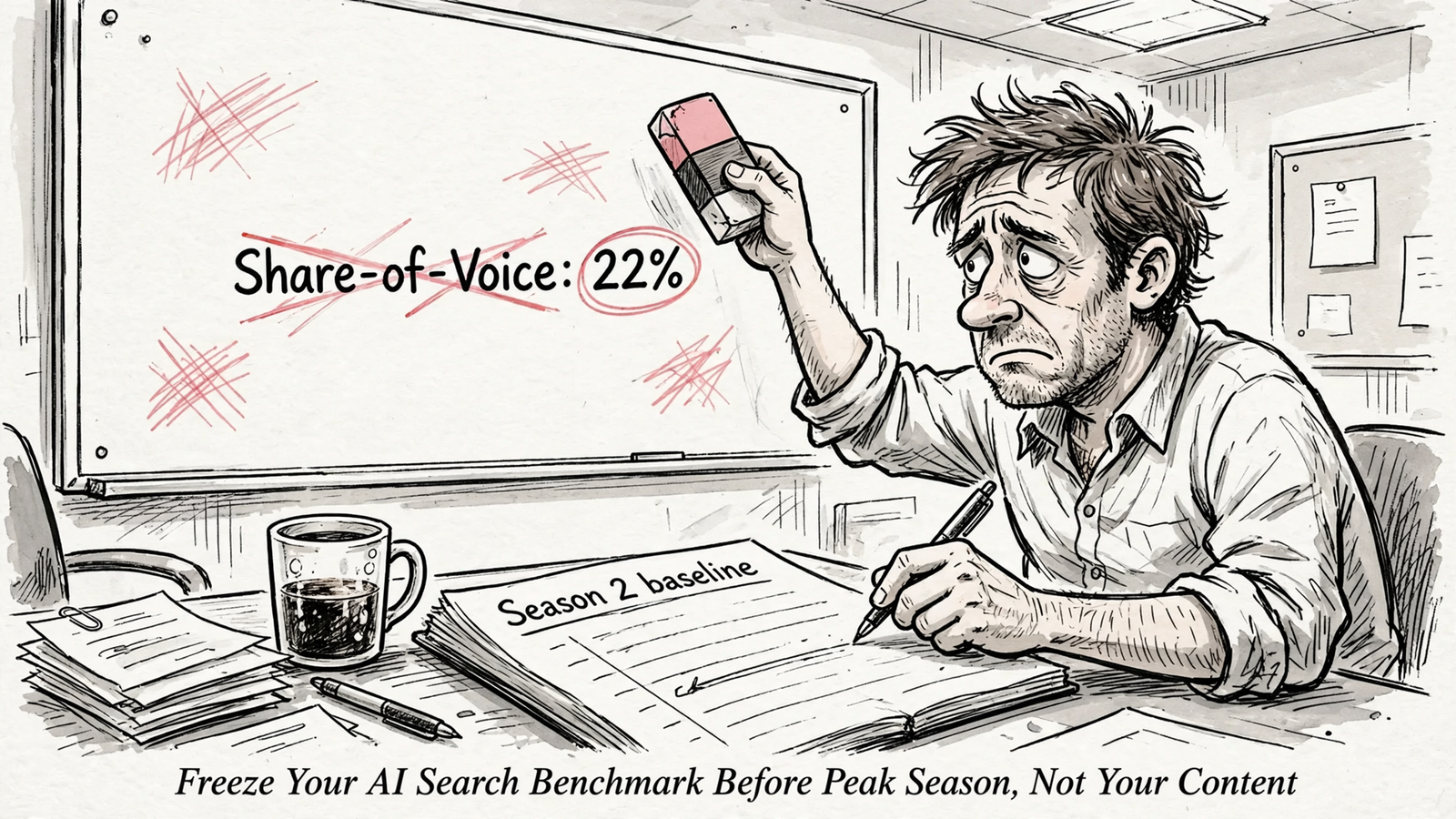
Freeze the benchmark, not the research
Before peak season, I lock a benchmark cohort of 30 to 50 buyer questions. Same wording, same competitor list, same assistants. The questions stay put even when the merchandising team wants to add the gift comparison everyone suddenly cares about. I’ll track that question. I just won’t pretend I asked it last season.
Write down what counts before running the benchmark. I ask Claude, with groas connected, to document four things:
- The prompt IDs and exact wording in the benchmark.
- The tracked competitors.
- The assistants and the repeat count for each prompt.
- The share-of-voice formula and what counts as a valid response.
Measure AI Search Share of Voice in Claude Without Moving the Goalposts lays out that setup. I keep branded questions out of the benchmark because the answers almost always name the brand in the question. I also report each assistant separately. Pool assistants that name or cite brands at different rates and one can dominate the total. At that point I have another blended number to explain, which is exactly what I’m trying to avoid.
The distinction that saves me the most arguments: missing is not the same as not mentioned. If the assistant times out or groas can’t parse the answer, I log a capture failure. It contributes neither an answer nor any mentions to the calculation. If the assistant answers cleanly and leaves my brand out, that’s a valid response and an observed non-mention. I count each brand at most once per answer and ask Claude to show the failures separately, right next to the valid response count and the fractions behind the scores. Otherwise I can end up briefing a content rewrite to fix a parser.
Give new seasonal questions their own score
Seasonal demand doesn’t wait for my reporting calendar. Ignoring it until January is how I miss the December comparison buyers actually care about. But a fixed benchmark can only tell me what happened on the questions it asks. A 72% visibility score can hide missing comparison-stage buyer questions. The answer isn’t to replace the questions inside that 72%. It’s to go find the ones the score doesn’t cover.
I build a seasonal discovery cohort from two places:
- Search demand: Search Console queries gaining impressions, site search terms, and support tickets.
- Gaps in captured AI answers: prompts where competitors get named and my brand doesn’t, or where the answer is thin and names no brand at all.
I ask Claude, with groas data connected, to use both sources to propose 15 to 20 seasonal prompts and tag each with the reason it made the list. That reason matters when somebody wants to turn a new question into a page brief. I want to know whether it came from something buyers are asking or from a gap in the answers I’m already collecting.
Report discovery beside the benchmark, never inside it. I give it a separate score and record any added questions or assistants, so a broader sample doesn’t pass for improvement. I don’t draw a trend line back to a season when I wasn’t asking those questions. The benchmark tells me what moved on the questions I kept. Discovery tells me what I should work on next.
Make Claude show which answers changed
When my frozen score drops from 22% to 18%, I don’t stop at four points. I ask Claude to pull the answers behind the change: same prompt IDs, same assistants, same repeat count, this period versus last. I check which runs came back valid before I read anything into the drop. There are no new seasonal prompts in that comparison and no pooled engines. Because engines list different numbers of sources, I keep citation share and share of voice separate by engine and use the same formula each time. Track AI Search Share of Voice With Claude: Build a Report You Can Defend walks through the report.
Match the questions before interpreting the answers. If I changed the panel, I start with the method, not the four points. If the panel held still, I can look at what the assistants did differently. Did they leave my brand out, or did they name it alongside more competitors? Both can pull share of voice down. Only one means I appeared in fewer answers.
I also keep mentions, recommendations, and citations in separate columns. An assistant can cite my buying guide without recommending the brand. A Semrush study of 50,000 brands found that only 21% of the most-cited domains were also the most-mentioned brand. And one analysis found brand names in 84.2% of Perplexity responses versus 58.4% of Claude responses, with individual brands going from 24% on one model to under 1% on another. Putting those engines in one bucket doesn’t make the answer clearer.
Then there’s answer non-determinism, the term for what happens when I ask the same question twice and get different brands seconds apart. BrightEdge saw ecommerce citation share move around 40% week to week while named brands barely changed. That’s why I want a presence rate across repeated runs, per assistant. One answer is worth reading. It isn’t a trend.
Keep publishing while the benchmark stays still
A fixed benchmark is not a publishing freeze. I want the site moving through peak season. I just don’t want each new page to come with a new definition of success.
Say Claude, reading groas data, finds three holiday answers naming two rivals for “best gift for clients,” with no mention of my buying guide. That’s a page brief, not a benchmark edit. I ask Claude for one specific change the captured answers support:
- Make the comparison table clearer.
- State the price range in plain numbers.
- Add the missing use case and show the proof.
The point isn’t to do all three. It’s to pick the edit that addresses the gap I can actually see. Your AI Search Dashboard Needs Fewer Prompts and a Denominator makes the case for keeping that editorial work separate from what counts in the fixed panel.
Publish from discovery. Measure against the benchmark. With groas plugged into Claude over MCP, I review the proposed edit against the captured answers before I approve it. groas ships it to the site, logs what changed and why, and lets me undo it in one step. That log gives me something concrete to inspect instead of another figure I’m supposed to treat as directional.
Then I run the same benchmark again. A new citation after a page update is worth noting, not claiming as a win. If it repeats across runs and assistants, I have a better read on whether the citation stuck. I still haven’t proved the edit caused it. I want the log to tell me what I changed and the benchmark to tell me what the assistants did, without asking either to do the other’s job.
Retire the benchmark without rewriting the past
I retire a benchmark when it stops describing the business: I’ve entered a new category, dropped the hero product the questions were built around, rebranded, or watched the way buyers ask shift enough that the old 40 prompts no longer describe demand. A bad quarter isn’t a reason. It’s when I most need the old line to stay put.
Close the old series and give the new one its own baseline. I leave the closed series dated and readable, with its prompts and competitor list attached. The new baseline gets a start date and one sentence explaining why I opened it. Anyone who looks at the report later can see where one test ended and the next began.
If I have to add competitors or prompts mid-season, I run both versions for three to four weeks and show the numbers side by side. That’s the cost of changing the benchmark honestly: I carry two scores instead of one. Running them over the same period lets me see how much the choice of panel changes the read without comparing one method in one season with another method in another. With groas holding both cohorts and logging each site edit with its reason, I can check which questions I asked and what I changed on the site. What I won’t do is backfill last season with this season’s questions and call the result a trend.
Ignore that and the bill comes due in Q1. I get a dashboard that slopes up, a content bill that went up with it, and no way to say whether ChatGPT and Claude name my brand more often on the same buyer questions. I’d rather walk into planning with a flat 18% I can defend than a blended 27% I can’t explain.
Freeze the test. Let the content move. Let the score mean the same thing twice.