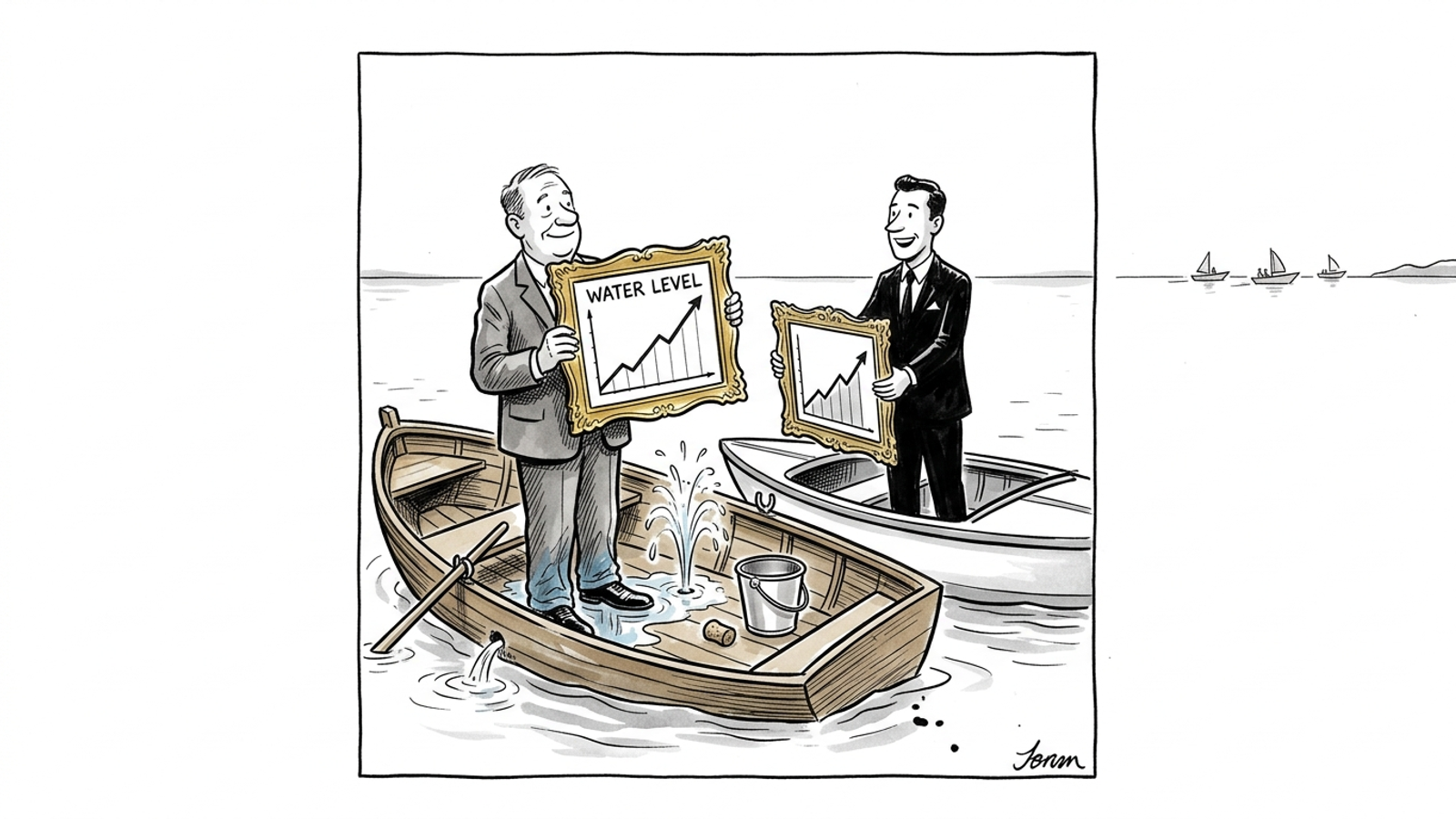
A Google Ads agency retainer model is a fixed monthly fee structure where advertisers pay an agency a set amount or percentage of ad spend for ongoing campaign management. In 2026, this model is structurally broken for growth-stage advertisers. The retainer was designed to stabilize agency revenue, not to maximize advertiser outcomes. It buys hours, not results. It rewards maintenance, not growth. And as AI-driven execution has fundamentally changed what is possible in Google Ads management, the retainer model has become a ceiling disguised as a floor.
This is not a soft critique. The traditional Google Ads management retainer cost structure creates misaligned incentives at every level: staffing, optimization depth, scalability, and accountability. If you are a growth-stage or mid-market advertiser paying a retainer and wondering why performance has stalled, the answer is probably not your creative, your landing pages, or your market. It is the model itself.
What Most People Believe About Google Ads Agency Retainers
The conventional wisdom goes something like this: you hire a Google Ads agency, you pay a monthly retainer (often a percentage of ad spend, sometimes a flat fee), and in return you get a team of experts managing your campaigns. The retainer provides stability. The agency can plan staffing. You get continuity. Everyone wins.
Agencies will tell you the retainer covers strategy, optimization, reporting, and communication. They will point to the complexity of Google Ads as justification for ongoing fees. They will argue that performance marketing requires sustained, expert attention and that the retainer model ensures your account always has someone watching it.
This framing is not entirely wrong. Google Ads accounts do require ongoing management. The platform changes constantly. Bidding strategies, audience signals, and creative formats evolve. Leaving an account untouched for weeks is a real way to waste money. A competent agency providing genuine, consistent optimization is worth paying for.
The problem is not the concept of ongoing management. The problem is that the retainer model, as it actually operates at most agencies in 2026, does not deliver what it promises. The structure rewards the agency for maintaining the account, not for growing it. And the gap between what you pay for and what you actually receive has widened dramatically as execution technology has advanced while agency staffing economics have not.
For a deeper look at why large agencies in particular struggle with this, see why big agencies structurally underdeliver for mid-market advertisers.
Your Google Ads Agency Retainer Is Priced For Their Business, Not Yours
How Traditional Agency Retainer Models Were Designed
The percentage-of-spend pricing model was imported from traditional media buying decades ago. When agencies negotiated TV and print placements, taking a percentage of the media budget made sense: larger buys required more negotiation, more creative development, and more coordination. The fee scaled roughly with the work.
Digital advertising inherited this model without questioning whether the economics still held. They do not. Managing $50,000 per month in Google Ads does not require twice the labor of managing $25,000. The same campaign structures, the same bidding strategies, and largely the same optimization work apply. Yet the agency’s fee doubles.
Why Percentage-Of-Spend Pricing Creates The Wrong Incentives
When an agency earns more as you spend more, their incentive is to increase your spend, not your efficiency. An agency billing 15% of a $100,000 monthly budget earns $15,000. If they optimize your account so well that you can achieve the same results at $70,000, they just took a $4,500 pay cut. The Google Ads management fee structure punishes the agency for doing its best work.
This does not mean every agency deliberately inflates spend. But the structural incentive is real, and over time, structures shape behavior. Growth-stage advertisers who need every dollar to work harder are particularly exposed to this misalignment.
What AI Automation Has Changed About Execution Economics
In 2026, the execution layer of Google Ads management has been transformed. Bid adjustments, audience targeting, budget allocation, and even creative iteration can be handled by intelligent systems running around the clock. The manual work that once justified retainer pricing, the hours spent pulling search term reports, adjusting bids by device and geography, shifting budgets between campaigns, has been automated for anyone with access to the right technology.
Yet most agencies still price as though execution requires the same human labor it did in 2018. The retainer buys a person’s time. The question is whether that person’s time is the bottleneck anymore, or whether it has become the ceiling.
What A Google Ads Retainer Actually Buys In 2026
How Google Ads agencies charge has not kept pace with what the work actually requires. Here is what your retainer is purchasing in practice.
Hours Vs. Outcomes: What You Are Really Paying For
A retainer buys hours. It does not buy results, growth, or even a guaranteed level of attention. Most agencies scope accounts based on estimated hours required, then assign staff accordingly. If your account needs 10 hours a month of work but the retainer covers 15, you are subsidizing the agency’s overhead. If your account needs 20 hours but is scoped for 10, you are getting underserved. Either way, the retainer is optimized for the agency’s capacity planning, not your performance.
The Staffing Reality Behind Most Agency Accounts
The person the agency pitched you during the sales process is rarely the person managing your account day to day. At most mid-size agencies, a senior strategist oversees a portfolio of 15 to 30 accounts. The actual optimization work is done by junior account managers or, increasingly, offshore media buyers. This is not a secret. It is how agencies hit their margin targets.
When your account manager changes every six months, institutional knowledge walks out the door. The new person spends weeks getting up to speed, often resetting optimizations the previous manager had in progress. You pay the retainer through every transition. The agency’s business continues uninterrupted. Yours does not.
How Much Actual Optimization Time Your Budget Gets
Take a typical $5,000 monthly retainer. After the agency’s overhead, margins, and management layers are covered, the actual optimization time on your account is often four to eight hours per month. That is roughly one to two hours per week of a junior media buyer’s attention.
For a growth-stage advertiser spending $50,000 to $200,000 per month on Google Ads, two hours of weekly optimization is not enough to explore new campaign structures, test creative angles, analyze competitive shifts, audit conversion tracking, and push performance forward. It is enough to check dashboards and make minor adjustments. That is maintenance, not growth.
The Three Signals Your Retainer Has Hit A Ceiling
Performance Has Plateaued Despite Increased Spend
You scaled your Google Ads budget by 40%, but ROAS stayed flat or declined. Your agency explains this as “market saturation” or “increased competition.” Sometimes that is true. More often, the account has hit the ceiling of what one person can physically manage with the hours your retainer funds. Scaling requires deeper execution: more granular segmentation, more aggressive testing, faster iteration on creative and landing pages. The retainer does not expand to cover that work. Your results plateau because the execution cannot keep up with the budget.
Your Account Manager Changes Every Six Months
Agency staff turnover is a structural feature, not a bug. Junior media buyers are hired at low salaries, given too many accounts, burn out, and leave. The agency backfills the role. You get an introduction email. The cycle repeats. Each transition costs you weeks of momentum and months of compounding optimization. If your account manager has changed more than once in the past year, the retainer is buying you churn, not continuity.
Reporting Shows Activity, Not Results
Your monthly report lists tasks completed: keywords added, bids adjusted, negative keywords applied. What it does not show is the impact of those tasks on the metrics that matter to your business. Activity-based reporting is a hallmark of retainer-model agencies because the model rewards effort, not outcomes. If your reports make the agency look busy without connecting that activity to revenue, margin, or customer acquisition cost, the retainer is funding a performance of work rather than the work itself.
Why AI Execution Changes The Math
What Autonomous Execution Does That Junior Account Managers Cannot
A junior account manager can analyze one campaign at a time, make adjustments during working hours, and prioritize based on limited experience. An autonomous execution engine can evaluate every campaign, ad group, keyword, and audience signal simultaneously, around the clock, and make thousands of optimizations daily based on patterns extracted from massive datasets.
This is not a hypothetical comparison. It is the reality of Google Ads management in 2026. The retainer model pays for the junior account manager. The question is whether that is the right purchase when the execution layer has fundamentally changed.
The Engine Trained On $500B+ In Profitable Ad Spend Vs. One Person’s Client History
groas runs a proprietary engine trained on over $500 billion in profitable ad spend. Compare that to the knowledge base of even the best individual media buyer, who might have managed $50 million across their entire career. The gap in pattern recognition, optimization speed, and decision quality is not incremental. It is categorical.
In the Done For You model, a senior strategist owns your account end to end while this engine handles execution depth that no human team can match. In the Done With You model, your team stays in control while the engine and a groas strategist work alongside you. In both cases, the execution does not stop when a human runs out of hours in the week. It runs continuously.
Why Execution Depth Does Not Scale With Headcount
Agencies try to solve scaling problems by hiring more people. But adding headcount introduces coordination costs, communication overhead, and inconsistency. Two junior media buyers managing your account do not produce twice the results of one. They produce fragmented execution with more handoff points and more room for error.
The alternative is execution infrastructure that scales without headcount. When groas manages an account, scaling spend does not mean finding another person to handle the incremental complexity. The engine absorbs it. The strategist focuses on higher-order decisions: offer positioning, funnel architecture, competitive strategy. That is how you grow past the ceiling the retainer model imposes.
The Alternative: Outcome-Based Google Ads Management
What To Look For Instead Of A Retainer
If the retainer model is broken, what replaces it? Look for three things: month-to-month commitment (no six-to-twelve month lock-ins), $0 onboarding fees, and a management structure where the provider’s revenue is tied to the scale of results, not the scale of your spend alone. Look for continuous execution, not time-boxed optimization windows. And look for a model where you never have to worry about account manager turnover or staffing constraints.
For a full comparison of your options, this breakdown of DIY vs. agency vs. autonomous management lays out the tradeoffs clearly.
The DFY Model: Full Ownership, No Retainer Ceiling
groas Done For You is fully managed Google Ads: a dedicated senior strategist runs your entire account and owns every decision. groas works on everything from the first click to the final conversion, including landing pages and offers. There is nothing for you to log into or manage. You reach the team on Slack or email around the clock.
This is not a retainer. There is no onboarding fee. No long-term contract. Cancel anytime. groas earns the next month by performing this month. The execution runs 24/7 through the proprietary engine while the strategist focuses on strategy, testing, and scaling. The result is that your account is never capped by what one person can get through in a workweek.
The DWY Model: Keep Strategic Control, Upgrade The Engine
If you have an in-house team that knows Google Ads and wants to stay in the driver’s seat, Done With You gives you the engine plus a senior strategist alongside your team. You get weekly reports on exactly what was done, a strategy call every other week, and exclusive insights from groas’s internal team. Your team runs the account. The engine handles execution depth. The strategist provides the expertise layer that would cost six figures to hire full-time.
DWY is the right fit if you want better tooling and senior advisory without giving up control. Many advertisers start on DWY and move to DFY as they scale or as the founder’s time becomes the bottleneck.
Who Should Still Use A Retainer (Honest Assessment)
When A Traditional Agency Retainer Makes Sense
If your Google Ads spend is very small (under $5,000 per month), your campaigns are simple, and you mainly need someone to keep the lights on, a modest retainer with a competent freelancer or small agency can be adequate. If your business requires deep integration with offline sales processes that demand in-person coordination, a local agency relationship may offer value beyond pure media buying.
The Scenarios Where Autonomous Management Is The Wrong Fit
If your account is brand new with zero historical data and you are spending less than a few thousand dollars per month, the leverage of an engine trained on $500 billion in ad spend will not be fully realized. Similarly, if your business model is so unusual that it requires constant human judgment calls on creative direction with no digital conversion path, a purely execution-focused model will not solve the problem. These are edge cases. For the vast majority of growth-stage advertisers spending real budgets on Google Ads, the retainer model is the wrong fit, not the alternative.
The Retainer Ceiling Is Real. What You Do About It Is A Choice
The Google Ads agency retainer model was designed for a world where human execution was the only option and agency overhead was the cost of doing business. That world is gone. In 2026, execution technology has made the retainer model a tax on growth-stage advertisers: you pay for hours while your competitors pay for outcomes.
If you are a founder, CEO, or performance marketer who wants Google Ads fully handled without the retainer ceiling, apply for groas Done For You. If you have an in-house team and want the engine plus a senior strategist while keeping control, get started with Done With You. Either way, stop paying for someone else’s business model and start paying for your own growth.