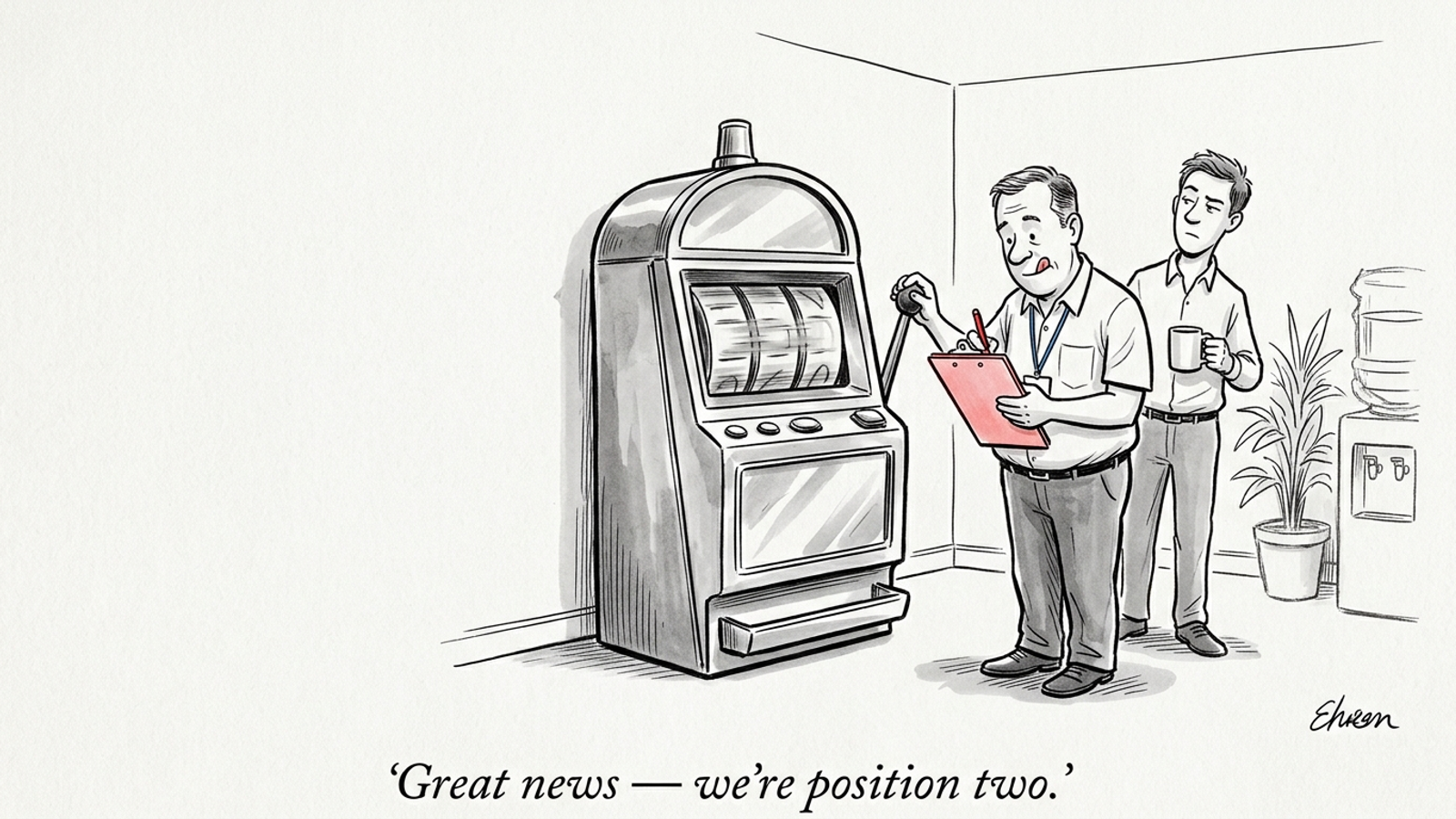

Google Ads audits are structurally broken as a mechanism for improving campaign performance. A Google Ads audit is a periodic diagnostic that scores your account against benchmarks and produces a list of recommendations, but it does not fix anything. Whether it comes from a free grader tool, an agency pitch deck, or Google’s own Optimization Score, the audit model is designed to surface anxiety, not deliver outcomes. The knowing-doing gap between “here is what is wrong” and “here is what we fixed” is where campaigns go to stagnate. Most advertisers who receive an audit never implement more than a fraction of the recommendations, and the ones they do implement are often the wrong priorities for their specific business.
This is not a marginal critique. The entire audit economy, from the WordStream Grader to the agency “free account review,” exists because diagnosis is cheap to produce and expensive-sounding to receive. What actually moves performance is continuous execution: identifying constraints, acting on them immediately, and iterating without waiting for the next quarterly review cycle.
What Most People Believe About Google Ads Audits
The conventional wisdom goes like this: before you can improve your Google Ads performance, you need to know what is wrong. An audit gives you that clarity. You run your account through a grader, or you let an agency pull your data and score it, and you get a report that tells you where you are underperforming relative to best practices. Quality Scores are too low. Impression share is bleeding. Ad copy is not using all available extensions. Bidding strategy does not match your goals.
This sounds reasonable. In medicine, diagnosis precedes treatment. In engineering, you measure before you optimize. The analogy seems natural: audit the account, identify the problems, fix them in order of severity, and performance improves.
The belief extends further. Many advertisers treat a high Optimization Score in Google Ads as validation that their account is healthy. They treat a low score from a third-party grader as evidence they need to switch agencies or overhaul their strategy. The audit becomes the foundation of the decision-making process.
There is nothing irrational about wanting a clear picture of your account. The problem is not the desire for diagnosis. The problem is that the audit model, as it actually operates in the market, systematically fails to deliver the outcomes it promises. The diagnosis is shallow, the recommendations are generic, the implementation rate is near zero, and the incentives of the auditor are misaligned with the advertiser’s goals.
Audits Are Designed To Create Anxiety, Not Diagnose Root Cause
The free Google Ads audit became the dominant agency prospecting tool for a reason: it works as a sales mechanism. An agency runs your account through a script or a manual review, produces a document full of red and yellow flags, and presents it as evidence that you are leaving money on the table. The implicit message is always the same: you need us to fix this.
Why Free Audits And Graders Exist
The WordStream Grader, the Google Ads Optimization Score, and the “complimentary account review” from every agency on LinkedIn share a structural feature. They are designed to produce findings. An audit that comes back clean does not generate a sales conversation. An audit that comes back with a long list of issues does. This means the scoring methodology is tuned to flag problems, not to accurately measure the relationship between your account configuration and your actual business outcomes.
Google’s own Optimization Score is perhaps the most transparent example. It frequently recommends actions that increase your spend on Google’s platform, such as enabling broad match, raising budgets, or adopting automated bidding with loose targets. These recommendations may or may not improve your ROAS. But they reliably improve Google’s revenue per advertiser. The Optimization Score is not measuring how well your account is performing for your business. It is measuring how fully you have adopted Google’s preferred account configuration.
Third-party graders face a different but equally problematic incentive. They need the score to be bad enough that you take the next step, whether that is signing up for their tool or booking a call with their sales team.
Surface-Level Signals Versus Causal Diagnostics
A typical Google Ads audit checks Quality Score, impression share, ad strength ratings, keyword-to-ad relevance, bidding strategy alignment, and extension usage. These are real metrics. But most of them are surface-level signals rather than causal factors.
Quality Score, for instance, is a composite of expected click-through rate, ad relevance, and landing page experience. An audit flags a low Quality Score and tells you to improve your ad copy. But the low Quality Score might be downstream of a structural problem: you are bidding on keywords that do not match your offer, your landing page converts at 1% because the offer itself is weak, or your account structure forces Google to show the wrong ad for the wrong query. Fixing ad copy while the landing page leaks conversions is like repainting a house with a cracked foundation.
Impression share recommendations are even more misleading. An audit tells you that you are losing 40% of impression share to budget. The implied recommendation is to raise your budget. But if the traffic you are currently capturing converts poorly, capturing more of it just means spending more on low-quality clicks. Without conversion path analysis and unit economics context, the impression share recommendation is not actionable. It is dangerous.
The Knowing-Doing Gap Is Where Performance Dies
Here is the core structural failure of the audit model: most advertisers who get an audit never act on more than one or two recommendations.
This is not because they lack discipline. It is because audits produce a long list of changes with no clear priority, no implementation pathway, and no accountability mechanism. You get a PDF. Maybe a spreadsheet. Then your team has to figure out which recommendations actually matter for your specific goals, sequence the changes so they do not disrupt active campaigns, execute them without introducing new problems, and measure whether each change actually improved outcomes.
For an in-house team already stretched thin, this is a project that competes with every other priority. For a founder running the account themselves, it is overwhelming. The audit sits in a folder. A few obvious fixes get made. The rest never happens.
This is not a failure of willpower. It is a structural problem with the periodic-diagnosis model. Teams that already know they need help but cannot execute on recommendations are exactly the ones who hit performance ceilings. An audit does not solve the execution bottleneck. It just documents it.
Audits As A PDF Of Problems Versus A System That Fixes Them
The distinction matters. An audit is a static artifact. It captures a snapshot of your account at one point in time and produces recommendations based on that snapshot. But Google Ads accounts are dynamic. Competitive conditions change weekly. Bidding landscapes shift. Seasonal patterns emerge. By the time you implement recommendation number five from a two-month-old audit, the first three may already be irrelevant.
What actually improves performance is not a better list of problems. It is a system that identifies issues and resolves them continuously, without waiting for the next review cycle.
Why The Grader Model Favors The Tool, Not The Advertiser
Google Ads grader accuracy is a question worth asking directly: are these tools actually measuring what matters? The answer, in most cases, is no.
Generic Benchmarks Ignore Your Competitive Context
Graders score your account against industry averages or platform-wide benchmarks. But your performance is determined by your specific competitive set, your margins, your customer lifetime value, and your conversion funnel. A 3% click-through rate might be excellent in commercial insurance and mediocre in consumer e-commerce. An average cost per click means nothing without knowing what a converted customer is worth to your business.
When a grader tells you your Quality Score is below average, it is comparing you to a distribution that includes every advertiser on the platform, from billion-dollar retailers to local dentists. That comparison tells you nothing about whether your account is performing well relative to what is achievable in your market.
What Google’s Optimization Score Actually Optimizes For
Google’s built-in audit tool deserves special scrutiny. The Optimization Score presents itself as an objective measure of account health. It is not. It is a measure of how closely your account matches Google’s preferred configuration.
Accepting all Optimization Score recommendations would, in many accounts, result in broader targeting, higher budgets, and more automated control handed to Google’s bidding algorithms. These changes sometimes improve performance. They always increase spend. The score goes up when you give Google more latitude and more money. That is not an audit. It is a nudge engine for Google’s revenue targets.
The same logic applies to bidding strategy recommendations. An Optimization Score that tells you to switch from Target CPA to Maximize Conversions may not understand your margin structure or your capacity constraints. It is optimizing for Google’s definition of “conversion volume,” which may not match your definition of “profitable growth.”
What A Real Account Diagnosis Looks Like
If audits are broken, what replaces them? The answer is not a better audit. It is a fundamentally different model: start with business outcomes, not account metrics.
A real diagnosis begins by asking what a profitable customer acquisition looks like for this business. What is the target cost per acquisition at which the unit economics work? What does the full conversion path look like, from click to lead to sale to repeat purchase? Where in that path is the actual constraint?
Sometimes the constraint is traffic quality: you are bidding on the wrong keywords or your targeting is too broad. Sometimes it is the offer: the landing page does not convert because the proposition is not compelling. Sometimes it is the bidding strategy: you are optimizing for the wrong objective. Often it is all three, interacting in ways that a surface-level audit cannot see.
This kind of diagnosis requires continuous access to performance data, business context, and the ability to act on findings immediately. It requires someone, or something, that is in the account every day, not once a quarter.
What Replaces The Audit: Continuous Execution, Not Periodic Diagnosis
The case for continuous execution over periodic diagnosis is straightforward. Every day your account runs with a known problem that has not been addressed is a day you are paying for suboptimal performance. The audit model accepts this delay as normal. The continuous execution model does not.
How groas Operationalizes Continuous Optimization
groas was built on the premise that the audit model is fundamentally backwards. Rather than diagnosing problems and handing you a report, the groas engine, trained on over $500 billion in profitable ad spend, identifies and acts on issues around the clock.
For in-house teams running their own accounts, Done-With-You management pairs this engine with a senior strategist who works alongside your team. The biweekly strategy call is not a report presentation. It is a working session where the strategist reviews what the engine has already done, discusses findings in the context of your business goals, and aligns on the next priorities. Your team stays in control. The engine handles the execution volume that no human can match. The gap between “we know this needs to change” and “it has been changed” collapses.
For businesses that want Google Ads fully handled, Done-For-You management makes the audit model entirely obsolete. A dedicated strategist owns your entire account, from the first click to the final conversion, including landing pages and offers. There is no PDF of recommendations because there is no gap between diagnosis and action. The engine runs continuously. The strategist directs strategy end-to-end. Problems are identified and resolved before they appear on any grader’s scorecard.
For agencies managing client accounts, the DIY product gives media buyers direct access to the groas engine, replacing the audit-and-implement cycle with continuous optimization across every client account. Agencies keep their brand, their clients, and their margin. The engine handles the execution depth that no individual media buyer can sustain across a growing book of business.
The core difference is structural. A traditional agency or freelancer is capped at what one person can physically get through in a week, and you pay full rate for that ceiling. groas puts a senior strategist on top of an engine trained on hundreds of billions in ad spend, so execution does not stop when a human runs out of hours. Month-to-month, no long-term contracts, $0 onboarding. The gap shows up in the numbers inside the first few weeks.
The One Thing Worth Taking From Any Audit
There is one use case where an audit has value: as a forcing function for asking the right questions about your business, not your account.
If an audit makes you ask “what is our actual target CPA based on our margins?” or “do we know which campaigns drive revenue versus which ones drive vanity metrics?”, it has done useful work. Those are business questions, not account configuration questions.
But you do not need a grader tool to ask those questions. And you certainly do not need a 40-page PDF. You need a conversation with someone who understands both the platform and your business, paired with a system that can act on the answers immediately.
The Bottom Line
Google Ads audits are not worth the weight advertisers give them. They are structurally designed to sell services, not to improve performance. Google Ads grader accuracy is poor because graders measure adherence to generic benchmarks, not alignment with your business goals. Google’s own Optimization Score is misleading because it optimizes for Google’s revenue, not yours. And even when an audit surfaces a legitimate issue, the periodic-diagnosis model ensures that most recommendations die in a drawer.
What actually moves the needle is continuous execution: a system that identifies constraints and resolves them every day, not every quarter. groas exists because this gap between knowing and doing is where most advertisers lose. Whether your team runs the account with a strategist alongside (DWY) or you want the entire function handled (DFY), the model is the same: the engine runs continuously, the strategist directs strategy, and the audit becomes a relic of a slower era.
If you have an in-house team and want to stay in control, get started with Done-With-You. If you want Google Ads fully handled end-to-end, apply for Done-For-You. If you run an agency and want to scale without adding headcount, start your 7-day free trial. Stop auditing. Start executing.