
The AI-Search Glossary: What AEO, GEO, Citations, and Visibility Actually Mean
A practitioner's glossary of AEO, GEO, prompt tracking, AI citations, and brand visibility—and the sales-deck spin that blurs them.
September 24, 2026
•
min read



I spent three years inside an account that paid twice to run Google Ads: around $18k a month to an agency on $180k in spend, then a Kenshoo license on top. The bidding rules worked. So did the bulk uploads. What nobody put in the deck was the full-time person still needed to feed the machine: approve pushes, clear sync errors, and explain why a portfolio bid dropped a brand term on a Tuesday.
That is the part to remember when you compare Kenshoo Infinity Suite, now Skai, with Marin Software in 2026. Both are serious enterprise platforms. Both solve real problems. Both also sell you software you have to staff. I’ll look at where each fits, what the licenses leave your people doing, and when you are better off skipping the cockpit and buying management that does the work.
Back in 2015, Kenshoo and Marin earned their licenses. Google’s own bidding was dumb. Exact match meant exact. You needed portfolio rules, dayparting scripts, and one place to push changes to Google, Bing, and Yahoo without opening three editors. I ran that setup. The platform paid for itself because it replaced about 15 hours a week of copy-paste work and bid-sheet math.
That math flipped. Google brought bidding inside the house with Smart Bidding, then took more control of inventory with Performance Max and query matching with close variants and AI Max. Say you spend $100k a month today. Google’s model sets bids and suggests budget splits. Skai or Marin sits on top, trying to steer a car that already has self-driving turned on.
What remains is narrower, but useful: bulk creation across engines, cross-channel reporting in one view, budget-pacing guardrails, and a workflow that keeps five people from stepping on each other. Buy a platform to organize a large team, not for autonomous bidding magic. Those are different purchases.
Skai, formerly Kenshoo, now pitches itself as an omnichannel platform for paid search, social, and retail media, rather than a search bid tool. That positioning makes sense. Its case is breadth and governance: one taxonomy and budget view across Google, Microsoft, Amazon, and social, with automation and reporting for medium to large advertisers.
I used to tell clients Skai was the safe enterprise pick. I was wrong about safe. You still need an operator who lives in Skai. You pay the platform fee on top of spend. Your team still writes ads, fixes the feed, and decides what a qualified lead is worth. For a 50-person organization running five channels with compliance sign-off, that control can be worth it. For a team of three spending $80k a month on search, it is overhead dressed as leverage.
Marin is the leaner, search-centered counterpart. It centers on paid search and shopping, with automation for bids, budgets, and creative, plus newer AI layers such as Connect and Ascend for insights across search, social, app, and retail media. I see its clearest fit with mid-market teams and agencies that need audit trails, controlled approvals, and reporting they can defend to a client.
The tradeoff is another operating layer. A sync between Marin and Google gives your team another place to investigate when a change does not land as expected. Someone still has to own the rules, check the pushes, and explain the result. If you run heavy Google plus Microsoft with a small team that lives on scheduled changes, Marin may feel familiar. If you expect a platform to take account management off that team’s plate, it will not.
That distinction sets up the third option most platform comparisons leave out. What if you do not want to staff the operating layer at all?
Platforms sell you a better cockpit. Autonomous management sells you not needing a pilot for every routine adjustment. What a deck calls workflow efficiency, I call paying for software plus paying someone to drive the software.
Say you spend $100k a month. With Skai or Marin, you pay the license and keep one or two operators at $90k to $140k each. They still spend time on pushes, pacing sheets, sync errors, and reporting. The machine suggests. The human does.
A system like groas takes a different approach to Google Ads. Within your guardrails, it builds, runs, and improves campaigns: writing and testing copy, blocking waste search terms, moving budget toward what earns, and deploying landing pages that reshape around intent. Its specialized models watch bids, budgets, keywords, ads, and pages 168 hours a week, trained on $500B+ in profitable spend. That continuous execution is the mechanism: a Tuesday 2 a.m. competitor move can get an answer Tuesday at 2 a.m., not at next Monday’s check-in. You keep control of budgets and targets, a named strategist owns direction, and actions are logged with reasoning. The full Skai vs Marin vs autonomous breakdown goes deeper on the staffing difference.
Autonomous does not mean every team should abandon its platform. If you need five approval layers, custom SOX audit exports, and one taxonomy across search, social, and retail media, buy Skai and staff it properly. If your team wants hands on keyboards and controlled search workflows, consider Marin. If your problem is lower CPA and fewer logins, stop buying tools that leave the work on your desk.
Practical takeaway: add up the license, salary, and agency percentage. Compare that total, not the license quote, with the cost of having the work done.
Licenses quote low. Staffing bills high. I price enterprise setups on total cost to run, not the number in the procurement email. Say you spend $120k a month on search. Skai or Marin may come with a platform fee, a percentage tier or minimum, and contract terms. Then add one operator at $110k loaded and a slice of a manager for QA. If you also use an agency, its percentage remains on the bill.
The license may be the smallest line in the operating cost. Every sync, rule, and report that needs a human to check or explain keeps headcount in place. That is the true cost math most teams miss: a $2,500 license can become $14k a month in real cost.
| What you pay for | Skai / Marin route | Autonomous route |
|---|---|---|
| License or fee | Platform fee and contract terms | Flat monthly fee, month to month |
| People running routine changes | One or two operators plus oversight | Execution handled by the system; named strategist included |
| Decisions you keep | Goals, approvals, account priorities, and review | Budgets, targets, and guardrails |
| Response to routine changes | Depends on rules and when the team reviews them | Continuous execution, with actions logged |
Control is the fear that keeps teams on platforms. I get it. I used to tell clients control meant clicking the buttons yourself. I was wrong. Control can mean setting CPA at $85, capping brand at 15% of spend, and blocking three states you do not serve, then checking changes against those limits. With Skai, you get control of process. With autonomous management, you set the outcomes and guardrails while the system handles execution.
Do not confuse an action log with proof that every action improved performance. Read the log, then look at CPA and pipeline. If you cannot staff the cockpit five days a week, do not buy it for the feeling of control.
If you spend $30k to $100k a month on search with one to three people touching the account, I would not start with Skai or Marin. You probably do not have a governance problem. You have a doing problem: 4,000 new search terms a month, bids that need attention daily, and copy that needs testing weekly.
I watched a $60k-a-month home-services account pay $2,800 for a platform plus $9k for the person to run it. CPA sat at $112 for four months. The operator spent 20 hours a week on pushes and pacing reports, so waste terms did not get blocked. On autonomous management, daily blocking and reallocation helped cut CPA to $81 in six weeks. That is one account, not a promise for yours. It shows why I check where the hours go before I praise the dashboard. A small team with heavy search volume needs execution more than another license.
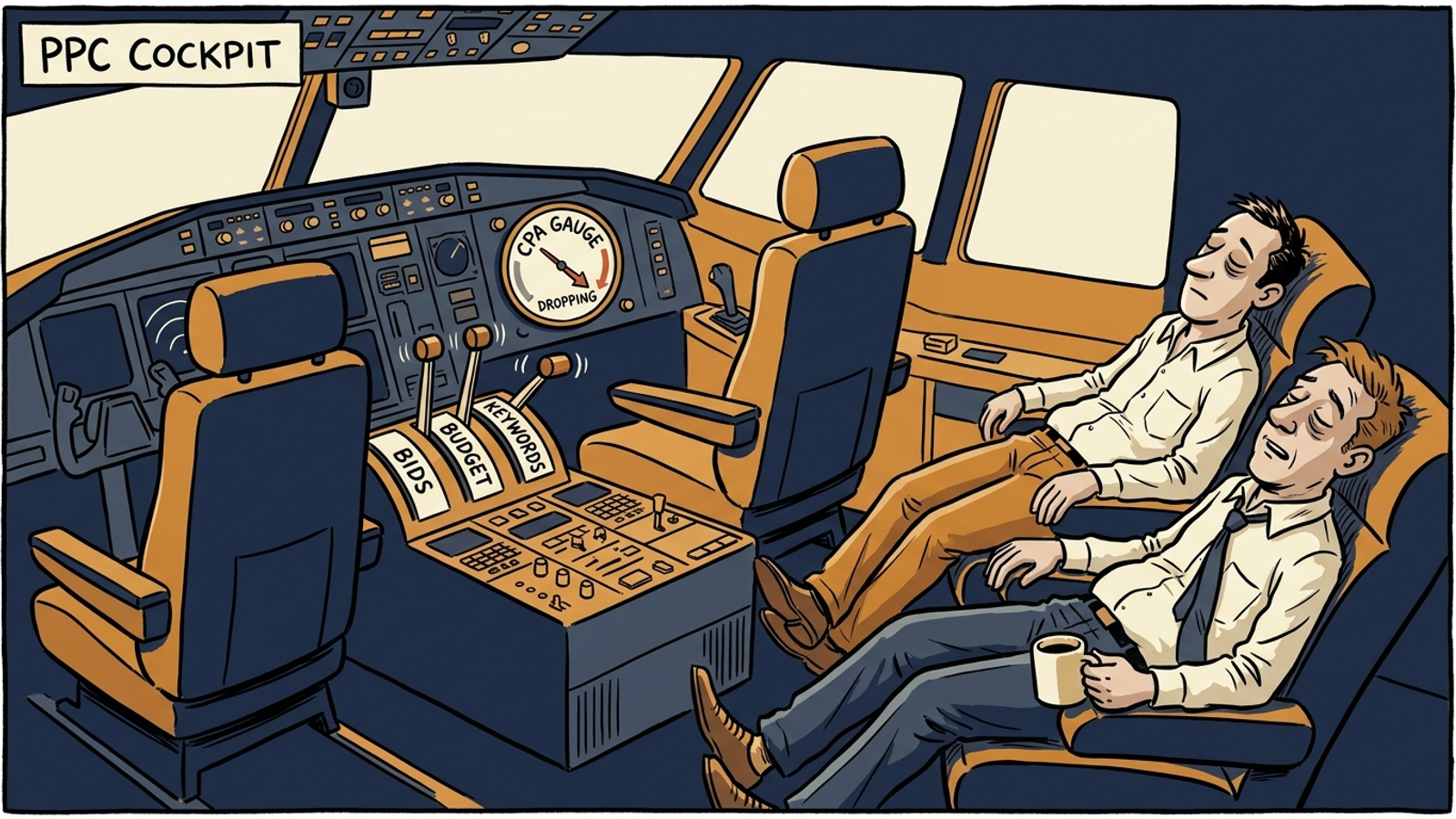
Practical takeaway: name the bottleneck before you buy. If it is hands, buy execution. If it is governance, buy the platform and staff it without complaint.
Do not rip out a platform on a sales call. Run a two-week count and let the work decide. You need a change log, time records, and a willingness to distinguish work that served the account from work that served the tool.
I did this with a $140k-a-month account. In ten days, 31 hours went to pushes, pacing, and failed syncs. Four hours touched what a customer would see: two new ads and one blocked waste cluster. Meanwhile, CPA sat at $94 and 1,900 junk search terms kept spending. The point is not that every push is worthless. It is that the tool’s upkeep took time that could have gone to the account.
Dividing management cost by converted pipeline gives you the cost per dollar of pipeline, not a verdict on its own. Use it alongside CPA and the hours by tag. The tag with the most hours tells you what you are actually buying. If that work is mostly feeding the platform, make the renewal case on that basis rather than on screenshots of rules.
Most agencies will not tell you this because the license helps justify the retainer. The platform proves work happened. Pacing charts look like management. I kept a cockpit for years for the same reason. It felt controlled. Then I added up what control cost and what it produced.
If you need governance across five channels, buy Skai or Marin and staff the platform without regret. If you need lower CPA on search, stop paying twice to run the same bids. Set the CPA target, set the budget limits, keep the log, and judge on pipeline in 30 days.