LinkedIn

One competitor, six buyer questions, 30 days in Claude, and at most one edit to one page. If your share of voice goes up because you swapped in questions you already win, the report got better. The answers didn’t.
I use this playbook when I can already see AI mentions in groas and need to decide what to do about them. The order matters: freeze the questions, find one factual gap worth fixing, then reread the same questions. If the evidence doesn’t support an edit, I leave the page alone. Either way, the losses go in the report alongside the wins.
1. Days 1–3: Freeze the questions before you look at the score
Cost: Three days to set up the panel without picking questions for the answers they give you. Buys: A baseline you can reread on day 30 without changing what you measured.
A 50- to 100-prompt suite buys coverage across buying stages. It also buys a lot of reading. Take 20 questions, four assistants and three repeats: that’s 240 answers to review before you change a word on the site. I cut the second assistant, the second competitor and the blended scoreboard. I want six questions I’ll actually reread.

Connect Claude to groas over MCP and ask: “Use our offer and measured search demand to propose six unbranded buyer questions. Include problem-led questions and comparisons.” Cut branded questions from the panel. Naming your brand in the prompt can inflate mention rates. I used to favor branded questions because they made for a good first report. I was wrong about what that report told me. Getting Claude to repeat your name isn’t the same as getting it to bring you up on its own.
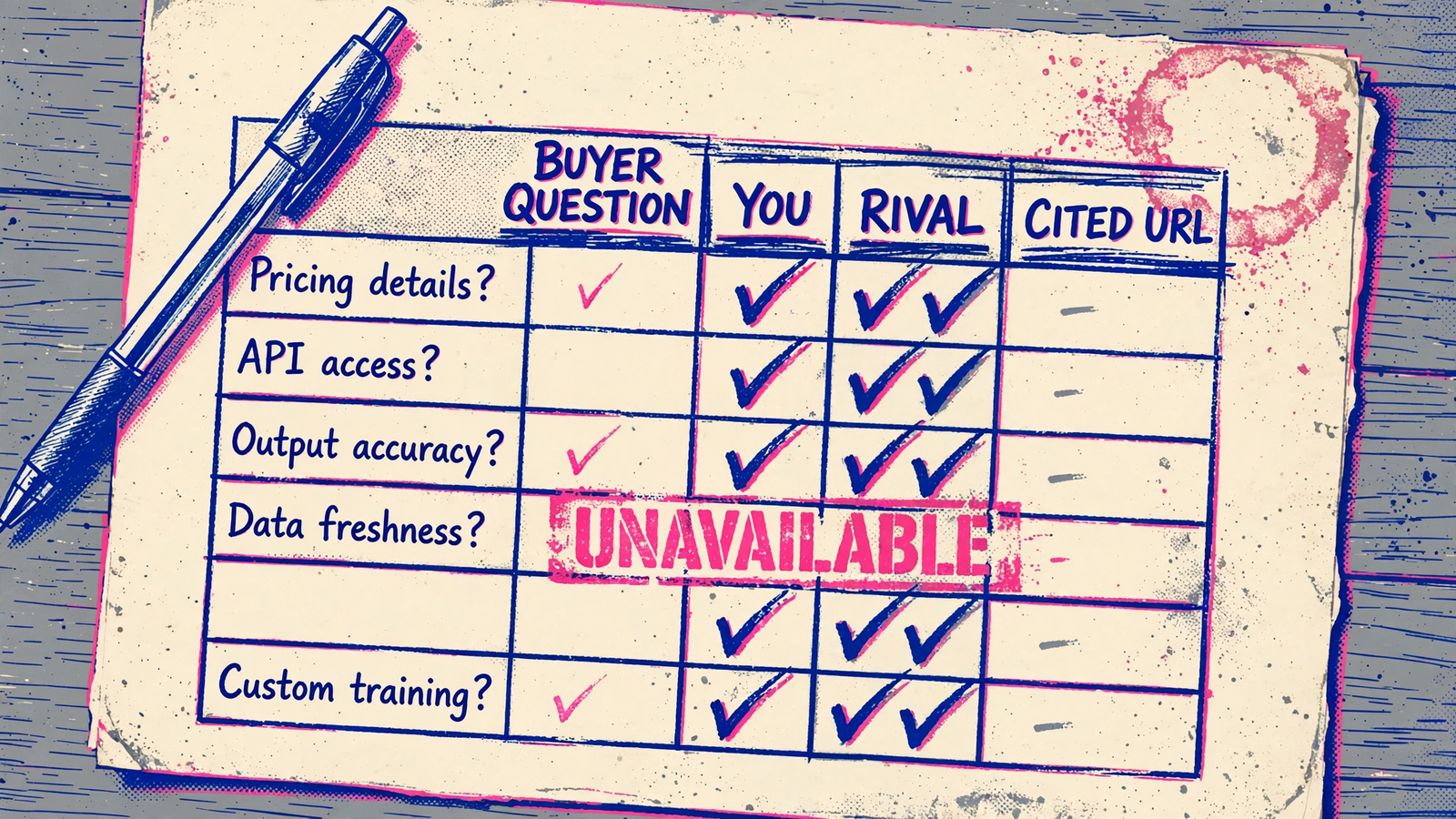
Approve the six questions, then lock their exact wording, the one named rival, Claude as the only assistant and the locale. Record collection dates. Run each question verbatim in a fresh thread, without follow-ups, following the same baseline collection method each time. If an answer can’t be collected, mark it unavailable. The rows I want to come back to are the ones where Claude recommends the rival and doesn’t mention us at all.
Change the wording after day 3 and the clock restarts. A better question might belong in the next panel. It doesn’t belong in this one.
2. Days 4–7: Build a baseline you can audit answer by answer
Cost: Four days of collecting and reading answers instead of glancing at a percentage. Buys: A record of what Claude said, including the answers you’d rather not put on a slide.
Ask Claude: “Separate our mentions, citations and recommendations from the competitor’s. Show the answer behind every classification.” Save the full text and every cited URL. Then check the classifications against the answers. A mention is a name in the text. A citation is a link used as a source. A recommendation presents a brand as a good choice. An assistant can recommend you while citing only third parties, so don’t give yourself a citation just because you got the recommendation.
Write down both denominators before anyone puts a percentage in a deck:
- Visibility: Answers that name you divided by all the answers you collected. If 40 out of 100 answers name you, that’s 40% visibility.
- Share of voice: Your mentions divided by all mentions of the two tracked brands, multiplied by 100. In the worked example, 40 mentions out of 250 tracked mentions give you 16% share of voice. A different set of tracked brands gives you a different denominator.
An answer that names neither brand is still an answer. A failed collection isn’t. Keep unavailable observations out of the calculation and show them separately. If neither brand gets a mention in a window, there’s no share-of-voice percentage to report.
Don’t mistake the first pass for a trend. In a 20-day ChatGPT citation test, 59% of citations were gone by day two. That’s not a forecast for Claude. It’s a good reason to save the answers and look for patterns across runs rather than celebrating one citation. If you need the full measurement setup before touching the site, use the groas guide to freezing prompts and counting mentions separately from citations.
Keep the counts and the misses with the score. Six questions tell you what happened on six questions, not what happened across the market.
3. Days 8–10: Pick one factual gap worth fixing
Cost: Three days of saying no to plausible ideas. Buys: A reason to touch one page that still makes sense if the score doesn’t move.
Ask Claude: “Identify a factual buyer question our page fails to answer. Show the missing evidence before proposing a change.” Start with the answers where the rival gets recommended and you don’t appear. Have Claude inspect their cited sources and your relevant page side by side through groas. I want three things, in this order:
- A specific question the page leaves unanswered. Pricing, compatibility, implementation time or limits. “We need more authority” isn’t a missing fact, and the rival showing up isn’t proof that your page is deficient.
- A reason this is a page problem. If the same review sites, best-of lists or forums keep supplying the answers, the pattern may point to outreach rather than a rewrite. Cut outreach from this cycle, too. If that’s where the evidence points, leave the page alone and keep observing.
- Evidence the gap matters to buyers. Use Search Console and GA4 to check whether the losing question maps to queries and pages that already earn impressions or assisted conversions. Say you’re spending $20k a month and the candidate page brought in 40 qualified visits last quarter. I’m not spending my one edit there just because it’s the easiest hole to fill.
Write down why the other ideas didn’t make the cut. On day 30, that note is more useful than trying to remember why a rewrite you now like didn’t look worth doing on day 10.
One factual miss on one page, or no edit. The plan gives you room to change something. It doesn’t require you to.
4. Days 11–12: Publish the smallest edit you can defend
Cost: Two days and an approval I don’t hand to the model. Buys: A change I can point to on day 30 instead of reconstructing what happened from a live page.
Ask Claude for a proposed diff through groas: the exact sentences to add or replace, the source behind each factual claim and the frozen buyer question each sentence answers. Check that the source supports the wording. Then approve publication explicitly. If you couldn’t justify an edit in step three, there’s nothing to approve.
Record what changed, on which URL, on what date and why. groas logs changes and their reasons, and a change can be undone in one step. That’s why I’m comfortable letting an assistant near a live page. It’s not a reason to let it publish without my say-so.
Cut the sitewide FAQ, the schema sprinkle and the blog post that tries to answer all six questions. I used to like shipping the bundle because it felt like momentum. The problem shows up in the review: change four pages and you have four edits to account for when the answers move. Change one and you have a before-and-after you can read. You still don’t have proof of causation.
If the diff touches more than one page, send it back. Leave unrelated pages alone.
5. Days 13–30: Repeat the questions, not the edits
Cost: Eighteen days of leaving the panel alone while Claude wobbles. Buys: A chance to tell a pattern from a good Tuesday.
Repeat the same six questions in fresh threads, with the same wording, rival and locale. Save full answers under the same rules as the baseline. Log changes in the rival’s answers alongside your own. If a citation disappears and comes back, keep both observations. Roughly three quarters of the dropped citations in that 20-day test came back later. A disappearing link is worth recording. It isn’t worth rewriting the page over.
Look at whole weeks during the observation period rather than picking the best day. For the before-and-after, label the actual windows and show how many answers you collected in each. If coverage is thin or the answers keep swinging, say so. A percentage can look decisive even when the rows underneath it aren’t.
What gets cut here is every mid-cycle improvement to the test. No polishing the question Claude seems to misunderstand, no swapping in one you now win, no adding prompts about the gap you just fixed. The fixed-set rule for content tests is simple: the before-and-after score uses only the questions you tracked from the start. Save new ideas for later. If collection fails, log it as unavailable rather than filling in a zero.
Read the answers before you read the trend. What the deck calls “momentum,” I call two Tuesdays until the rest of the record backs it up.
6. Day 30: Report the losses and make the call
Cost: One honest table. Buys: A decision you can defend when someone asks what the edit actually got you.
Ask Claude: “Give me a before-and-after table for all six frozen questions. Separate mentions, citations and recommendations for both brands. Include unchanged questions, regressions and unavailable observations.” If one question moves from loss to tie and another moves from tie to loss, both rows stay in. Put the collection windows and counts beside the percentages. Use the same formula and compare only the same prompts, assistant and locale. There’s no cross-assistant score to compute. You only ran Claude.
Read what moved before you decide whether it mattered. Your share can rise because the rival lost mentions, even if you gained none. A new citation isn’t a new recommendation. And if Claude starts recommending you on the question the edited page now answers, that’s worth noting, not claiming as proof that the edit caused it. groas doesn’t guarantee rankings or citations. This panel doesn’t prove causation either.
Make one call:
- Keep observing if too many answers are unavailable or the results still swing week to week. Keep the original panel intact and don’t make another edit inside this cycle.
- Revise in the next cycle if the losing answers point to a different, specific factual miss on the same page. Take that gap through the same evidence check before approving anything.
- Stop if there’s no next fix the evidence supports. If the table shows no observable gain, write no observable gain. If it shows a gain, name the question and say whether you gained a mention, a citation or a recommendation. Don’t make the headline do more work than the row.
When the constraint lifts, keep the original six locked. Add a second competitor, a second assistant or six more questions as a separate layer with its own start date. The original panel keeps telling you whether the first fix held. Everything else is expansion, and expansion never gets to rewrite history.