LinkedIn

Mixpanel appeared in all 63 AI answers that CueScout read back two ways. It got recommended in 3.2% of them. If you track AI search visibility and have watched an answer cite your docs while telling a buyer to pick a competitor, that’s the choice I’m writing about: recommendation share vs. citation share. One measures who gets the nod. The other measures whose pages supply the evidence. Neither deserves to be the single headline score for AI search visibility.
In 52.4% of those answers, nobody got recommended at all. The assistant named a few products and handed the decision back to the buyer. Fold that into a share-of-voice score that treats every name-drop like a win and you get a strong-looking number that tells you almost nothing about who got picked.
I’d lead with recommendation share for the reader trying to explain why a rival keeps getting the nod. I’d pick citation share for the person deciding what page to build next. Here’s the head-to-head on four things that determine whether either number is worth putting in a report: what it counts, what it divides by, where it breaks, and what decision it helps you make.
1. What counts: the nod or the source?
Start with one illustrative answer, not a captured transcript. A buyer asks what a 20-person ecommerce team should use for attribution. The assistant puts Kettle, Marlin, and your brand on the shortlist. It links to your documentation on incrementality testing and to Kettle’s breakdown of blended versus channel reporting. Then it says, “If you want the least setup work, go with Kettle.”
- Citation: The link to your documentation is evidence the answer draws on.
- Mention: Your brand gets a slot on the shortlist.
- Recommendation: “Go with Kettle” is the call. Kettle gets it; you don’t.
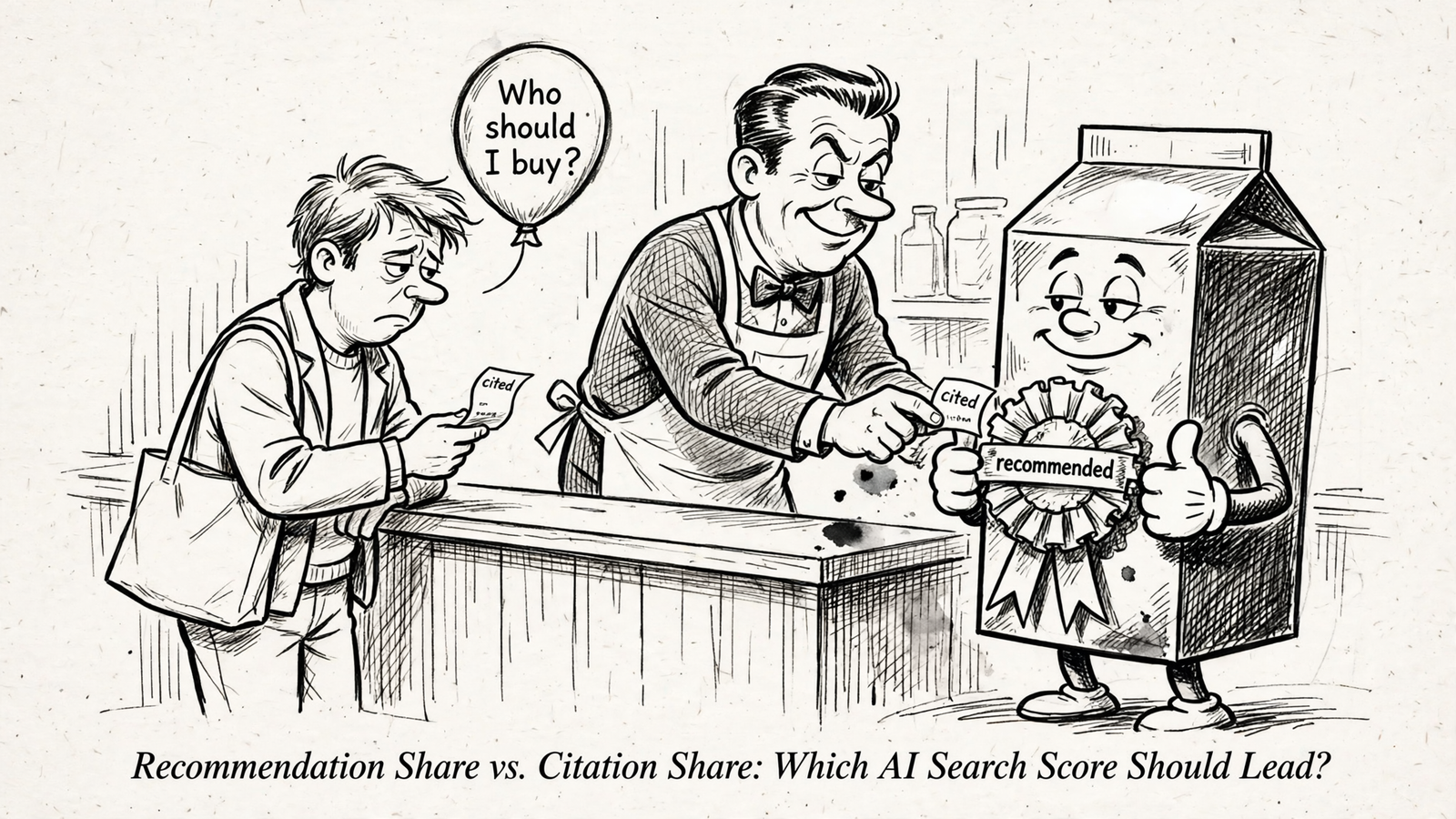
Recommendation share counts the endorsement, not the name-drop. Vercite classified 152,195 brand mentions across 65,746 AI answers and found that only 1.5% of mentions were top picks and 16% were endorsements of any kind. A shortlist can look good in a report. It’s still not a recommendation.
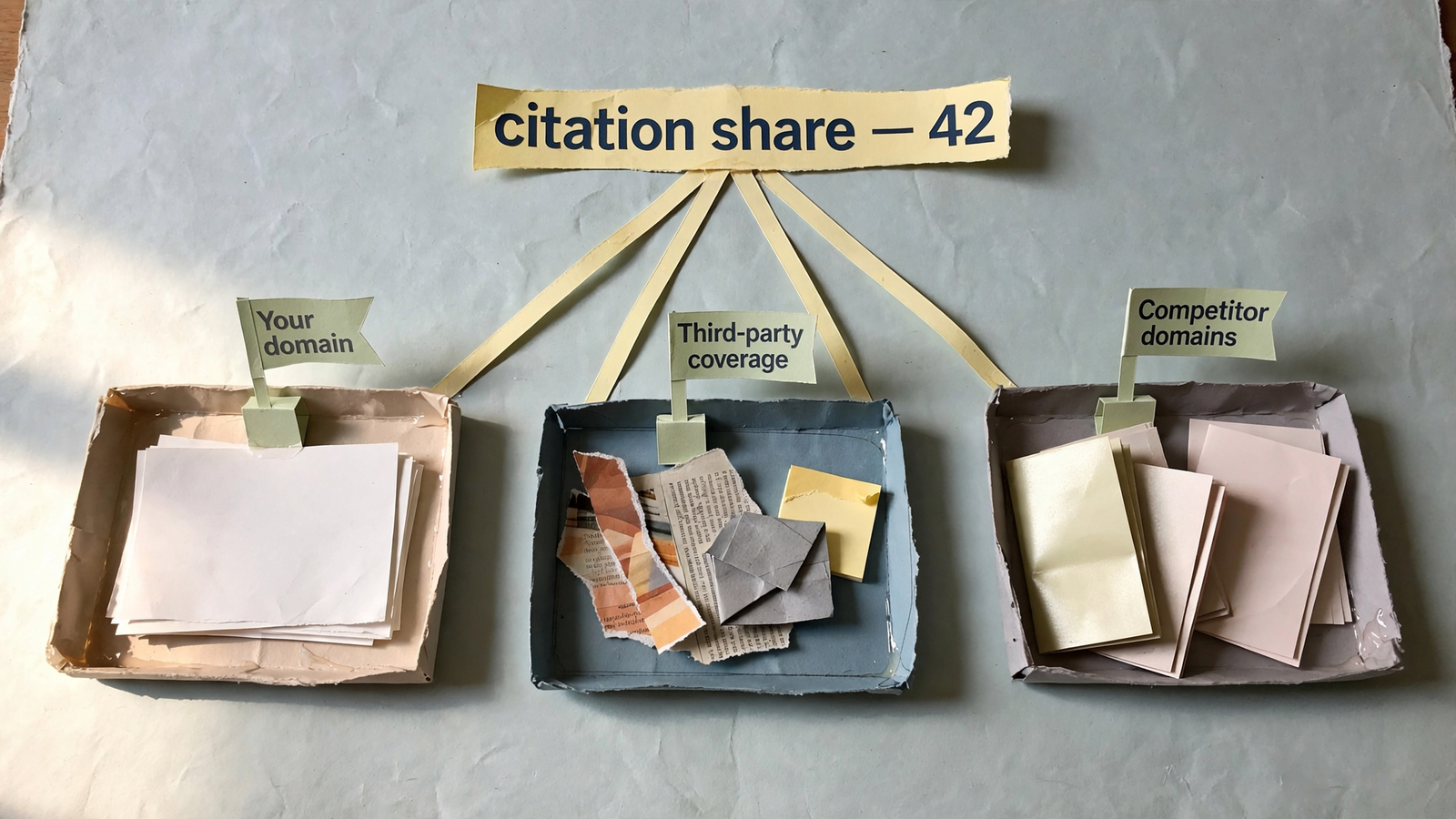
Citation share counts linked sources. The link is what makes the number useful, so don’t flatten all the links into one bucket:
- Your domain: Pages you publish and can fix directly.
- Third-party coverage: Reviews, roundups, Reddit threads, and docs on someone else’s site. You can influence them, but you can’t edit them.
- Competitor domains: Pages rivals publish that supply evidence in the answers you’re tracking.
I’d keep that last bucket visible. When a rival’s page supplies the evidence in an answer that also names you, you have an actual page to read, not a vague instruction to improve “visibility.”
2. What’s underneath the percentage?
For recommendation share, I count every completed run of a decision-style prompt in the denominator. The numerator is the runs where the assistant explicitly recommends your brand. If a buyer asks what to buy and the assistant doesn’t pick anyone, that’s a completed answer with no recommendation. It stays in. An informational prompt is out of the recommendation calculation because the buyer didn’t ask for a pick in the first place.
That distinction is easy to lose in a dashboard. FAIND’s breakdown puts recommendation rate against decision-style prompts and mention and citation rates against the full panel. In the same dataset, it measured a brand at a 41.8% recommendation rate and a 27.5% mention rate. Neither number has to be wrong for one to be higher than the other. They have different bases.
For citation share, the denominator is all cited links across the full prompt panel, not all answers and not just answers that recommend someone. For the owned-domain share, the numerator is the links pointing to your site. Keep third-party coverage and competitor domains visible alongside it so you can see where the rest of the evidence comes from. One score divides by answers; the other divides by links. Print that next to the percentages, not in a footnote you have to go looking for.
The prompt panel matters as much as the math. GrowByData suggests freezing a set of 50 to 150 prompts and a list of three to five competitors, and stripping out prompts that name your brand. Vercite’s data shows why the wording matters: “best” phrasings produce a recommendation in half of answers that name a brand, while “how,” “what,” and “why” prompts almost never produce a top pick. Change the prompt mix and you’ve changed the measurement. Don’t call that a lift.
3. Where each score breaks
Recommendation share breaks at the judgment call. “Kettle is the safest pick, though your brand does more out of the box” takes more reading than “Go with Kettle.” CueScout found that asking a chat model to classify its answers produced variable prose that then needed parsing. By its account, parsing took roughly half the engineering effort. It switched to a decision model that returned probabilities instead. Whatever does the classification, I want to see the sentence behind the label and be able to overrule it. A percentage you can’t trace back to an answer won’t survive the first awkward question in a meeting.
Citation share has a cleaner unit, but the links don’t sit still. In Muck Rack’s analysis of AI citations, cited domains repeated on same-day runs at rates of 41% for ChatGPT, 45% for Gemini, 56% for Claude, and 94% for Perplexity. A share calculated from a handful of answers can be sampling noise wearing a percentage sign. And even a stable citation doesn’t turn a roundup into an endorsement. A page can help the assistant describe the field without helping it pick you.
Recommendations move around too. SparkToro and Gumshoe ran 12 prompts across ChatGPT, Claude, and Google AI nearly 3,000 times. The odds of getting the same brand list twice were under 1 in 100. The same list in the same order? About 1 in 1,000. I’d count endorsements over repeated runs on a fixed panel before I’d put “ranked third on Tuesday” in a board deck.
Make Claude score the same captured answers
The two numbers are only worth comparing if they come from the same batch of answers. Running ChatGPT by hand one morning and Claude the next gets you two percentages with a spreadsheet in common. Use one fixed prompt panel and one collection window, then classify the stored answers. I covered the fixed-prompt setup in a previous walkthrough. With groas connected to Claude over MCP, I’d run the comparison in one session:
- Pull the captured answers. Ask groas for the responses on the frozen panel, with linked citations, brands named, model, and timestamp.
- Separate the three events. Ask Claude: “For this fixed prompt set, separate explicit recommendations, other mentions, and linked citations. Show the supporting answer for every classification.”
- Review the ambiguous calls before calculating either share. If the answer names a brand but Claude can’t point to a sentence that recommends it, count it as a mention, not a recommendation.
Keep the prompt panel, competitor list, and collection-window setup consistent across reporting periods. And disclose missing observations separately. An answer that comes back without a recommendation counts. A run that returns no answer is missing. Treat those as the same thing and you’ve changed the recommendation score before you’ve read a word.
4. Which decision does each score help you make?
For a pipeline report, I want to know whether the assistant tells a buyer to choose you. That’s what recommendation share captures. It doesn’t tell you whether the buyer bought anything. It tells you whether, at the moment the buyer asked for a choice, the assistant made a case for picking you. Ahrefs makes the distinction plainly: a brand can be named without its site getting cited, and a page can be cited without the brand getting recommended. Neither is a substitute for the endorsement.
For a content brief, I want the page behind the claim. Citation share gives me somewhere to start: a page on my own site that the assistant already uses, a third-party roundup carrying the category, or a competitor page supplying the evidence my site doesn’t. A recommendation tells me who got picked. The links give me something specific to read before I decide what to build or fix.
The head-to-head at a glance
| Decision axis | Recommendation share | Citation share |
|---|---|---|
| What it counts | Answers that explicitly recommend your brand | Linked sources, split by where they point |
| What it divides by | All completed decision-prompt runs, including answers with no pick | All cited links across the full prompt panel |
| Where it breaks | Ambiguous endorsements need human review | Links vary across runs, and a citation isn’t an endorsement |
| What it helps you decide | Are buyers being told to choose us? | Which evidence should we build or fix? |
Recommendation share wins for the reader reporting whether AI assistants put the brand in the running for a sale. I’d put it first in that monthly report because it captures the event the reader actually cares about: the assistant getting past the shortlist and making a call. Pick citation share anyway if you own content and source strategy. It points you to the pages to build, the coverage to earn, and the rival content to answer.
That’s a winner for a decision, not a winner for all of AI search visibility. Show both numbers with their denominators printed next to them and the underlying answers within reach. Merge them and you hide which one moved.
Turn the weaker score into one proposed action
If citation share is the weak column, ask Claude for one source-backed content proposal. Which page or passage could plausibly supply the evidence the answer needs, given what the cited pages actually contain? That’s a proposal, not a promise of citations. The publish call is yours. Remeasure on the same prompt set and look for a change in the citation split. The recommendation column may follow later or not at all.
If recommendation share is the weak column, resist the reflex to publish more. Open the answers where you got cited but lost the recommendation. Read what the assistant said made the other brand the better fit. Look for a claim, an offer, or a statement about who the product is for that’s missing from the sources the answer uses. An extra article won’t fix a missing offer. The point of comparing scores from the same answers is to see what the gap actually calls for before you assign the work.
Back to Mixpanel: being named in 100% of those answers didn’t get it recommended in more than 3.2% of them. A citation is a different event again, and you don’t need to turn any of the three into a proxy for the others. Lead with recommendation share when the question is who gets the nod. Let citation share pick the next page you build. Print both denominators, keep the prompts frozen, and let the two numbers disagree. The disagreement is the measurement.