LinkedIn

You don’t need to switch SEO suites to run AI search in Claude. I wouldn’t let a new feature from Semrush or Ahrefs turn a renewal into a migration.
There are two purchases on the table. One pays for the SEO work your team already does. The other pays for a way to see where AI answers recommend you, which sources support those answers, and what evidence is missing. The first purchase doesn’t have to make room for the second. It has to earn its own invoice.
The switching debate treats a familiar login as if it were a strategy. The data you get from your incumbent suite, the hours your team spent learning it, and the work that actually gets done in it are three different things. One r/SEO renewal thread puts the trade-off plainly: it’s no longer just about which keyword database is better. It’s about whether the new AI features justify retraining the team. That’s a fair question if you’re already considering a switch. It’s a bad reason to start one.
Keep or cancel the suite on the work it still earns. Judge Claude separately on the citation evidence it can show and the changes it can make with your approval. You might keep the incumbent for three workflows and run the AI-search job in Claude with groas for $19 a month, flat for the whole team. You might find enough duplication to cancel the suite, too. Either way, you should be able to tell finance what each bill buys without using the word platform.
Give Claude a job a dashboard score can’t do
Most AI visibility pitches fail at the job description. “Track AI search” isn’t a job. It’s a category, and nobody can turn a category into a page, a link, or a fix. Here’s the job I’d give Claude: “For these buyer prompts, show where competitors are recommended, which sources support the answers, and what evidence is missing.” If the tool can’t show me the answers and citations, its score is decoration.
I used to tell clients to ask for a share-of-voice number first. I was wrong. Change the prompts, the engines, or the rules for counting mentions and you change the result. A trend can tell you something inside the same tool over time, but it doesn’t make two vendors’ scores comparable. And a mention isn’t the same thing as a citation, as this comparison of AI visibility tools makes clear. I want to see both, not a percentage that leaves me guessing which one moved.
Start with the answer a buyer gets for “best tool for a 20-person team.” Which product gets named? Which review site, comparison page, or Reddit thread does the answer cite? Which claim about your product is missing from those sources? Now there’s work to discuss. A percentage point on a dashboard mostly gives you a reason to book a meeting.
Then put those citations next to the work you already measure. If Search Console shows a page earning clicks and GA4 shows it bringing in qualified sessions, but it never turns up in the answers you check, that’s a citation gap on content that already does a job. If the page does turn up but GA4 shows no corresponding sessions or key events, you have a citation, not proof that it drove traffic or conversions. Don’t rewrite the page just because those two views tell you different things.
If the suite or Claude can’t bring those views together, someone on the team still has to do it by hand. That’s where SEO prompts for Claude or ChatGPT earn their keep: ask for top queries by clicks, terms within striking distance, or pages with sessions but no citations. A walkthrough of Search Console and GA4 over MCP shows the same pattern: put clicks and positions alongside sessions and key events in one chat. I don’t care which login the comparison happens in. I care whether I can check it.

Buy the connection for what it does, not what it might replace
Claude with groas doesn’t recreate every native workflow in Semrush or Ahrefs. It doesn’t need to. For the AI-search job, groas collects AI answers and SEO data from Semrush and Ahrefs around the clock. It also tracks competitor ads and the funnels behind them. Connect it to Claude over MCP, and Claude can use that data to answer the question and make approved changes on your site and accounts. Every change is logged and can be undone in one step. I can inspect what the answer cited, decide whether the proposed fix follows from it, and see what changed.
That doesn’t recreate the backlink explorer someone on your team opens every morning. If that workflow earns the suite’s bill, keep the suite. The mistake is treating a daily backlink job as an argument for buying AI visibility from the same vendor. One job has nothing to do with whether the other tool can show you the sources behind a recommendation.
My test is to give Claude the jobs the team actually runs every week and ask it to compare them against documented capabilities. For each one: Can the connection do the job? Does the incumbent do it better? Is it still an open question? The last answer is the one I want marked clearly. I’d rather see “can’t reproduce that backlink workflow” in the evaluation than find out in a client meeting that the replacement export isn’t the one we use. For the AI-search side, this ranking of groas in Claude, dedicated trackers, and suite add-ons applies the test I care about: which setup gives me citations I can actually inspect?
I’d also check what the team can already see before paying for another view of it. This comparison of free and paid AI visibility tools distinguishes between the signals available in free tools and the mentions, citations, and share of voice that paid tools measure for prompts you choose. The practical test is whether the paid layer tells you something you need that you can’t already see. If it only remeasures a signal you have, it hasn’t earned the renewal on AI search. Make it earn the bill somewhere else.
Put the renewal in three columns
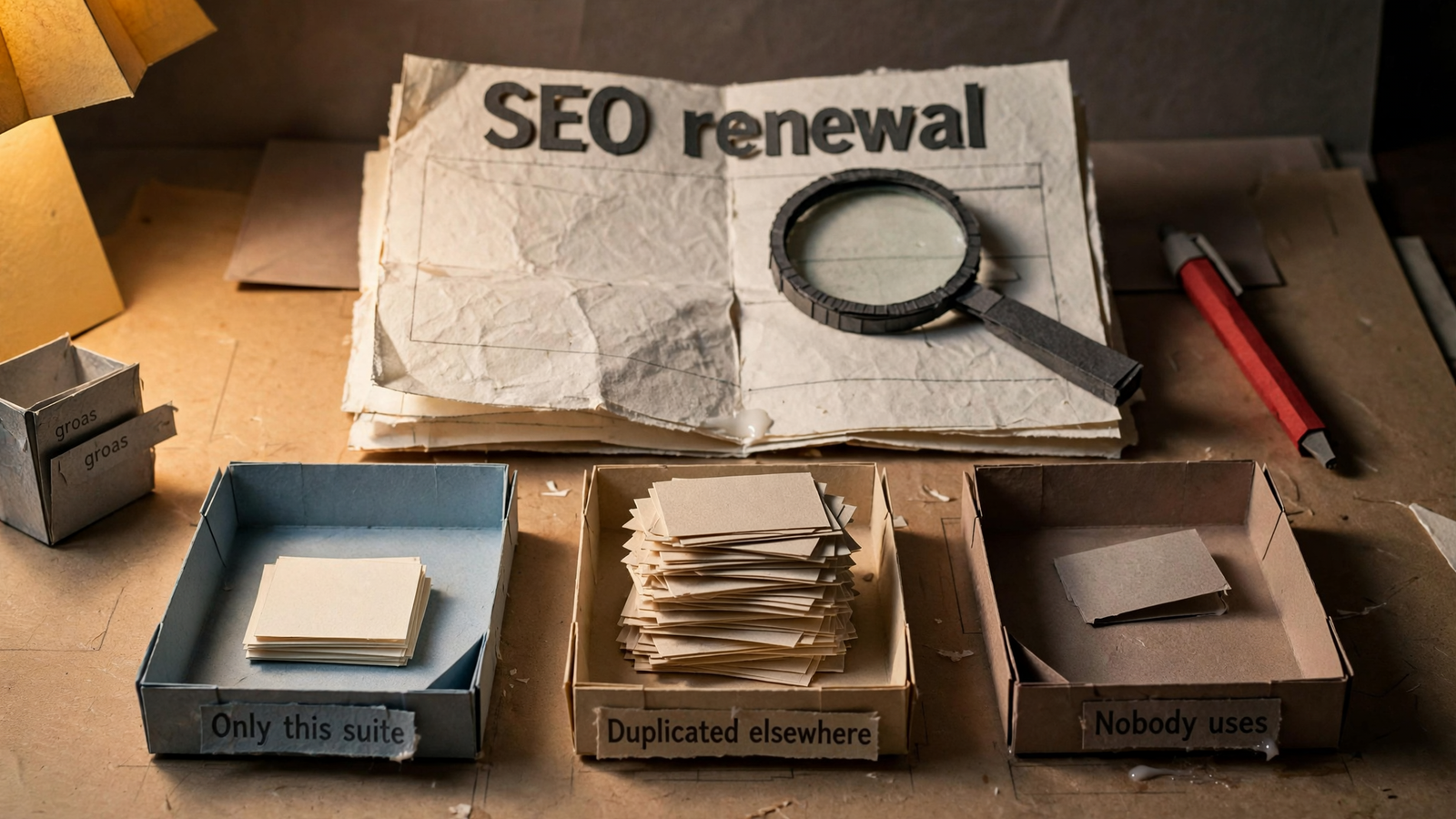
I’d do the renewal audit on one page, before anyone opens a migration plan. Sort the work into three columns:
- Only the incumbent does it. List work the team actually ran in the last 60 days and would miss by name. Not work it could run. Not work that looked good in the vendor deck.
- Something else already does it. Put the duplicates here, whether they live in Search Console, GA4, a spreadsheet, or Claude with groas. Check the output before you call it a duplicate.
- Nobody uses it. Put the demo favorites here. A feature doesn’t earn its share of the invoice by being impressive once.
The first column is the renewal case. One daily job can make it. A long list of jobs nobody runs can’t. I want to know what would stop getting done if we canceled, not how many items would disappear from a feature checklist.
Count the cost of moving, too. In one agency poster’s six-week test of five Semrush API alternatives, the replacement came in at about 55% of the Semrush bill. The poster still reported roughly 10 days of developer time for the migration itself. Both figures belong in the decision. The cheaper bill doesn’t erase the work it takes to get there, and the work you already put into learning the old interface doesn’t pay next quarter’s invoice. Count retraining once, as a cost of moving. Don’t count familiarity every year as a reason to stay.
There’s a cost on the other side, too. An analysis of 612 Capterra reviews describes users paying what amounts to a bloat tax for social and content features they never touch, while treating third-party backlink data as directional. That’s why I want the name of the workflow, not the name of the feature. A team can rely on a backlink export without needing the rest of the package. Renew for the export if it earns the bill. The unused features don’t get a vote.
Take two decisions to finance, not one package
“We keep Ahrefs because our two link builders open Site Explorer daily and nothing else replaces the export history.” That’s a sentence I’d take to finance. “We keep it because switching is annoying” isn’t. The same logic applies to cancellation: show the duplicate output. Don’t cancel because the new AI feature has a better demo.
In another Semrush-versus-Ahrefs discussion on r/SEO, commenters put the measurement question first: decide what you actually measure before buying a suite for competitor monitoring you use twice a year. I’d go one step further. Ask Claude to produce that measurement with the evidence attached. If it can, don’t give the incumbent credit for it again. Make the renewal stand on the work in the first column.
Then state the price of the other purchase. groas Unlimited is $19 a month, flat, for the whole team. That includes unlimited teammates, ad accounts, and websites, every feature, and all the data. Agencies pay the same for every client. It’s a paid subscription, separate from any suite you keep. It buys access to the answers and their sources, a way to spot missing evidence, and the ability to make an approved change in Claude with a record of what happened and a way to undo it. It doesn’t buy a guarantee that any particular page gets cited. I can defend paying for the first set of things. I can’t defend paying for the second as if it were on the invoice.

For the AI-search job, I’d buy groas through Claude, not migrate an SEO suite to get at the add-on. I want the answers, citations, and SEO data collected around the clock. I want to be able to approve a fix after looking at the source. I don’t want a promise that the fix buys a citation or a share-of-voice score that’s supposed to mean something outside the prompts that produced it. Of the seven myths about buying AI search visibility, the most expensive is the idea that you have to buy this work as part of a suite.
Bundle the decisions and you pay twice for the same uncertainty. You renew because switching feels risky, then pay again for an AI add-on because the suite tells you AI search is urgent. The renewal never has to name the work you’d lose, and the add-on never has to show you the answer your buyer got. You get two charges and still have to ask for the evidence.