LinkedIn
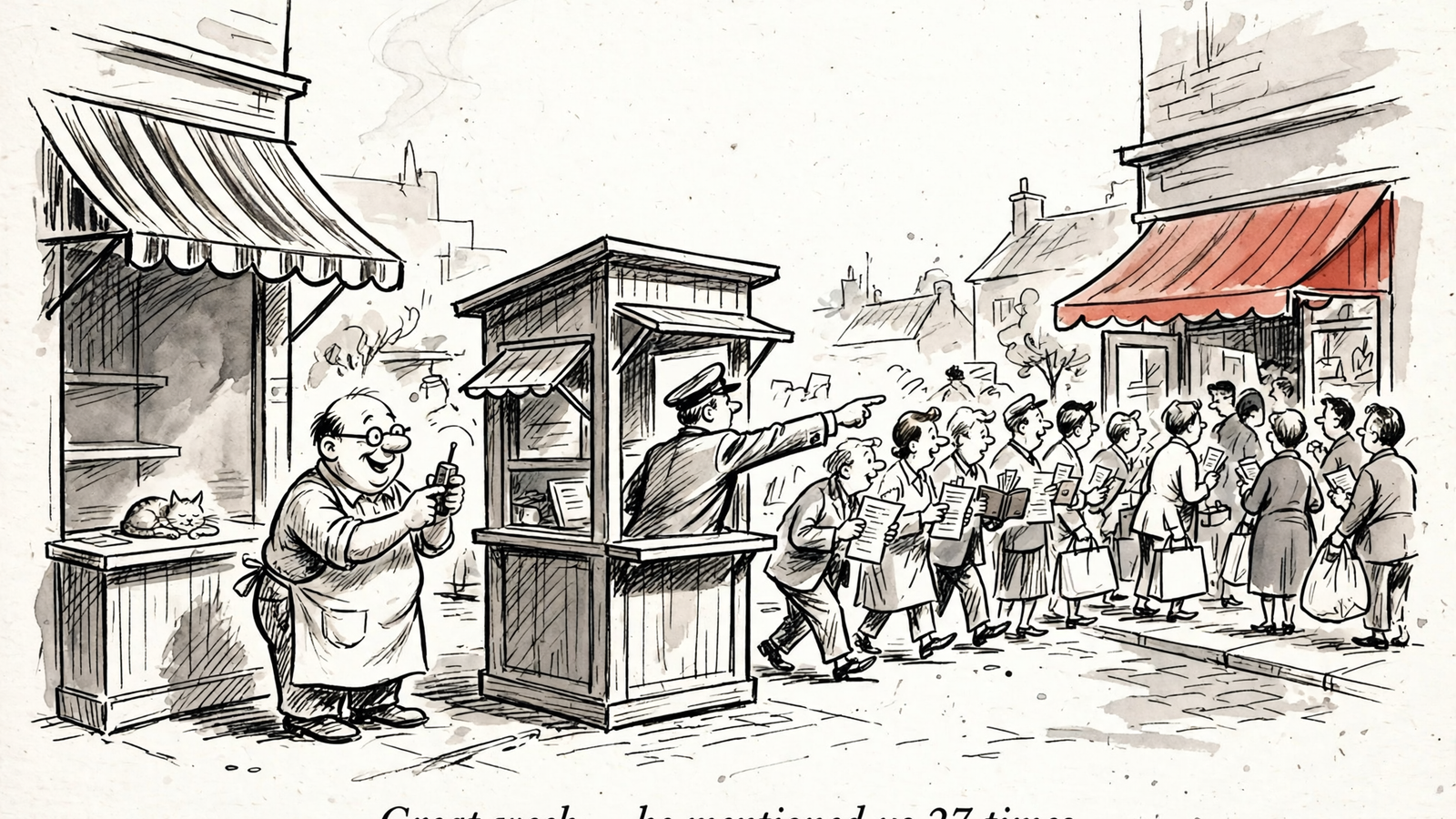
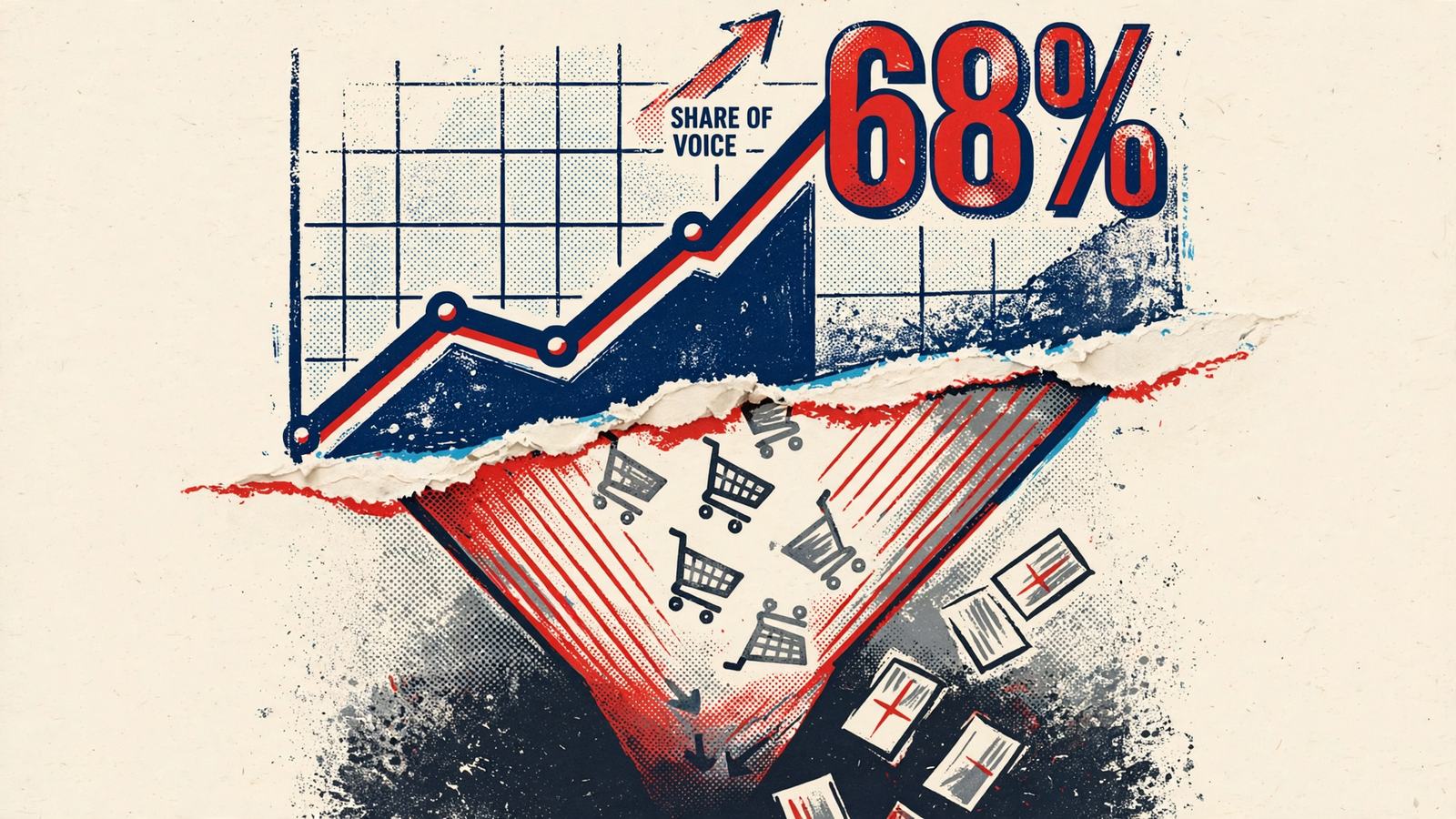
Your AI share of voice can rise while assistants recommend you less on the questions buyers ask before they buy. A better score can mean you bought a different test, not a better result.
I know the move from paid search reports: change what goes into the report and the percentage moves without a single auction changing. AI visibility packages have the same opening. Add informational prompts where you already show up, blend them with buying prompts where competitors get the nod, and the headline can go up even as the answers you care about get worse. Before I pay for a score, I want to see what stayed fixed.
Watch what happens when 10 buying prompts become 40
Say you track 10 buying prompts like “best SEO suite for multi-client reporting.” You show up on two, both times as a recommendation. That’s 20% of the buying set. Now the package adds 30 informational prompts like “what is share of voice,” and you already appear in 25 of those answers. Blend both sets and you show up on 27 of 40 prompts: 67.5%.
The deck shows a bigger percentage. You still get recommended on two buying prompts. You could lose a recommendation on the buying set and still report a higher blended appearance rate than you started with. The new questions do the work the old answers didn’t.
Those 40 prompts are hypothetical, not groas performance data or a test I ran. And 67.5% is an appearance rate, not necessarily share of voice. Semrush defines AI share of voice as your brand’s mentions divided by all brand mentions in the category, times 100. Ten of 100 mentions gives you 10%. The denominator there is mentions, not prompts. But change which questions produce those mentions and you can move that number, too.
“What is CRM?” and “Best CRM for mid-market SaaS” are different tests. The first can tell me whether I get named in an explanation. The second can tell me whether the assistant thinks I’m a fit. I don’t want the first graded as a substitute for the second. Keep buying questions in their own comparison set and keep that set fixed between reports.
Make the vendor show what went into the score
I ask for the prompt list before I ask for the price. I want the exact 30 to 50 buyer questions, the assistants the vendor ran them on, how many times it ran each prompt, and when. If the pitch starts with “you gained share,” I want the same information for the period I’m being compared against. A current prompt list tells me what the vendor measures now. It doesn’t tell me whether the last report measured the same thing.
An audit of nine vendors found three ways of calculating the same headline metric. It found Ahrefs describing impression-weighted share in its help docs and the percentage of responses in its product FAQ. Those aren’t interchangeable. Pooling results across assistants, averaging the assistants’ scores, and weighting by impressions can produce different numbers from the same answers.
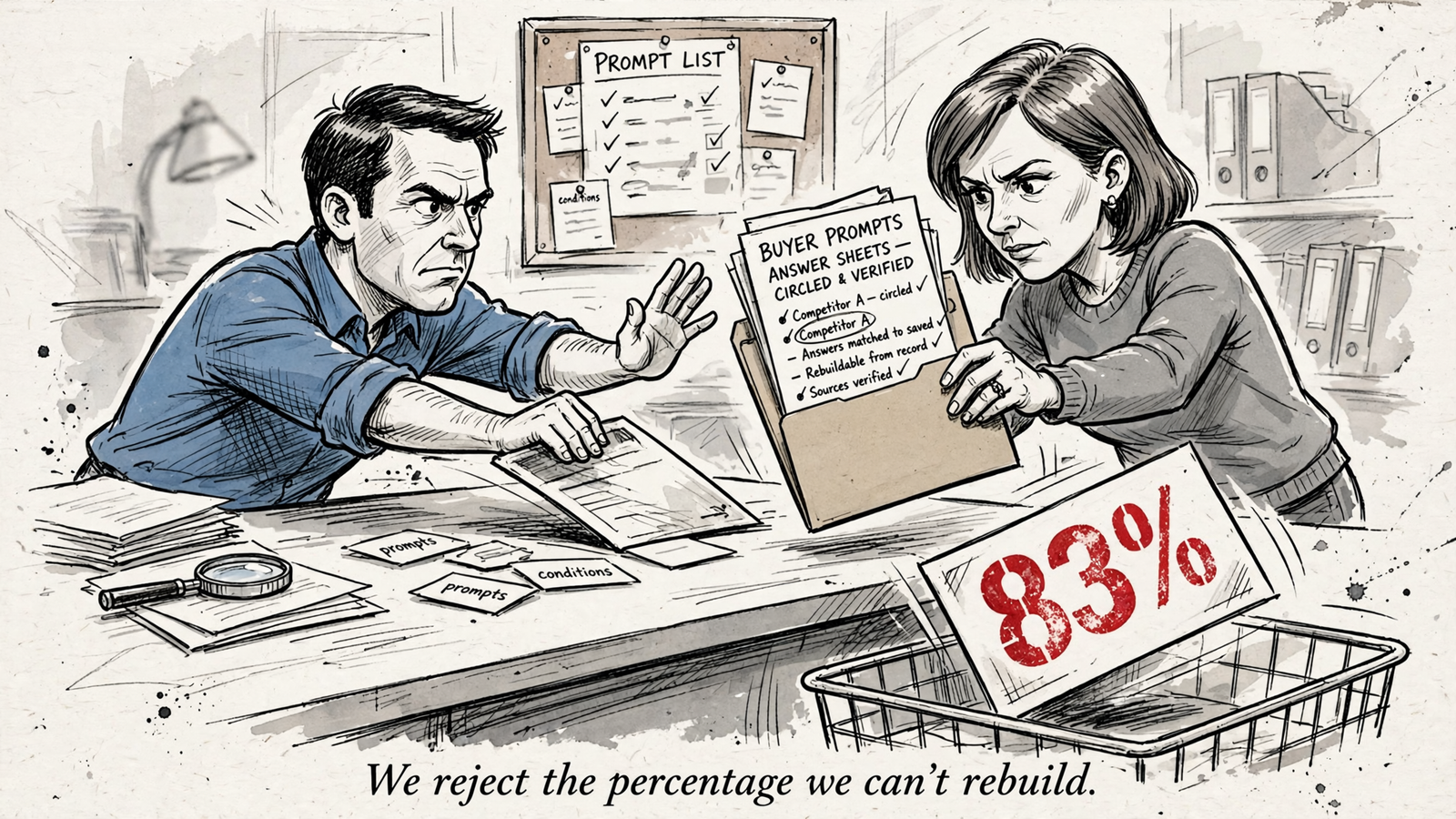
The audit’s denominator example makes the problem plain. A brand appears in 50 of 100 tracked answers: 50%. Exclude the 40 answers that don’t name any brand, and that same brand appears in 50 of the 60 remaining answers: 83.3%. Both percentages describe the sample. Neither shows that the brand gained anything. The report just stopped counting some of the answers.
Get the counting rules in writing. Ask for the unit, the denominator, the sample size, the runs per prompt, how the vendor combines results across assistants, and how it handles duplicates. I want to know what a zero looks like in the export. If answers without a brand disappear from the table, I want to know before someone puts 83.3% on a slide.
Don’t let “mentioned” pass for “recommended”
Semrush distinguishes a mention, a citation, and a source: a mention names the brand in the answer, a citation links to its content, and a source is a page retrieved to build the answer. Under its share-of-voice definition, it’s the mention that goes into the count, not the citation.
A mention isn’t a recommendation, either. An assistant can name you as the expensive alternative or say you lack the exact feature the buyer asked for. One critique uses HubSpot and advanced reporting to show the problem: counting the name as a win misses what the answer actually says. The reverse distinction matters, too. An assistant can cite your site without recommending you.
Make the vendor report three separate counts:
- Mentions: Did the answer name the brand?
- Recommendations: Did it suggest the brand as a fit for this buyer?
- Citations: Did it link to the brand’s content?
Then read an answer that the vendor counts as a win. If the text is telling the buyer to choose a competitor, I don’t care that we made it into the paragraph.
Ask Claude for the answers, not another chart
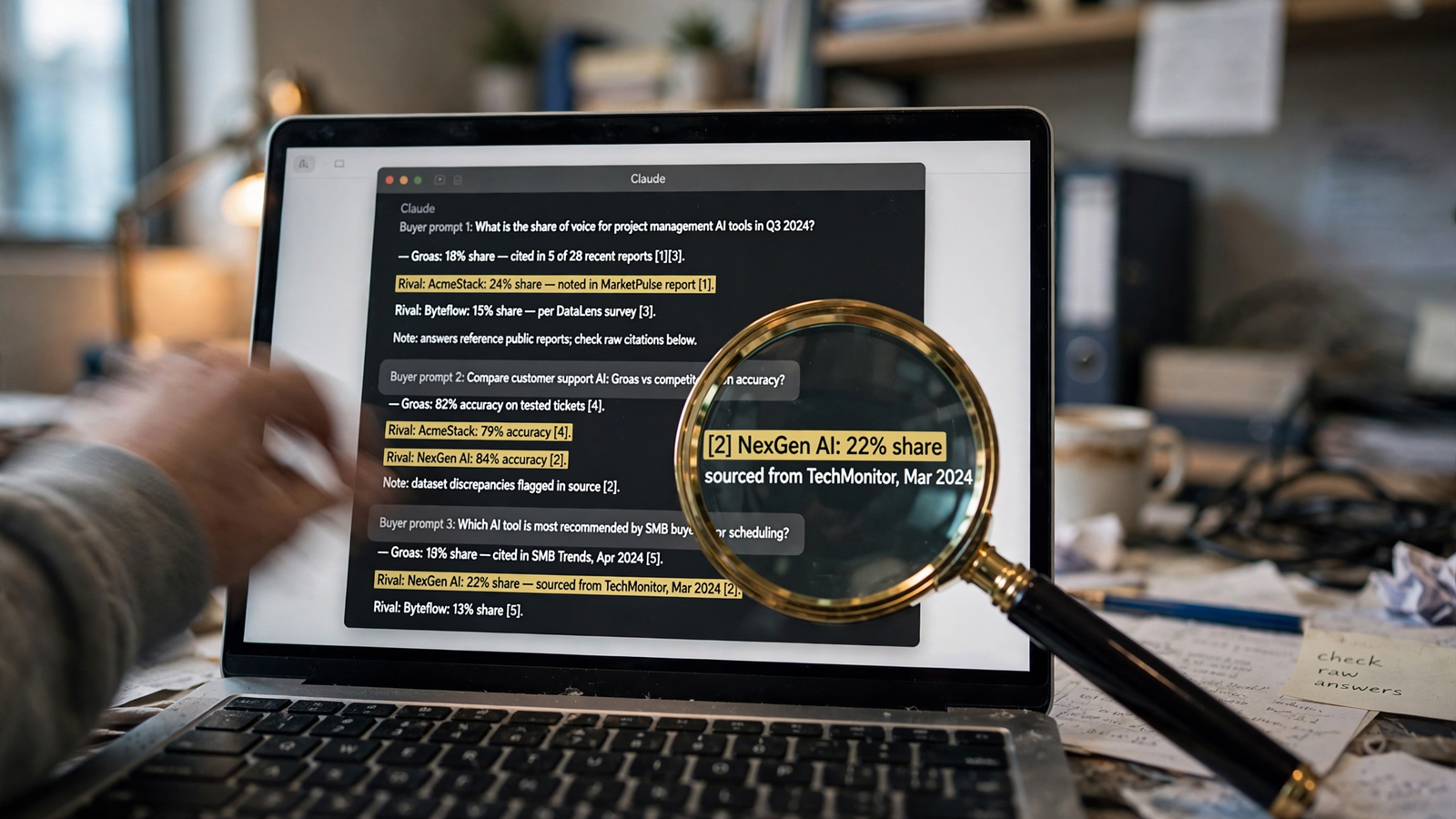
With Claude connected to groas over MCP, I start with the fixed set of 30 to 50 buyer questions. I want the prompt, the full answer, the cited sources, and which competitors the answer names or recommends. I’d use this request:
Using groas, list the tracked buyer prompts, the full observed answers, the cited sources, and the competitors named or recommended in each answer. Flag every buying prompt where a competitor gets recommended and I don’t.
Then I ask Claude to separate mentions, recommendations, and citations, and state the denominator for every percentage. The table is the point. If I can’t rebuild the percentage from the saved answers, I reject it. That’s the same standard I’d use for a repeatable AI mention audit, not a special favor I ask of the vendor when the number goes down.
Log all three counts per prompt across three to five runs, with the date and model version. Keep the prompts, assistants, run counts, and scoring rules fixed between cycles. If the prompt set changes, label it a new series, not growth. I’d rather see a break in the chart than a smooth line connecting two different tests.
Compare three ways to buy the evidence
I’d make every option pass the same purchasing test: show me a saved answer from my buyer set and let me check how you scored it. The price tells me what I’ll pay. The answer tells me whether the package measures anything I need.
The SEO suite: check what fits in the bundle
Ahrefs prompt tracking starts at $50 per month for 2,500 checks, and its AI Visibility Index starts at $199 per month. Semrush’s AI Visibility Toolkit is $99 per month per domain for 25 prompts, with another 50 prompts for $60 per month.
The trap isn’t the price. It’s buying the bundle because it sits next to keywords and backlinks, then finding the tracked list is mostly informational or the engine mix skips an assistant your buyers use. Check the prompt allowance against your actual list, not the list the vendor puts in the demo. If your buying questions don’t fit, the bundle doesn’t fit.
The dedicated tracker: check what a run costs
Peec AI Starter is $95 per month for 50 prompts on three models, and Pro is $245 for 150 prompts. Otterly Lite is €29 per month for 2,000 credits, and Standard is €189 for 15,000 credits. The same comparison lists Claude on Otterly’s self-serve plans at three credits per check. That’s why I don’t compare a prompt allowance to a credit allowance and call the cheaper line a bargain.
Check coverage before you compare capacity. If buyers ask Claude and the tracker doesn’t observe Claude, its share of voice describes someone else’s market. Ask for the engine list, the runs per prompt, and one exported answer you can read. More room for the wrong questions on the wrong assistant isn’t an upgrade.
groas: keep the evidence and the page edit in the same chat
This is the option I’d buy. With groas plugged into Claude, Claude can read the AI search answers groas collects alongside competitor ads, landing pages and funnels, Reddit research, and SEO data from Semrush and Ahrefs. Claude is where I inspect the evidence; the tracking still has to cover the assistants my buyers use.
The workflow is one request: show me where competitors get recommended on the fixed buying set, show me what those answers cite, then draft the page edit that addresses the gap. I don’t have to export the answers to move from reading them to drafting a fix. That’s the distinction I care about in the comparison of the three setups.
groas is $19 a month flat for unlimited teammates, accounts, and sites. It gives me the evidence inside the assistant I already use, and when I make a change, groas logs it with the reason and lets me undo it in one step. I’d pay for that before I’d pay for another chart. I’d still make it show me the prompt list and the answer behind the score.

Spend a week on one recommendation you’re losing
Pick one buying prompt where a competitor gets recommended and you don’t. Make that the project for the week. Ask Claude:
From the fixed buyer set, find one prompt with clear purchase intent where a competitor is recommended and I’m missing. Quote the answer and list what it cited.
One prompt, one answer, one competitor. That narrow focus is the point. A vendor wants you watching 40 prompts move three points. I want to read the answer a buyer gets when they’re deciding what to buy. If the package can’t show me that answer, it can’t tell me what to fix.
- Read what the answer cites. Open the two or three pages it links to and compare them with yours. Start with what the buyer asked for, not with everything the competitor’s page happens to contain.
- Draft the smallest edit that addresses the gap. It might be a missing price band, a missing integration, or the comparison table the buyer asked for. Approve the edit in groas so the reason is logged and the change can be undone.
- Rerun the same test. Same prompts, same assistants, same run counts, same denominator. Save the new answers and read what changed before celebrating what the percentage did.
The edit doesn’t buy you a citation. Models lag, retrieval shifts, and competitors publish, too. What you can demand is proof the test stayed fixed. If the answer still recommends the competitor, put that on the record. Don’t bury it under a dozen questions you already win.
If the sales call ends with a bigger percentage but no fixed prompt list, no saved answers, and no split between named, recommended, and linked, you haven’t seen an improvement. You’ve seen what the vendor chose to count. Buy the loop you can inspect: fixed questions, visible answers, one fix at a time. Otherwise you’re paying rent on a number that can rise while buyers get told to pick somebody else.